
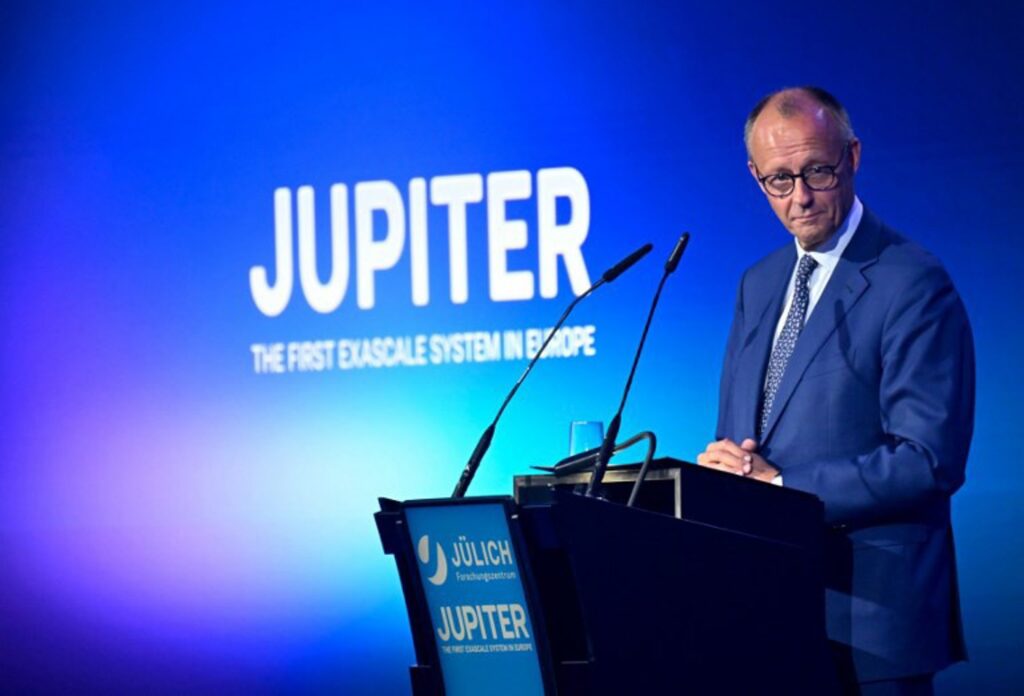
The EU has inaugurated Jupiter, its first giant, ultra-fast computer, in Germany. The aim is to close the gap in artificial intelligence and strengthen scientific research, particularly on climate change.
Based in the town of Jülich, west of Cologne, Jupiter is the Old Continent's first ‘exascale’ supercomputer, capable of performing at least one quintillion calculations per second, or one billion billion.
Its colossal computing power represents ‘the most powerful computer in the world today for performing calculations,’ Emmanuel Le Roux, head of Atos' Advanced Computing business, told AFP.
Researchers hope to use Jupiter to create more detailed, long-term climate forecasts in order to more accurately predict extreme events such as heat waves.
"With today's weather models, we can simulate climate change over the next 10 years. With Jupiter, scientists estimate that they will be able to go back at least 30 years, and with some models, perhaps even 100 years," according to Le Roux.
The machine will also be able to assist research into energy transition, for example by simulating air flows around wind turbines to optimise their design. In healthcare, it could be used to simulate brain processes more realistically, for the development of drugs to treat diseases such as Alzheimer's.
Jupiter covers an area of nearly 3,600 square metres – about half the size of a football pitch – with rows of processors and around 24,000 chips from the American giant Nvidia, which are highly prized by the artificial intelligence industry.
The supercomputer, developed by the French group Atos for a budget of €500 million, financed equally by the European Union and Germany, is Europe's first exascale computer and the fourth in the world according to known data. The United States already has three machines of this type, all operated by the Department of Energy.
Jupiter is the first supercomputer that can be considered internationally competitive for training AI models in Europe, which lags behind the United States and China, according to Thomas Lippert, director of the Jülich centre.
According to a report published this year by Stanford University, American institutions produced 40 ‘notable’ AI models in 2024, i.e. particularly influential ones, compared with 15 for China and three for Europe.
"The performance of an AI model depends directly on the computing power of the computer used," says Jose Maria Cela, a researcher at the Supercomputing Centre in Barcelona, adding that Europe suffers from a ‘deficit’ of systems of this size.
Jupiter thus provides the computing power needed to effectively train large language models (LLMs) that produce enormous volumes of text and are used in generative chatbots such as ChatGPT and Gemini.
However, due to its numerous Nvidia chips, Jupiter remains heavily dependent on American technology, at a time when points of contention between the United States and Europe are multiplying.
