
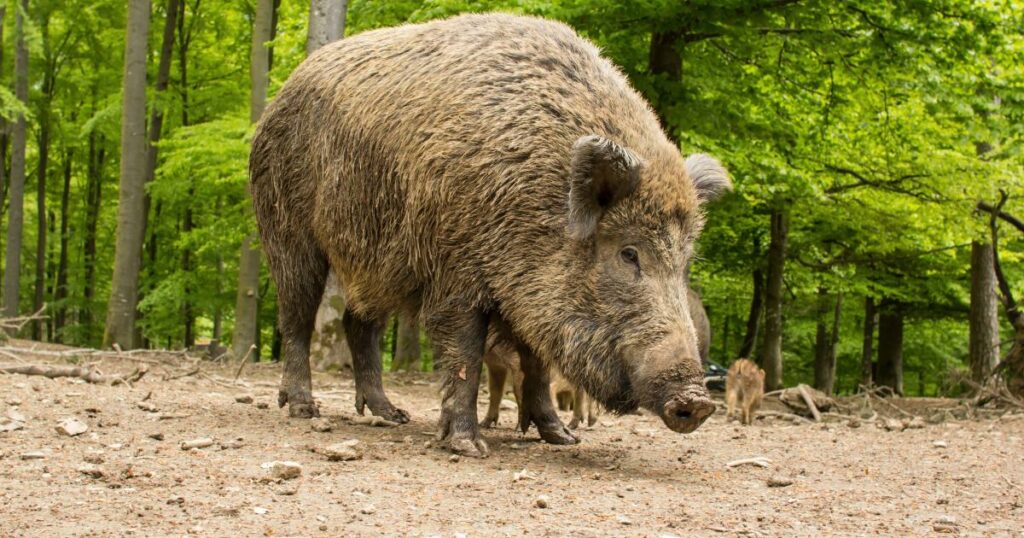
Rooting behaviour by wild boar may be key to protecting some of Europe’s most endangered grassland habitats, according to new research.
Calcareous grasslands — lush meadows growing over chalk or limestone — are among the continent’s most diverse yet threatened ecosystems, home to a wide range of plant and animal species.
Their survival depends on regular disturbance, typically grazing by livestock, but traditional farming has declined sharply across Europe, leaving these habitats vulnerable to takeover by shrubs and trees.
A team of researchers studied the effects of wild boar in Germany’s Hainich National Park — a site where grazing by sheep stopped almost 30 years ago — by comparing patches of grassland where boars had turned over the soil in search of food with untouched areas.
Boar bring biodiversity boost
The results show that areas disturbed by wild boar rooting had higher numbers and greater diversity of plants, including several threatened species, compared to undisturbed plots.
The boar-rooted land featured more bare soil and herbs, reduced leaf litter, and fewer invasive grasses and shrubs.
However, the researchers cautioned that too much bare soil, resulting from excessive rooting, could make it difficult for plants to recolonise. Balance, the researchers say, is crucial.
The team concluded that controlled wild boar activity can help slow the natural transition of grassland into woodland, which threatens the survival of these rare habitats.
They recommend a mix of approaches — allowing boars to root in some areas, using livestock grazing in others, and carefully monitoring boar populations to avoid over-disturbance.
The research underscores the complexity of conserving Europe’s precious calcareous grasslands, highlighting how native wildlife can play a surprising role in the fight to protect biodiversity.
