
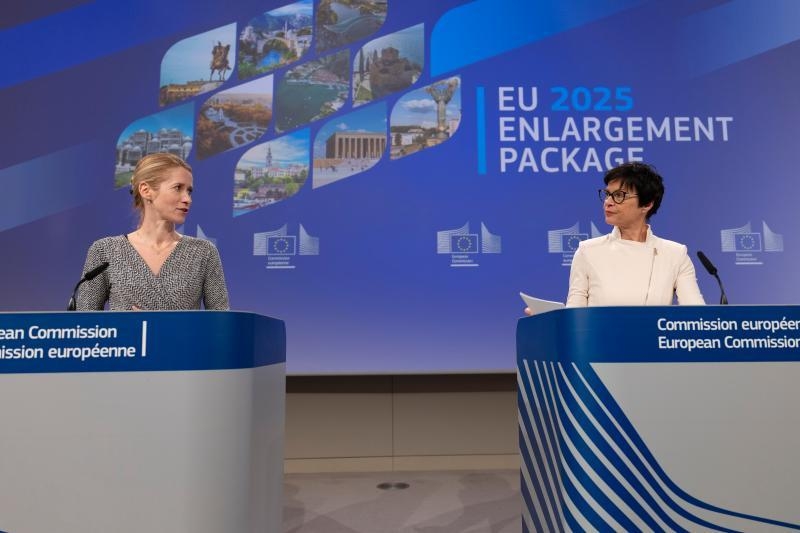
The European Commission adopted on Tuesday its annual Enlargement Package which presents an assessment of the state of play and the progress made by the ten enlargement partners (candidate countries) over the last year on their respective paths towards accession to the EU.
Last year’s enlargement package (2024) was described as historic because it for the first time in many years includes ten countries, nine of which had been granted formal EU candidate status and one (Kosovo) was a potential candidate country which has applied for joining the EU.
The ten countries are Albania, Bosnia and Herzegovina, Kosovo, Montenegro, North Macedonia, Serbia (all of them located in the Western Balkans), Turkey, Ukraine, Moldova and Georgia. The Commission wrote in 2024 that enlargement is a historic opportunity, both for the acceding countries and for the current Member States, and for the EU as a whole to become “bigger and stronger”.
This year’s enlargement package can also be described as historic because it for the first time ranks the candidate countries according to their readiness to close the accession negotiations and the year it will likely happen. The assessment is based on criteria in the country reports but the ranking can be seen as a new approach, a senior Commission official told The Brussels Times.
According to the Commission, the 2025 package reaffirms that the momentum for enlargement stands high on the priority agenda of the EU. It also confirms that the accession of new Member States is increasingly within reach. This year, it is time for concrete actions, both for the candidate countries and the EU.
Notwithstanding the Commission’s optimism, a statistical annex on governance indicators to the 2025 Communication on the EU enlargement policy shows that all ten countries are still considered to be transitional or hybrid countries, partly free or flawed democracies. Indicators on press freedom and corruption have hardly improved since last year.
“The enlargement process is moving faster today than in the last 15 years,” commented Kaja Kallas, EU High Representative for foreign affairs and security policy. “The global order is shifting, and Europe's security is increasingly at risk. The window for enlargement is wide open and we have to seize the opportunity now. New countries joining the EU by 2030 is a realistic goal."
The four frontrunners
Significant progress has been achieved over the past year in four candidate countries: Montenegro, Albania, Ukraine and Moldova, the Commission says. “With enlargement as a clear policy goal in this mandate, the Commission is committed to ensuring both the readiness of aspiring members as well as the EU's preparedness to welcome them.”
Montenegro, the first ranked frontrunner, opened accession negotiations already in 2012. All 33 acquis chapters have been opened and 7 of them have been provisionally closed. It is on track to close the negotiations by the end of 2026, subject to maintaining the pace of reforms.
Albania, which opened the negotiations in July 2022 has also made significant progress, with four clusters opened over the last year. Preparations for the opening of the last cluster this year are well advanced. Also subject to maintaining the pace of reforms, Albania is on track to conclude the negotiations by 2027.
Ukraine was given a European perspective in June 2022 and the accession negotiations were opened in December 2023. It completed the screening progress of the acquis in September 2025. In this short period, despite the on-going war against Russia’s aggression, Ukraine met the conditions to open three clusters, including the fundamentals cluster. The Commission expects it to meet the conditions for opening the remaining three clusters.
It is now working to ensure that the Council will be in a position to take forward the opening of all clusters before the end of this year. The Ukrainian government has signalled its objective to provisionally close accession negotiations by the end of 2028. To meet this ambitious objective, which the Commission supports, an acceleration of the pace of reforms is required.
But first the fundamentals cluster must be opened, something which all EU Member States besides Hungary supports. Enlargement Commissioner Marta Kos said at a press conference presenting the package that the Commission expects to receive a mandate from the Council or the EU Presidency to continue the work in technical working groups.
Will Hungary accept to be circumvented in this way? “It’s difficult to say if Hungary will accept the ‘technical working group’ solution,” Marc Loustau, Affiliated Fellow at the Institute for Advance Study, Central European University in Budapest, and author of the "At the Edges” newsletter on Substack, told The Brussels Times.
“A more truthful name would be ‘technical workaround group’ since everyone knows that the working group is an invention to avoid Hungary’s veto. The Commission should realize by now that bureaucratic fictions won’t satisfy Orban.” He recalled the Hungarian Prime Minister’s ‘orchestrated abstention’ in December 2023 when he left the room during the vote on Ukraine’s candidacy.
That said, the working group solution was not a big topic in pro-government Hungarian media, Marc Loustau added. “The media are always trying to personalize Hungarian-Ukrainian relations and make foreign policy into some kind of Orbán-Zelenskyy soap opera. Zelenskyy is playing into the hands of Orbán every time he is entering into a polemic discussion with him.”
Moldova, which was granted candidate status in June 2022, is another frontrunner giving a date. The Commission says that its goal to provisionally close accession negotiations by early 2028 is ambitious but achievable, following the strong parliamentary support for the country's European path in the elections in September.
The EU is not keen on accepting new Member States with unsolved bilateral issues with neighboring countries. Asked about the frozen conflict with Russian-supported breakaway state Transnistria, Marta Kos replied that it is part of Moldova and was hopeful that the conflict will be solved before accession.
To the ambitious time plans above should be added 1 – 2 more years for the ratification by all current Member States of the accession treaties with the new Member States.
The six laggers behind
The other candidate countries are all lagging behind and one is candidate country only by name. Kosovo is not a candidate country but a potential candidate country with a European perspective. Its accession path continues to be closely linked to that of Serbia, a candidate country since 2013. Without normalizing their bilateral relations none of them can become EU members.
Former High Representative Josep Borrell initiated in February 2023 a normalisation agreement in the framework of the Pristina-Belgrade dialogue. However, the agreement was not signed and has so far not been implemented, pending Serbian recognition of Kosovo’s independence. Furthermore, five EU states do not recognise Kosovo's independence: Spain, Slovakia, Cyprus, Romania, and Greece.
Asked whether the Commission will do things differently now, a senior EU official replied that the agreement, although not signed by Kosovo and Serbia, was agreed upon by the leaders in both countries. It will be the basis and starting point at next high-level meeting in the dialogue facilitated by the Commission.
Serbia is backsliding in the accession process and is closest to being ruled by an authoritarian regime. Most of the acquis chapters have been opened but only two of them have been provisionally closed. According to the Commission, polarisation in society has deepened against the background of mass protests since 2024. Restoring trust between political and civil society actors is key.
North Macedonia, which became a candidate country already in 2005, has not yet opened negotiations on the Fundamentals cluster. Its accession process was delayed for years because of the name issue with Greece. Now it is the bilateral issue with Bulgaria on amending its constitution to include the small Bulgarian minority as one of the recognized minorities in the country.
Bosnia and Herzegovina, a candidate country since December 2022, submitted a reform agenda last September. With a complex and fractured governance structure since the Dayton agreement (which ended the Bosnian civil war in 1995), it must finalise and adopt two judicial reform laws and appoint a chief negotiator before the start of the screening of the aquis.
The Sejdić and Finci case, which requires changes in the constitution and the electoral law, is not mentioned by the Commission. In a ruling in 2009, the European Court of Human of Human rights confirmed the discriminatory nature of the electoral system in Bosnia and Herzegovina, preventing those not belonging to its “constituent peoples” (Bosniaks, Croats or Serbs) from standing for election.
“The two judicial laws are conditions required by the EU Member States,” the senior Commission official explained. “The alignment of the constitution with the ruling in the Sejdić and Finci case will have to come later - not now when we are going to adopt the negotiation framework.”
Türkiye started accession negotiations in 2005 but they have been at a standstill since 2018 because of the deterioration of democratic standards, judicial independence, and fundamental rights in the country. The Commission says that it remains a key partner in trade, migration management, security and cross-regional connectivity. In November 2023, the EU reengaged with Türkiye in areas of mutual interest.
The tenth enlargement country, Georgia, is considered by the Commission as a candidate country in name only. It was granted candidate status in December 2023 but its EU accession process was de facto halted the following year due to the democratic backsliding by the current government.
Commissioner Kos commented that backsliding is impossible during the accession process because it is based on a proven track record and aims at gradually integrating the candidate country into the EU.
Learning the lessons of backsliding after accession in previous enlargement rounds, the Commission announced that future accession treaties should contain stronger safeguards against backsliding on commitments made during the accession negotiations. As examples of strategies, Marta Kos mentioned a ‘democratic shield’, more civil society involvement and support to media resilience.
Candidate countries are also required to align their policy with EU’s common foreign affairs and security policy. The frontline countries are practically fully aligned and so also North Macedonia and Bosnia and Herzegovina.
For more information about this year's enlargement package, including all country reports, click here.
