
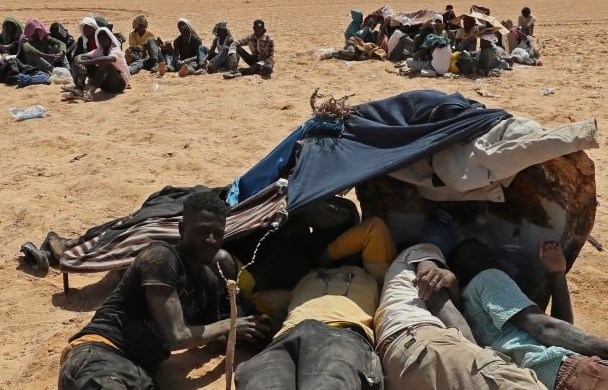
In an investigative report released last week, Amnesty International confronts the EU with embarrassing information about the treatment of migrants by Tunisia only two years after the signature of the EU – Tunisia Memorandum of Understanding (MoU).
As previously reported, the EU faced a dilemma when Team Europe met Tunisian President Kais Saied in Tunis in June 2023 to discuss economic aid and cooperation amid concerns about democratic backsliding and human rights violations.
The concerns prompted an inquiry by the European Ombudsman. In its report in October 2024, the Ombudsman found that the European Commission was not transparent about the human rights information it relied on before signing an agreement with Tunisia that includes EU funds for border management.
According to the report, ‘Nobody Hears You When You Scream’: Dangerous Shift in Tunisia’s Migration Policy, the Tunisian authorities have over the past three years dismantled protections for refugees, asylum seekers and migrants, particularly Black people, with a dangerous shift towards racist policing and human rights violations.
The crackdown on migrants was triggered by a remark in February 2023, when Tunisia’s President in a speech referred to “hordes of irregular migrants from sub-Saharan Africa” and “a criminal arrangement… to change the demographic composition of Tunisia.”
The EU risks turning a blind eye to these violations by maintaining cooperation on migration management without effective human rights safeguards, Amnesty International warns.
Amnesty documented how Tunisian authorities carries out racially targeted arrests and detentions; reckless interceptions at sea; collective expulsions of tens of thousands of refugees and migrants to Algeria and Libya; and subjected refugees and migrants to torture and other ill-treatment, including sexual violence, while cracking down on civil society providing critical assistance.
“The Tunisian authorities have presided over horrific human rights violations, stoking xenophobia, while dealing blow after blow to refugee protection,” commented Heba Morayef, Regional Director for the Middle East and North Africa at Amnesty International. “They must immediately reverse this devastating rollback by ending racist incitement and stopping collective expulsions that threaten lives.”
On 14 July 2025, UN High Commissioner for Refugees, Filippo Grandi, stated in a media interview: “[In] Tunisia… The crackdown is even more severe than in Libya… They no longer let us register asylum seekers… It's difficult to endorse the notion of Tunisia as a ‘safe third country’.”
The report is based on interviews with refugees and migrants between February 2023 and June 2025 about their experiences in Tunisia, mainly in and around the capital Tunis and the cities of Sfax and Zarzis in the country. In total, Amnesty International interviewed 120 people from nearly 20 countries. Almost all referred to themselves as “Blacks” when describing their perception of being racialized.
Amnesty also reviewed publications by relevant UN bodies such as the UN International Organization for Migration (IOM), UN Special Procedures and the Office of the UN High Commissioner for Refugees (UNHCR); media and human rights organizations; and the Facebook pages of Tunisia’s presidency, interior and foreign affairs ministries, and the National Guard.
“Access to information and official documents was one of the main challenges in the investigation,” Sofia Rayan, a researcher in the project, told The Brussels Times. “It was difficult to ask sensitive questions to migrants at first. However, once trust was established, they became more open and willing to share their experiences.”
She highlighted the suppression of civil society organisations working on migration-related issues in Tunisia. “The report identified around 20 NGOs, out of which six were directly targeted. Other organizations were indirectly affected, particularly those dealing with broader human rights matters. NGO staff who support migrants and refugees are harassed and targeted.”.
“There are no monitoring or risk-assessment mechanisms, and the Tunisian government has been opaque about migration data. The EU does not demand transparency and continues cooperation aimed at containing migration—effectively trapping people in Tunisia or neighbouring countries.” She stressed that the EU is fully aware of the ongoing violations, yet remains silent.
“The silence of the EU and its member states over these horrific abuses is particularly alarming. Each day the EU persists in recklessly supporting Tunisia’s dangerous assault on the rights of migrants and refugees and those defending them, while failing to meaningfully review its migration cooperation, European leaders risk becoming complicit,” said Heba Morayef.
The violations of their rights include interceptions at sea and disembarkations and the lack of respect for the principle of non-refoulement. Amnesty International says that it on several occasions since November 2023 has shared its preliminary findings but did not receive any response by the time of the publication of the report.
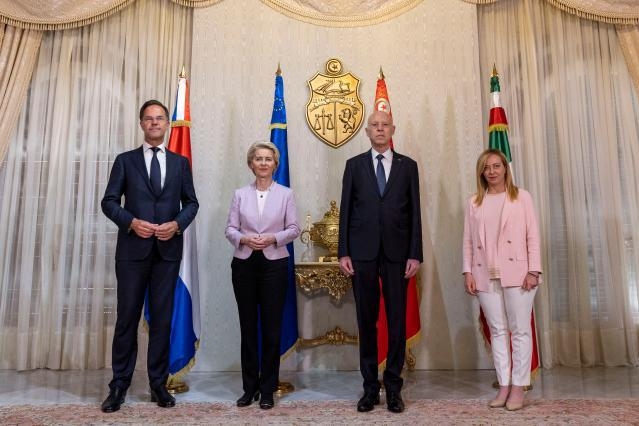
European Commission President Ursula von der Leyen, together with Italian Prime Minister Giorgia Meloni and Dutch Prime Minister Mark Rutte, meeting Tunisian President Kais Saied in Tunis, 11 June 2023, credit: EU
The Commission’s position
Asked for a comment to the report, a Commission spokesperson told The Brussels Times that the Commission is aware of the report and will look into it. “We are fully aware of the challenges that migration management poses for Tunisia and other partner countries in the region”.
“That’s why intensified engagement is ongoing with the Tunisian authorities and other partners on the ground, notably with IOM to step up assisted voluntary returns to countries of origin from Tunisia, in full respect with international law and necessary safeguards.
The core objective of our engagement is to ensure a comprehensive and human-rights based approach to migration. We continue to support the country in the areas of protection, returns, border management and the fight against migrant smuggling, building on existing migration programmes, and priorities agreed under our MoU.
In this context, the respect for human rights and human dignity of all migrants, refugees and asylum seekers are fundamental principles of migration management and obligations under International Law.”
In February 2025, a question was asked in the European Parliament about the implementation of the EU – Tunisia MoU and the EU funding to among others the Tunisian Coast Guard. Four months later, the Commissioner for Internal Affairs and Migration, Magnus Brunner, replied that “tangible progress has been achieved across all areas of cooperation, including migration management.”
“The Commission considers that increased actions by Tunisia against migrant smuggling, including the prevention of departures and the interception of vessels in its waters, as well as search and rescue operations to save lives at sea, have contributed to a consistent trend of reduction of arrivals from Tunisia.”
He also confirmed that no Member State has applied the safe third country concept vis-a-vis Tunisia and that the Commission has no information of transfers of non-Tunisian third-country nationals to Tunisia while an application for international protection in the EU was pending.
The EU normally conducts a human rights dialogue with its partner countries about the conditions for aid and trade relations with them, including compliance with the principles and values of democracy, rule of law and human rights. The Association Council with Tunisia, where such a dialogue would take place, was supposed to have been reinstated already by the end of 2023.
A meeting was planned to take place last month (28 October) but was cancelled. A Commission spokesperson told The Brussels Times that the Tunisian authorities had informed the EU that they were not in a position to hold the meeting and needed more time for internal preparations.
Paulo Cotrim contributed to the reporting.
