
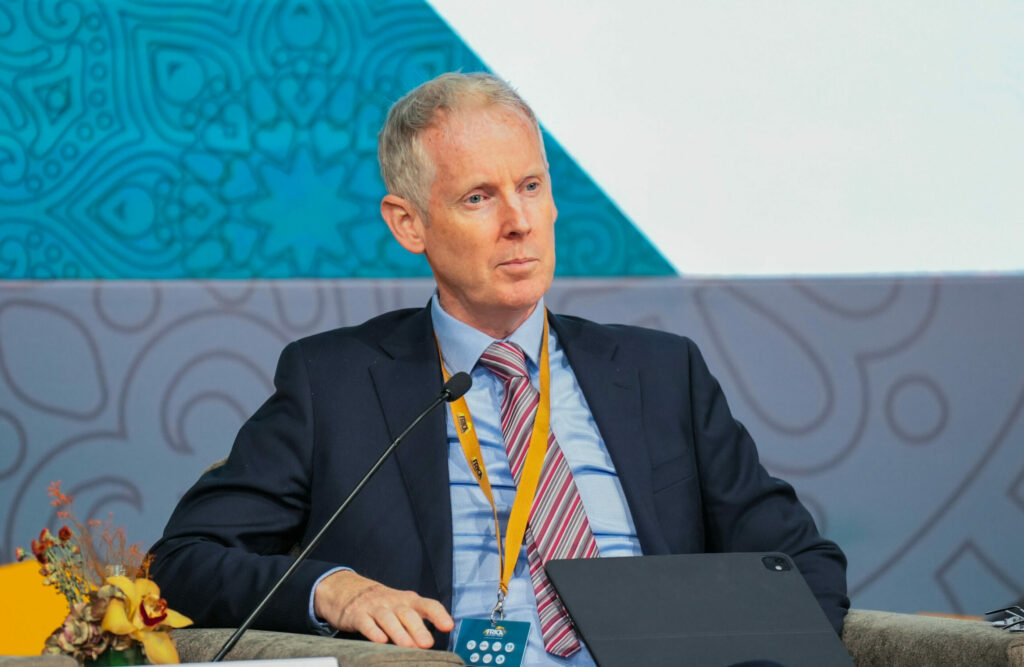
A senior European Investment Bank (EIB) executive believes the EU must "strengthen and up its game in Africa".
After years of looking on while other players have taken centre stage in developing Africa's infrastructure, the EU appears to be boosting its efforts to engage with the continent.
According to Andrew McDowell, Director General of the EIB’s global arm, this is an obvious step for the EU. He believes the bloc needs to move its relationship with the continent to a new level.
“It's on our doorstep. We need a stable, prosperous, secure Africa,” McDowell told The Brussels Times at last week's Africa Investment Forum in Rabat, Morocco.
“Europe's had a long and complex history with Africa, as we all know. But I think Europe is waking up to the fact that it needs to present itself as a reliable and trusted partner of Africa.”
A flurry of announcements
November was an important month in Europe-Africa relations. A flurry of eye-catching announcements were made last month, aimed at boosting trade and cooperation between the two continents.
Ahead of the G20 Summit in Johannesburg, the EU struck a trade deal with South Africa hailed by European Commission President Ursula von der Leyen as crucial for securing key critical minerals for EU members while helping South Africa's economic development.
A few days later, senior EU figures were in Angola for a two-day summit with the African Union, where the parties pledged to increase trade in clean energy and critical raw materials and develop projects related to electricity transmission and infrastructure.
For more than a decade, China has pumped investment into Africa as part of its global ‘Belt and Road' initiative’, building bridges, airports, roads and other infrastructure projects.
Now, Europe is positioning itself as a challenger. Africa has sunlight and rare mineral resources in abundance, and is seen as crucial to the EU’s energy transition - and its goal to achieve carbon neutrality by 2050.
In October, the bloc pledged nearly €12 billion in clean energy investments in South Africa as part of its Global Gateway programme, focused on infrastructure projects in developing countries, particularly in Africa.
Geopolitical competition has naturally played a big part in the EU’s recent overtures to Africa – something McDowell readily acknowledges.
“There was maybe a sense of complacency in the past that Europe had this traditionally strong relationship with Africa and Europe was kind of taking that for granted a little bit,” he says.
“Obviously, other partners are presenting themselves increasingly to Africa - not just China, the Gulf countries are getting much more involved - and I think Europe has realised that this is a relationship that it needs to nurture and strengthen and up its game in Africa.”
What can the EU offer Africa?
For McDowell, who served as vice-president of the EIB from 2016 to 2020 before leaving for a four-year stint in the private sector, the key to success for African countries is avoiding becoming dependent on a single country or bloc.
“What we hear, even this week, from a lot of governments in Africa is they don't want to create dependencies and become exclusively reliant on one partner or another partner for critical sectors of their economy and for development and for financing,” he says.
“They want to diversify their relationships and I think perhaps some of them have recognised that they have become too dependent on certain partners for financing and development.”
While emphasising that “different partners bring different value propositions and different skills”, he argues that the EU can offer African countries a guarantee that “we will never finance a project if it doesn't make economic sense for the partner country - we're never going to lumber a country with debt for projects that do not make sense.”
Private capital, not aid
African states are in dire need of investment. The continent has a huge annual investment gap, estimated at between €123 billion and €147 billion for infrastructure alone. For many countries, financing is increasingly hard to come by. Since 2021, foreign direct investment flows to the continent have fallen by around a third.
McDowell is keen to emphasise the role private capital should play in bridging this gap. African leaders, too, are keen for the continent to move away from the aid dependent image of the 1990s.
“It's no longer just about development and it's no longer this kind of donor-beneficiary relationship,” says McDowell. “It's about economics, it's about trade, it's about mutual investment, it's about jobs and competitiveness on both sides.
“I think we need to reframe the relationship from one of being a donor-beneficiary to being about a partnership that addresses the needs of both sides.”
A new scramble for Africa?
Despite such assurances, concerns have been raised in some quarters that the EU is engaging in a form of neo-colonialism with its recent endeavours, which are often linked to resource development and extraction.
McDowell says he “hears that concern”, but rejects the idea that the EU is not giving anything back to the continent, citing efforts to develop local skills and know-how in key industries.
“What Europe certainly wants to do is diversify its sources of supplies in critical industries, including in rare earths and critical raw materials, but not just in those sectors - in other critical value chains, you know, in agriculture, food, energy and so on,” he says.
“But it is also recognised that African countries want a share of that, and want a fair share of the value creation and move up the value chain in those sectors. And that's certainly something that we're supporting.”
“So in the areas of, for example, critical materials, we're very happy to support not just extraction projects, but processing and battery development - moving African countries up the value chain. In agriculture, we are explicitly supporting projects that are about actually beginning to develop African brands and African value-added and critical value chains, not just simply supporting the export of the monoliths.
"It has to be a win-win and we know for the relationship to be sustainable, Africa needs to see its fair share of the value creation.”
Further investment projects in the pipeline
At last week's Africa Investment Forum, investors expressed interested in US$15.2 billion (around €13 billion) worth of investment projects in Africa.
During the forum, the EIB, along with the African Development Bank (AfDB), signed a financing package worth around €238 million to help Mauritania modernise its main railway corridor.
Under the agreement, the EIB pledged to deliver a €108 million loan, guaranteed by the EU, to upgrade the railway linking Mauritania’s main mining region with its export terminal and boost the country’s economic growth.
