
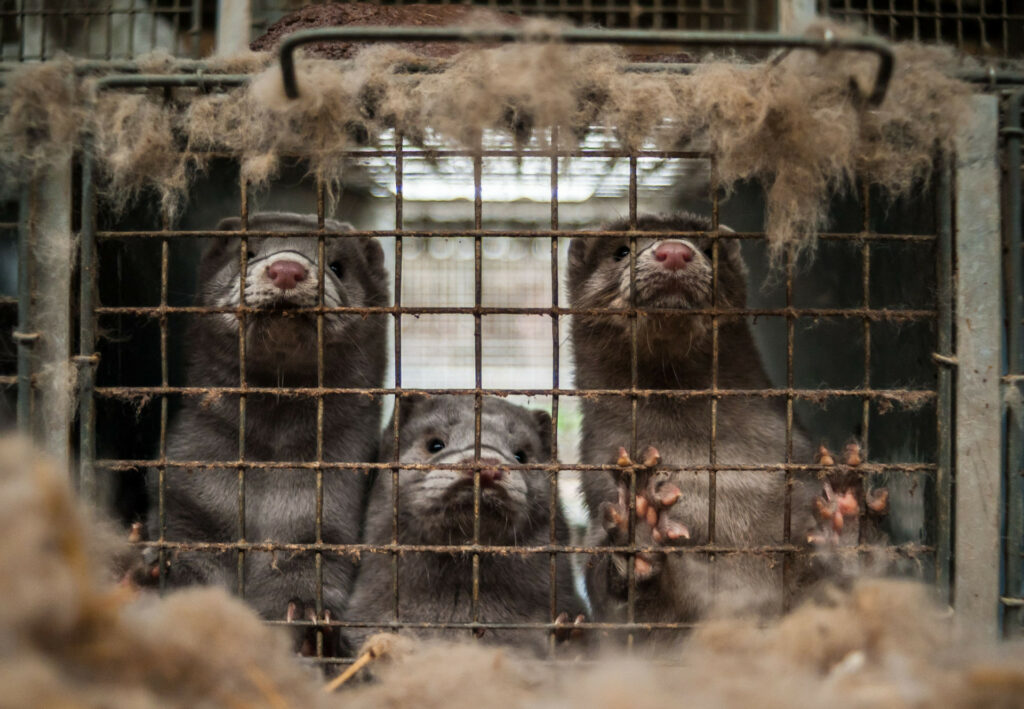
Poland’s President Karol Nawrocki signed on Tuesday the ‘Animal Protection Act’ banning fur farming following a vote in the parliament last October making the country the 23rd EU Member State outlawing the practice.
The move is particularly significant as Poland is Europe’s largest fur producer and the world’s second largest. The key provisions include an immediate ban on establishing new fur farms, an 8-year transition period for existing operations, degressive compensation for breeders over the first 5 years (incentivizing early exit), and 12 months’ severance pay and career transition support for farmworkers.
Anima International, a pan-European animal advocacy organisation which has campaigned to end fur farming for over 20 years, contributed to the legislation.
“Fur farming is in decline across the whole of Europe,” commented Kirsty Henderson, President of the NGO. “If the continent’s biggest producer can take the step to outlaw the cruel practice, there is no reason the EU cannot do the same. Harmonized EU legislation is now essential to prevent market distortions and ensure animal protection standards.”
Despite Poland’s status as a major producer, the industry has been in free fall. Since peaking in 2015, the number of animals raised for fur has plummeted 70% to around 3 million annually. Mink fur exports collapsed from €402 million (2014–2015) to just €71 million in 2024.
The sector now contributes approximately 0.01% to Polish GDP, employing around 900 farmworkers in largely seasonal work.
The industry is dominated by large mink farms backed by Danish and Dutch capital. Almost all Polish fur is exported via Finnish auction house Saga Furs to markets in China, Russia, and South Korea, according to Anima International.
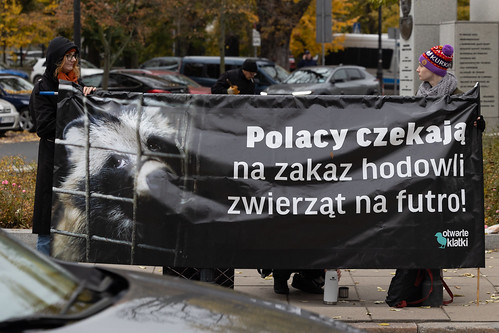
Demonstration in Poland – ‘Poles are waiting for a ban on fur farming’, Credit: Anima International
“This is a breakthrough, historic moment, one that Poles have been waiting decades to see,” said Małgorzata Tracz, the Polish MP who co-authored the bill.
“We are delighted that legislation is finally reflecting public sentiment and that the President along with the majority of MPs have chosen to ban fur farming. We see that caring for animals is something that unites us all, beyond all divisions.”
The European Commission is expected to table a legislative proposal by March 2026 which could lead to a future EU-wide ban. In December 2023, when announcing new rules to improve some of EU’s outdated animal welfare legislation, it proposed further steps to address the European Citizens' Initiative (ECI) 'Fur Free Europe'.
As previously reported, the initiative was officially closed in June 2023 after one year of campaigning reaching over 1,5 million of valid signatures in 18 EU member states. When the ECI was launched in May 2022, several reasons for a ban on fur farming were listed by animal welfare NGOs.
The complex behavioral needs of wild animals cannot be met in fur farms. Furthermore, fur farms pose a risk to animal and human health, as proved during the COVID-19 pandemic, when hundreds of mink farms were affected by coronavirus outbreaks, and new variants of the virus were transmitted from animals to humans.
The ECI marked the 10th successful ECI since the tool for participative democracy was launched in 2012. Seven out of the ten ECIs were dedicated to animal welfare issues. ‘A Fur Free Europe’ represented the most successful ECI for animal welfare, while being the third most successful overall.
A majority of EU Member States have already totally or partially banned or strictly regulated fur farming, sometimes with phasing-out period, on grounds of animal welfare and public health. The ECI goes further than most member states in calling not only for a ban on fur farming but also on a ban on the placing and marketing of farmed fur products in the European market.
The Commission says that it will take into account the opinion of the European Food Safety Authority (EFSA) and the outcomes of its own assessment.
EFSA issued a scientific opinion on 30 July 2025 on ‘Welfare of American mink, red and Arctic foxes, raccoon dog and chinchilla kept for fur production’. According to the opinion, current fur farming practices could not guarantee acceptable animal welfare due to structural problems such as severe confinement and the inability for animals to express natural behaviors.
On 4 July 2025, the Commission also launched a Call for evidence requesting input from stakeholders and citizens on the follow-up of the Initiative. The call for evidence was running for four weeks, until 1 August 2025. The feedback received is publicly available but has not yet been summarized by the Commission.
The Commission will consider if it is appropriate to propose prohibitions, after a transition period, on the keeping in farms and killing of farmed animals (mink, foxes, raccoon dogs or chinchilla), and the placing on the market of fur and fur products derived from such animals. It leaves the option also open to adopt EU legislation on appropriate standards suited to better address the welfare needs of the animals.
