
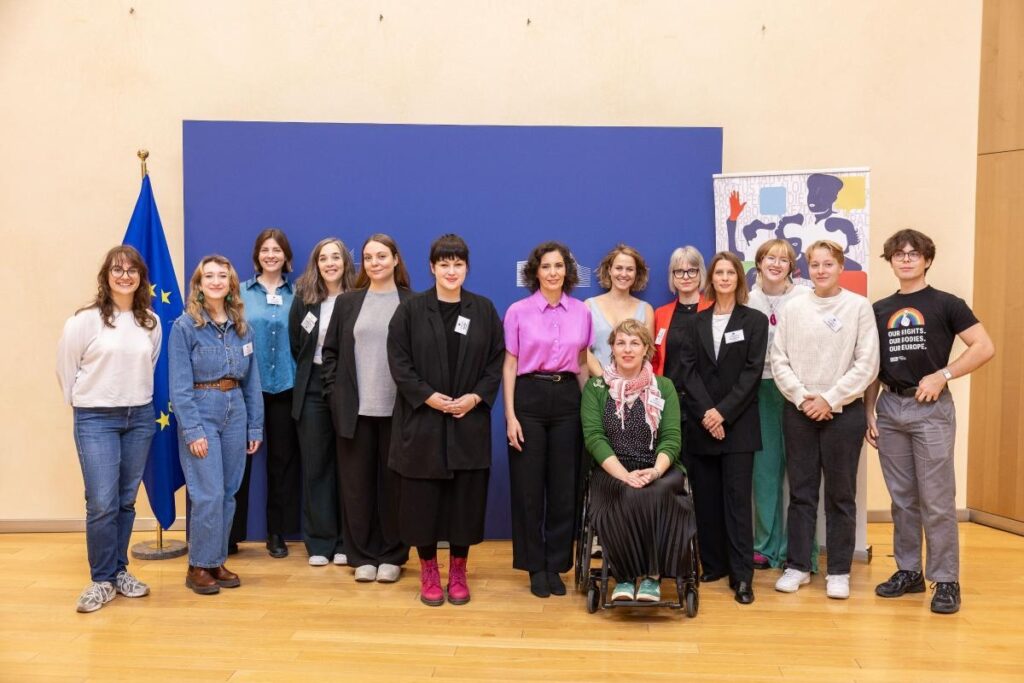
The European Parliament hosted on Tuesday a hearing on the European Citizens’ Initiative (ECI) “My Voice, My Choice” on safe and accessible abortion for all women in the EU.
At the heart of the initiative is a concrete proposal which respects that health is a national competency: A European financial mechanism that supports EU Member States in providing access to safe abortion care free of charge to women without access in their own country and does not interfere with national legislations.
Campaign coordinator and leader of the pan-European movement ‘My Voice, My Choice’ Nika Kovač opened with a testimony about what it means for the EU to deny access to life-saving healthcare:
“In some EU countries, laws and practices send women a devastating message: that their lives are not worth protecting. This is happening here, now, inside the EU. No woman should fear being abandoned when she needs help the most. No woman should risk her life because healthcare has been replaced by politics.”
Kovac also shared the story of Mirela from Croatia, who was present at the hearing. Mirela wanted a baby but the fetus she carried developed a tumour. Continuing the pregnancy could endanger her life. She needed an abortion urgently, but even though she had a legal right to an abortion in Croatia, hospitals refused to help her and she was forced to seek abortion across in Slovenia to save her life.
Théo Gauthier, human rights lawyer, reminded the Parliament that unsafe abortions do not vanish when access is restricted—they simply become dangerous. “We created a mechanism fully compatible with EU law. Member States that choose to help can receive EU funding to provide care. It’s solidarity, not interference.”
Dr. Annika Kreitlow outlined the medical reality: “Denying abortion does not stop abortions—it only makes them unsafe. Infection, infertility, and even death is preventable. The fact that 20 million women in the EU lack access to essential care should be reason enough for the EU to act.”
Representing the Polish organisation Foundation for Women and Family Planning (FEDERA), Justyna Faszcza highlighted the consequences of one of Europe’s most restrictive systems: “We have lost Izabela, Dorota, Justyna and others. Criminalisation forces women to travel abroad, and only those who can afford it are safe. ‘My Voice My Choice’ offers dignity, equality, and real support.”
“This hearing is a milestone, but we are far from done,” concluded philanthropist and campaign supporter Marlene Engelhorn. “On 18 December the European Parliament will show where it stands—and then the Commission must decide whether to follow the voices of over a million Europeans demanding basic reproductive healthcare.”
Representatives of the European Commission confirmed at the hearing that the Initiative is within the competencies of the EU and announced that the decision will be made in early March 2026. The issue belongs to the portfolio of Commissioner Hadja Lahbib, responsible for Emergency Crisis Management and Equality, who last October met the team campaigning for the Initiative.
She told The Brussels Time that the outcome cannot be predicted. “But what’s important is that initiatives like this spark much-needed debate.” Asked what the Commission will do to prepare a proposal on an EU-wide fund to support abortion she replied that the Commission is committed to promoting the health and protecting the fundamental rights of women and girls.
