
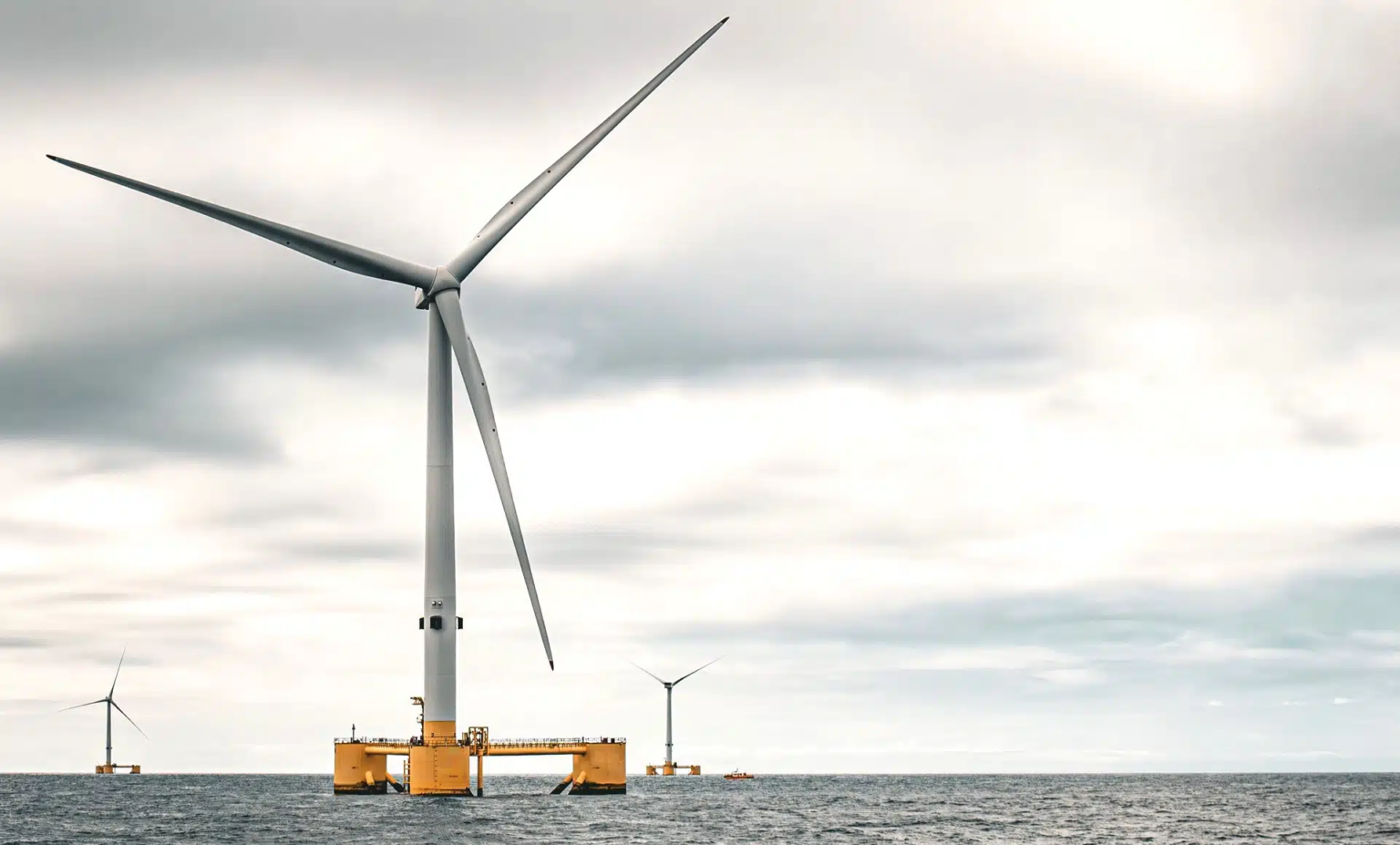
Offshore wind energy is one of the most powerful sources of green electricity but many countries are not yet able to utilise it because their seas and oceans are simply too deep. That might not be the case for too much longer.
Wind power is split into two distinct types: onshore and offshore. Onshore turbines are generally cheaper because the engineering is less complex and power transmission infrastructure is easier to install.
But they are limited by a number of factors. Finding a place to install a wind farm onshore is a tricky prospect and the turbines have to respect spatial planning laws that curtail the size of the blades and tower.
Out at sea that is not so much of a problem. Public opposition to offshore turbines is not unheard of but more manageable. The amount of power an offshore turbine can generate is much greater, both because of the turbine size and the greater prevalence of winds.
Onshore turbines hover around the 4 megawatt mark, while offshore counterparts are now reaching 15 megawatts. Some developers are even breaking the 20 megawatt mark with turbines that rival the Eiffel Tower in height.
They are truly marvels of human ingenuity and engineering. On 5th December, the United Kingdom generated nearly half of its electricity demand from wind power, illustrating that the technology is not a nice-to-have add-on to the energy mix: it is a fundamental pillar.
But not everyone can tap into its benefits. Land-locked countries obviously have to make do with onshore turbines but the main reason the likes of the UK, Denmark and the Netherlands have been able to become leaders is thanks to how shallow the North Sea is.
Its average depth is just below 100 metres, so large swathes of the basin can accommodate wind farms, which can be built at depths of up to 60 metres.
Developers are now seriously eyeing the Baltic Sea as ‘the new North Sea’ for the very same reason. Poland, for example, is holding its first offshore wind auction next week as part of its plans to become the Denmark of the Baltic in that regard.
Mediterranean countries are not so lucky though. Very few areas are suitable for offshore wind because it is too deep. The parts that are shallow enough are often close to tourist hotspots or protected areas.
The likes of Italy, Greece and Croatia may well be able to call upon greater solar power capacity than their northern neighbours but given that full energy system decarbonisation needs a mix of clean technology options, not being able to tap offshore wind is an issue.
Recent developments give hope for a breakthrough on that front though, as offshore wind is also split into two distinct categories: fixed-bottom and floating. The latter looks like it is not far off from having its eureka moment.
Floating in the fjords
Floating offshore wind turbines work in the same way as their fixed-bottom cousins but are moored to the seabed rather than built directly into it. Advanced engineering and software keeps the entire tower upright when the waters get rougher.
They are also easier to install, as they can be assembled in ports and then towed out to sea by ships. For fixed-bottom, you need to build the foundations and install the turbines using specialised vessels, all of which is weather-dependent and takes a lot of time.
Testing and pilot projects have been in the works for a number of years. France, with its deep Mediterranean and Atlantic waters has made several attempts to get the technology moving but the results are yet to pay off substantially.
The first of three floating turbines were actually towed out to their operating site off the south coast on Wednesday. But the total capacity will be just 30 megawatts. Not bad but not game-changing either. It is more test of concept than test of a new industry.
Meanwhile, fixed-bottom wind giant the UK auctioned off a third floating wind farm site in November, in the Celtic Sea between Wales and Ireland. Those projects are now moving further forward in the planning stage.
Those projects are gigawatt in size, so will be a bigger leap forward for floating if they can get all the right permits and enter into service in the mid 2030s as planned.
A big part of why floating is not yet ubiquitous is down to costs, which can be up to four times greater than fixed-bottom. Given that conventional offshore wind projects are feeling the financial bite of inflation and supply chain woes, it is no wonder progress in floating is slow.
Costs come down with economies of scale though and recent developments in the UK have now been mirrored by Norway, which this week picked two consortia to develop two floating sites.
Norway also has to contend with deep waters and public opposition to onshore turbines means that investing in floating is a strategic priority for the government and its trillion dollar oil and gas investment fund.
Hydropower provides the backbone of Norwegian electricity generation but climate change has increased the risk of that technology failing in the future to meet demand, so diversification is now the smart bet.
If the Norwegians can get floating started, develop a supply chain and show that it works at scale, others will follow suit. If the sector can bring costs down enough, new markets in the Mediterranean and Atlantic could then open up.
There is a massive competitiveness angle here of course: China is threatening to undercut Europe's offshore wind turbine industry on cost, so floating technology could be an intelligent pivot.
It is maybe fair to say that a lot of stars have to align and it is probably only going to be in the 2030s that floating will really come good but all great technologies have to start somewhere.
This year and next could well be the years when the seeds of success start to germinate.
Want more updates and analysis of what is happening in the world of energy and climate? Interested in finding out more information about public tenders and consultations? Sign up to our Energy Rundown newsletter here!
