
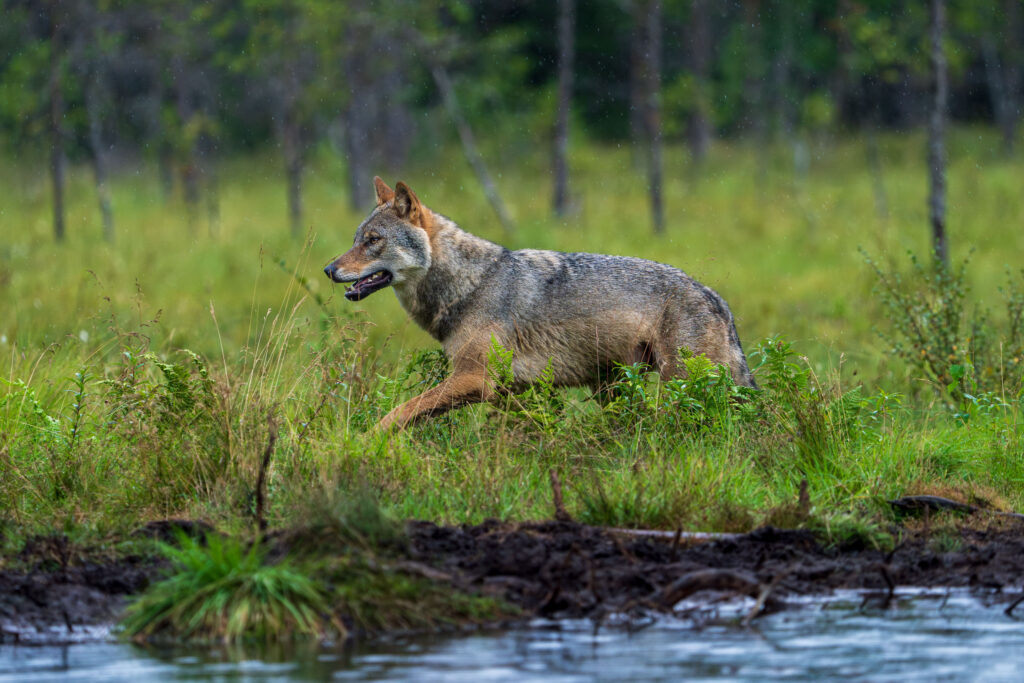
The European Commission announced on Thursday that it has closed the infringement case against Sweden for not respecting EU legislation on protecting wolves while continuing to express concerns about its wolf management.
In its December infringement package, the Commission closed 84 cases because the Member States concerned had cooperated in bringing an infringement to an end and ensured compliance with EU law. The Swedish case, dating from 2011, was an exception. Despite a Letter of Formal Notice and a Reasoned Opinion, the case dragged on and was never referred to the European Court of Justice.
A Commission spokesperson told The Brussels Times that the infringement was based on the listing of the wolf population as “strictly protected” under Annex IV of the EU Habitats Directive. In July 2025, the Directive was amended, which downgraded the protection status of wolves in the EU from ‘strictly protected' to ‘protected', moving it from Annex IV to Annex V of the Directive.
Neither the infringement case nor multiple complaints until now have a legal basis anymore and can no longer be pursued. As a consequence, EU law now allows wolf management measures in certain conditions. Although the infringement case was closed, the Commission will still continue to assess Sweden’s wolf management under the new legal framework, the spokesperson added.
As previously reported, Sweden hurried to take advantage of the amendment and announced that it would increase the budget for measures to manage the gradual reduction of its endangered wolf population from currently 350 to 170 (favourable reference population - FRP).
The new reference value was set by the government and reported to the Commission last August by the Swedish Environmental Protection Agency despite its misgivings. The Agency was of the opinion that the reference value could be lower than today but should be higher than 170. If the population number falls below the reference value, there is a risk that the species will not survive in the long term.
This time, the Swedish authorities did not have to wait for the Commission’s response. The Commission’s Directorate-General for Environment (ENV) sent last month a letter to Sweden on its reporting on the conservation status of the wolf under article 17 of the Habitats Directive. In the letter, seen by The Brussels Times, the Commission raised two main concerns.
First, Sweden’s goal of reporting a FRP of 170 wolves was determined and communicated to the public without a scientific assessment by the Agency and before it had completed its work on the conditions needed for reaching the FRP. Second, the reported FRP of 170 wolves does not seem to be supported by scientific evidence in line with the Habitats Directive and the related guidance.
“Accordingly, I would like to invite you to review, as appropriate, the Swedish Article 17 report as regards wolves and to send a revised version at the earliest possible date,” the Director - General of DG ENV wrote.
Asked if there is a deadline for Sweden’s reply, the spokesperson replied that the Commission expects Sweden to respond rather soon.
The annual license hunt of wolves is Sweden is planned to take place during 2 January - 15 February 2026. Considering the Commission’s concerns, is it advisable for Sweden to go on with the hunt?
“Sweden is bound by the Habitats Directive which obliges every Member State to maintain a favourable conservation status of protected species,” the spokesperson replied.
The Director of EU and international affairs at the Swedish Ministry of Climate and Enterprise, to which the Commission letter was addressed, referred The Brussels Times to the Ministry of Rural Affairs for comments. The ministry did not reply in time of press to a request for comments.
As regards the question when Sweden will submit a revised version of the previous report, the Swedish Environmental Protection Agency referred to the government as the letter from the European Commission was not addressed to the Agency.
The Agency confirmed that the decisions on licensed hunting – that have been taken by the county administrative boards - have been appealed and are now before the Administrative Court in Luleå for review.
Two Swedish NGOs, The Society for Nature Conservation and The Carnivore Association, have appealed to Swedish court against the upcoming license hunt. “Sweden has currently no valid reference value and without any such value the hunt cannot take place,” commented Ann Dahlerus, an expert on large carnivores at the association of Wildlife Protection Sweden and former Secretary General of the Swedish Carnivore Association.
Update: The article has been updated to include the reply from the Swedish Environmental Protection Agency.
