
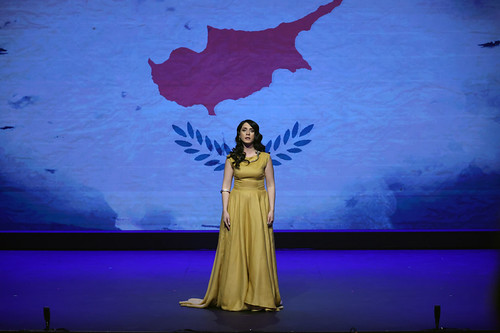
Cyprus took over the rotating EU Presidency on 1 January but the official opening ceremony took place yesterday (7 January) with a cultural event in Nicosia mixed with political discussions with Ukraine’s President Volodymyr Zelenskyy.
As already reported, Cyprus will chair the EU Presidency under the motto “An Autonomous Union – Open to the World”. Its programme focuses on achieving ‘autonomy’ for the EU as whole across five policy areas or interconnected pillars: Defence, security and preparedness, competitiveness, ‘open to the world’ (foreign affairs), ‘values that leave no one behind’, and the long-term budget (the MFF).
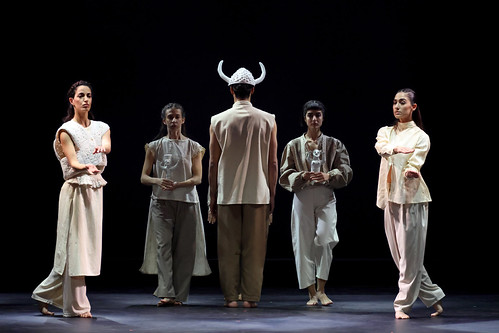
The opening was designed as a cultural journey through Cyprus’ long history showing its rich archaeological heritage and traditions and culminating in the anti-colonial struggle for independence in 1960 and the joining of the EU in 2004. Despite its progress as an EU Member State, the Cyprus issue has not yet been resolved and it is has remained the only divided EU country since 1974.
The division of Cyprus cast a shadow over the opening. “Cyprus’ own history of occupation and division has given it a very concrete understanding of the crucial value of international law for peace and stability among nations,” said Council President Costa. The final act in the cultural show looked to the future, conveying a vision of a united Cyprus that continues to inspire and to be inspired.
Welcoming the guests, the Deputy Minister for European Affairs, Marilena Raouna, emphasised Cyprus’ resilience, sense of responsibility and commitment to unity, peace and dialogue, highlighting its role as Europe’s lighthouse in the Eastern Mediterranean and a unifying force at a pivotal moment for the EU.
“Cyprus embarks on the Presidency journey, with commitment, hard work and the ability to be resilient in the face of adversity, and above all, with the determination to do what Cyprus knows well – to act as a bridge between member states, between institutions, between ambition and delivery, and between Europe and the wider region.”
Cyprus’ President, Nikos Christodoulides, said that the assumption of the EU Presidency is a collective national mission, undertaken with a sense of pride and responsibility, as well as a clear vision and aim to contribute as an honest broker to institutional cohesion and the reinforcement of the unification process.
Referring to the EU Presidency programme, he emphasised that the current geopolitical environment offers an opportunity for stronger, more secure, united and autonomous Europe. Cyprus due to its geostrategic location, will continue to serve as a reliable bridge for dialogue and cooperation in the wider region.
In fact, Cyprus has already started in that direction. Before Christmas, the Cypriot President met with the leaders of Greece and Israel in Jerusalem where they issued a joint statement on deepening trilateral cooperation. Cyprus was one of the first countries which recognized Palestine and to support the two-state solution, as recently as last December in an UN vote.
“This will also be the objective of our presidency: a EU that combines its strategic autonomy with its international openness,” he added. “A Union that can defend its interests and its citizens while also acting as a force for peace, stability and growth. A Union that boldly supports multilateralism and the rule of international law.”
Among the invited dignitaries to the opening of the Cyprus EU Presidency were the Presidents of Iraq and Lebanon, and the Secretary-Generals of the League of Arab States and the Gulf Cooperation Council.
European Council President António Costa highlighted Cyprus’ leadership role in strengthening EU unity, supporting Ukraine, advancing enlargement, and contributing to regional stability and humanitarian efforts, especially in the Mediterranean and the Middle East.
“Cyprus’ proximity to and diplomatic engagement with the Mediterranean and the Middle East and the Gulf are a key asset for Europe’s relations with all these regions,” he said. “Cyprus plays a central role, notably through its leadership in humanitarian assistance to Gaza, with the Amalthea initiative (maritime corridor) ensuring aid reaches civilians safely.”
“It will also make a crucial contribution to the EU’s role in implementing the Peace Plan for Gaza endorsed by the UN Security Council. Cyprus’ leadership will be equally important to strengthen ties through the Pact for the Mediterranean.” The Council President announced a meeting between EU leaders and EU’s Mediterranean partners, scheduled for April 2026 in Cyprus.
European Commission President Ursula von der Leyen, described Cyprus as “a land of remarkable beauty, fitting for the birthplace of Aphrodite”. She praised Cyprus as a successful and forward-looking European country that uniquely blends history, culture and innovation, highlighting its thriving economy and fast-growing tech sector.
“Cyprus brings to its Presidency a unique moral authority,” she said. “As a country at the crossroads of continents, cultures and crises, Cyprus understands the strategic importance of peace and stability in our neighborhood; the urgency of security in an uncertain world; and the enduring value of international law.”
She brought also hope for reunification of Cyprus. “For the EU, a comprehensive, fair and lasting settlement for Cyprus remains an absolute priority. That is why I appointed former Commissioner Johannes Hahn as EU Envoy for Cyprus. And it is why we will do all we can to ensure that the UN-led process succeeds, so that 2026 can bring renewed momentum towards a reunified Cyprus.”
The guest of honor was Ukraine’s President Volodymyr Zelenskyy, who stressed the importance of Cyprus’ solidarity and leadership in supporting Ukraine, advancing enlargement and contributing to Europe’s stability, security and unity.
“I truly hope that during these months, Europe will become stronger, and that people across our continent will feel that tomorrow can be safer, more stable and better than today. I also deeply believe that together, we can help deliver one of the most important guarantees of peace and security for our nation and for the whole of Europe – Ukraine’s membership in the EU.”
“We all understand how wars like this one – Russia’s war of aggression against Ukraine – come to an end. When pressure is strong enough to exhaust the source of the war, peace comes. That pressure exists now, and the EU plays a key role in maintaining it. And I thank you for your willingness to help.”
Referring to the talks on Monday in Paris with the Coalition of Willing, he said that, “Sanctions on Russia, support for Ukraine, strengthening our defense together – all of this works for peace. Sanctions need to be upgraded. A new package is being prepared. And many steps are being taken to target Russia’s shadow fleet.”
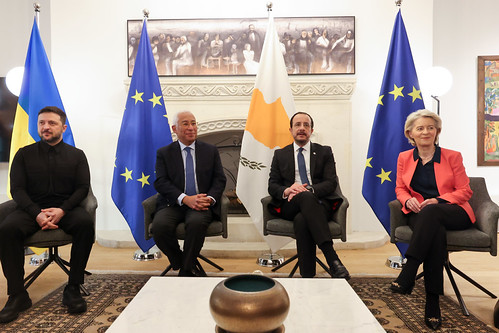
After a joint meeting with the Cypriot President and the EU leaders, he twitted on X that the key points were the priorities of the Cyprus EU Presidency, defense support for Ukraine from EU member states, including strengthening air defense, combat aviation, and drone production; and real progress in negotiations on Ukraine’s EU accession.
On the latter, he said in his speech that he expects to start accession negotiations during the Cyprus EU Presidency. The Ukrainian government signaled last year that its objective to provisionally close the negotiations by the end of 2028. The Paris Declaration says that any peace settlement will have to be backed up by robust security guarantees for Ukraine. That would also have to include EU membership in the near future.
