
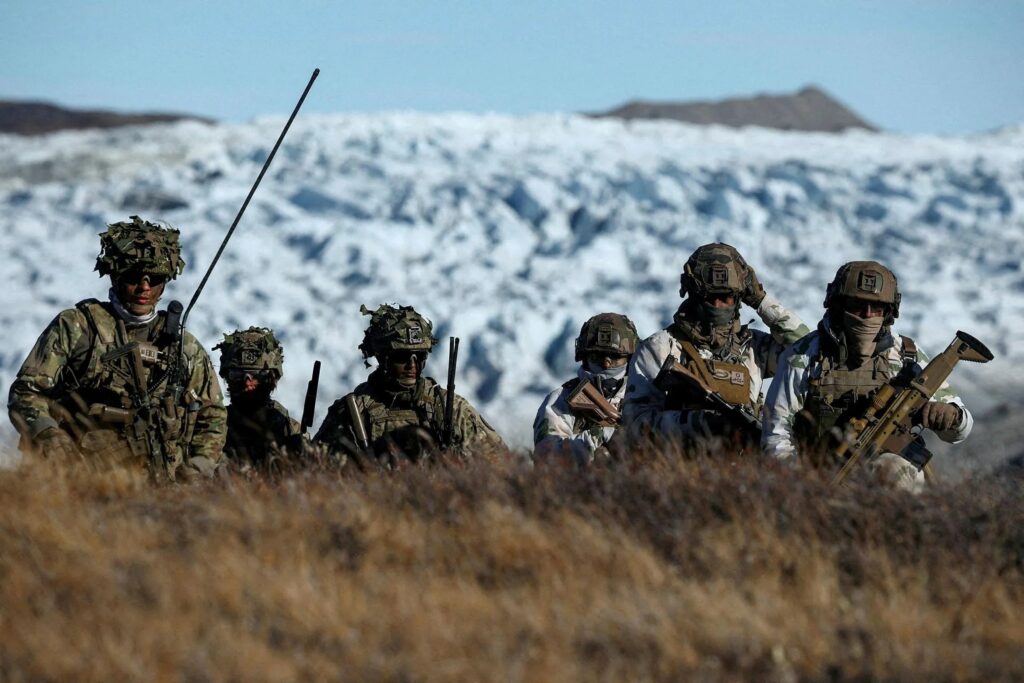
When in 2019 Donald Trump first suggested that the United States acquire Greenland, Europeans dismissed the idea as a bad joke. But they’re not laughing now.
Last month, the US president’s new national security strategy telegraphed his ambition to restore American dominance over the western hemisphere – which includes the vast Arctic island, a self-governing territory of Denmark, a longstanding NATO ally.
Trump’s bold Venezuela raid on 3 January demonstrated that he means business.
And only hours later, he bluntly asserted that taking control of Greenland – by force, if necessary – was now a priority for America’s national security.
Denmark and its European allies rightly object that this would violate international law, trample on local democracy and destroy NATO, the North Atlantic alliance that is the cornerstone of Europe’s defence.
But Trump scarcely cares about any of that. He believes that great powers led by strongmen such as himself can do as they please: coerce lesser powers, weaponise their dependencies on the US, plunder their resources and even seize their territory.
As his deputy chief of staff Stephen Miller told CNN, “You can talk all you want about international niceties. But… the real world… is governed by strength… force… power.” He added: “We’re a superpower. And under President Trump, we are going to conduct ourselves as a superpower.” Meanwhile, Miller’s wife posted on X a map of Greenland in the colours of the American flag, and one word: “SOON”.
Such threats are alarming not just for Greenland and Denmark, but also for Ukraine and the rest of Europe. Since Europe is unable to defend itself against Russian aggression – let alone an unprecedented attack by its supposed ally, the US – it is dangerously vulnerable to Trump’s bullying.
Why Greenland?
Trump seems to covet Greenland for three reasons: economics, security and legacy.
Economically, global warming is opening up Arctic shipping routes and making it easier to tap the region’s previously inaccessible oil and rare-earth mineral resources.
Geopolitically, competition with Russia and China for control of the newly strategic Arctic region is heating up. Thanks to its ownership of Greenland, Denmark has staked a claim to much of the Arctic seabed.
And in legacy terms, gaining Greenland would expand US territory by 2.2 million km2 – adding an area the size of France, Germany, Norway, Sweden and Finland combined, albeit with only 57,000 inhabitants.
In doing so President Trump would be succeeding where several of his predecessors failed, most recently Harry Truman in 1946. And he would be following in the expansionist footsteps of his hero William McKinley, a protectionist and imperialist president at the end of the 19th century.
Related News
- Why the EU isn’t a superpower yet
- US threats against Greenland: Could this spell the end of NATO as we know it?
As well as imposing sweeping import tariffs, McKinley annexed Hawaii and seized Puerto Rico, Guam, American Samoa and the Philippines from Spain – all of which the US still controls, apart from the Philippines.
Like winning a Nobel peace prize, expanding the US would be a status symbol that ensured Trump’s place in history. And unlike his trade, immigration and foreign policies, it could not readily be reversed by his successors.
Although one can never be sure whether Trump means what he says, he seems determined to acquire Greenland before his second term ends in 2029.
Three options
Invasion is probably not his preferred option for doing so. Indeed, his secretary of state, Marco Rubio, argues that military threats are merely a negotiating tactic.
With luck, Trump might settle for a much-expanded US presence in Greenland.
It already has a military base there, albeit with fewer than 200 personnel. To better defend the Arctic region, Denmark would be open to a much greater US presence, as there was during the Cold War. It would probably be willing to designate American bases as US territory, akin to the status of UK bases in Cyprus. As for developing the territory’s mineral wealth, greater investment by US companies – including potentially ones linked to Trump’s family – would be welcomed.
Yet Trump seems obsessed with “ownership” of the territory, so that might not satisfy him.
A second option would be for the US to obtain control of Greenland through bribery and bullying.
Trump might be able to strongarm Denmark into selling Greenland – by threatening not to defend it against Russian attack, for instance – although this would also require Greenlanders’ consent.
More plausibly, Trump could bypass Copenhagen and deal directly with Greenland. Greenlanders have the right to obtain independence from Denmark subject to a referendum. Since an independent Greenland would be defenceless, it might then decide to become an American protectorate, or to join the US outright.
The territory’s second-biggest party favours independence, as do a small majority of Greenlanders, according to a recent poll. But only 6% want to join the US, although that might change if Trump bribed them enough. With such a tiny population, that would be relatively cheap. For instance, giving all 40,000 registered voters $1 million each would cost $40 billion (€34 billion), a drop in the ocean for the $7 trillion US budget.
The worst outcome would be for Trump to seek to annex Greenland.
To deter him, Europeans might threaten to stop buying US weapons and boycott American products more generally. They could also deny the US access to its European bases, which it uses to project power globally.
The US Congress could also try to block him, since even Republicans baulk at invading an allied democracy and blowing up NATO.
But if the US did invade, it would definitely prevail. Denmark could scarcely resist, and its European allies would doubtless not either.
Rearm now
The bigger picture is even more alarming.
If the entire western hemisphere is the US’s “backyard”, in which Trump asserts the right to intervene at will, it seems plausible that he views Ukraine – and perhaps eastern Europe – as Russia’s sphere of influence.
While Ukraine and its European allies have so far dissuaded Trump from striking a dirty deal with Vladimir Putin that would sacrifice Ukraine and leave the rest of Europe open to Russian attack, he is clearly tempted by such a great-power bargain.
While Europeans’ flattery and appeasement of Trump have bought time, there is still too little urgency about the need to rearm.
If Trump invaded Greenland, abandoned Ukraine and jettisoned NATO, Europeans’ plight would be grim. In a world governed by force, Europe needs to be able to defend itself – not by 2035, but now.
