
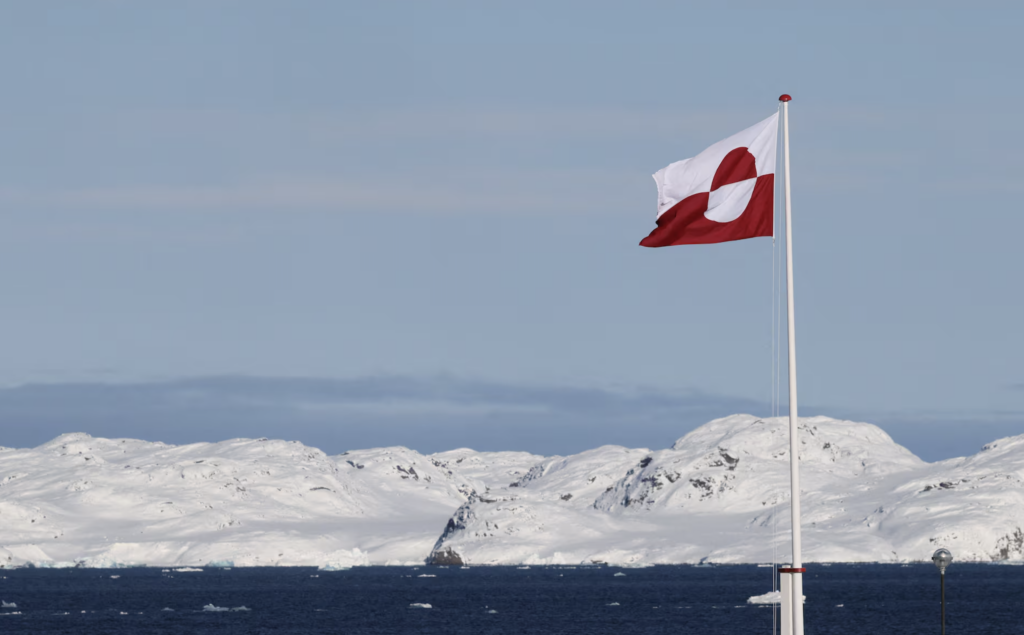
The United States’ sabre-rattling over control of Greenland is the biggest geopolitical story of the year so far. But what is the EU status of the island and which other members of the bloc have overseas territories with complex standings?
Greenland is an autonomous country within the Kingdom of Denmark and has been since 1979, when Greenland was granted a degree of self-governance, nearly two decades after its status as a Danish colony was terminated.
At that point in time, Denmark was a member of the predecessor to the European Union, the European Communities, having joined the club along with Ireland and the United Kingdom in 1973. So, in a way, for a brief period Greenland was a member of what is now the EU.
That changed in 1982, when Greenlanders voted narrowly to leave the EC, mirroring how they had voted during Denmark’s membership referendum in 1972.
Greenland’s membership lapsed as a result at the beginning of 1985, technically making it the first country before the UK to leave the Union. The country is now marked as one of the overseas countries and territories of the European Union.
United States President Donald Trump’s insistence that Greenland fall under American control may lead to a change of this status, if Greenlanders believe they are better off within the EU. Whether that would dissuade Trump’s advances is another question of course.
Another autonomous country within the Danish state is the Faroe Islands, whose self-governing rights were established in 1948, long before Denmark’s decision to join the EC. As a result, the islands opted not to join in order to protect their lucrative fishing rights.
Denmark did have a temporary unilateral right to force the islands to be a part of the EU but this expired shortly after its own membership began.
Currently, the Faroe Islands are not part of the EU and any Danes living there are also not considered EU citizens. It is outside of the Schengen zone and does not use the euro.
Opinion polls about joining the EU generally favour the ‘no’ option but there is a school of thought that a successful independence movement would naturally eventually culminate in the islands joining the EU as a fully-fledged member.
The Netherlands has six overseas territories which have varying statuses ranging from autonomous countries to special municipalities. None are part of the EU but all of their citizens are entitled to citizenship.
As for overseas territories that are part of the EU, six of France’s 13 are officially classed as Outermost Regions: Guadeloupe, French Guiana, Martinique, Reunion, Mayotte and Saint Martin.
French Guiana is notable for hosting the European Space Agency’s rocket launch centre and for also being France’s longest border: the frontier with Brazil at 730 kilometres is 100 kilometres longer than the border with Spain.
Other countries with Outermost Regions include Portugal and Spain, represented by the Azores, Madeira and the Canary Islands. They are part of the EU but certain rules and regulations do not apply due to their geographical remoteness.
The United Kingdom, which until 2020 was a member of the bloc, has 14 overseas territories, only one of which was also part of the EU before Brexit.
Gibraltar, on the southern tip of Spain, did not participate in the UK’s membership referendum in 1975 and only voted in its first European Parliament elections in 2004.
The territory was granted the right to vote in the non-binding 2016 Brexit poll though and 95% declared their support for membership. Ultimately, the overall 52% vote in favour of leaving was the policy chosen by the Conservative government at the time.
Gibraltar’s government had indicated before the vote that the territory would aim to remain part of the EU in the event of a leave vote but that option was not pursued in the wake of the vote. Suggestions that Brexit would trigger an independence movement or interest in uniting with Spain have so far not meaningfully developed.
It was only last year when a new agreement on custom checks and Schengen zone requirements was finally brokered. It is still making its way through the EU’s legislative process.
These territories all have complex relationships with the countries they are linked to and the European Union itself. Geopolitics are quickly reshaping how we think about borders, states and countries, so those relationships could foreseeably change as well in the coming years.
