
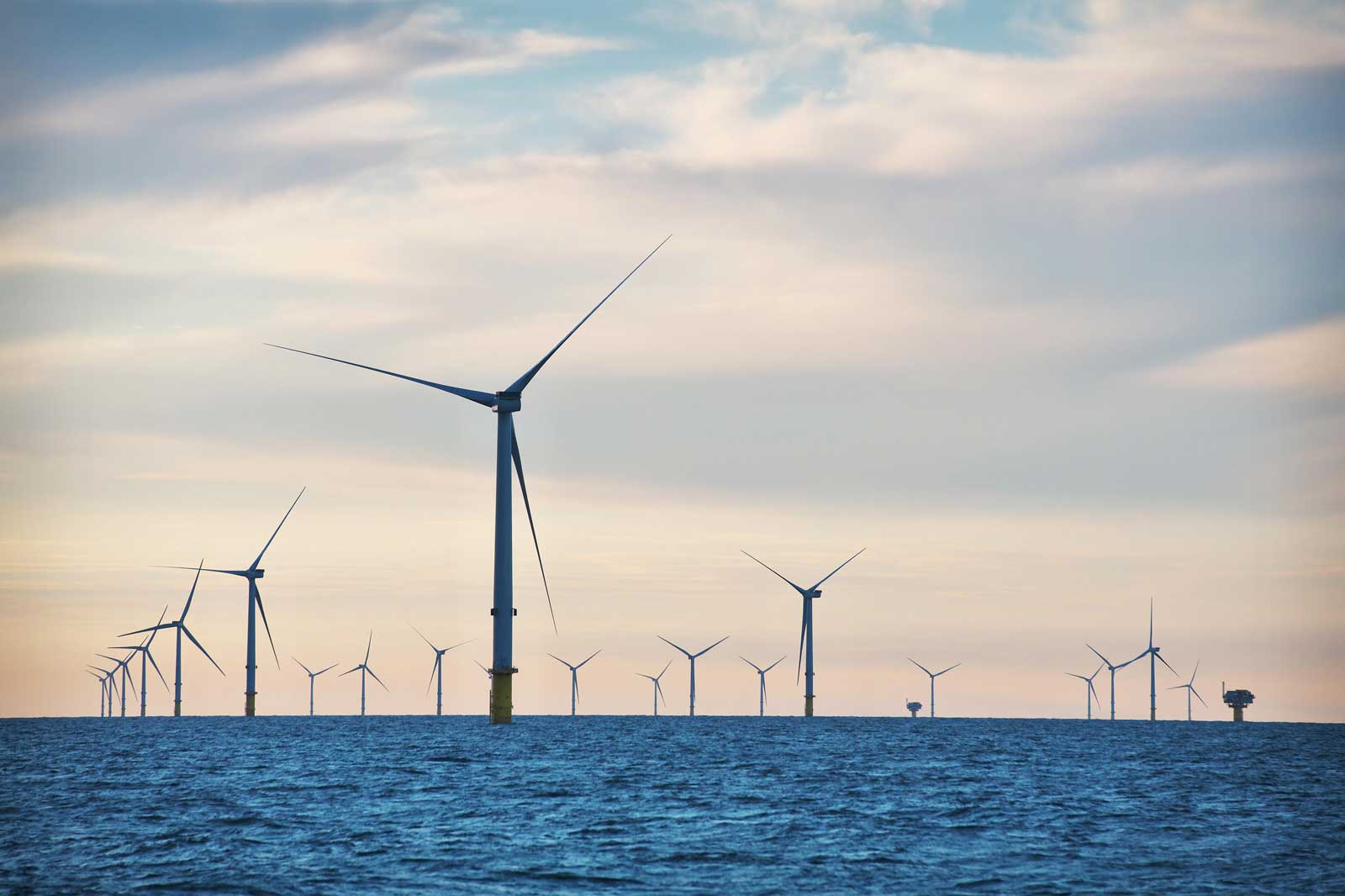
The United Kingdom’s government made a big statement of intent with its offshore wind auction results this week, bolstering the country’s chances of achieving its ambitious green targets. The rest of Europe should take notes.
Britain has become an offshore wind superpower, ranking alongside the likes of early-adopters Denmark, thanks to its ideal location on the North Sea and government willingness to give the technology a chance.
The current government has an ambitious target of running the country’s power system on completely clean energy by 2030, which means a lot more offshore wind farms need to be built. Between 40 and 50 gigawatts will be needed to make the goal achievable.
In order to get projects off the ground, the UK organises annual auctions. Winning bidders are awarded financial support in the form of a so-called contract for difference (CfDs).
CfDs guarantee the developer a certain price for their power output. When electricity prices fall, they are compensated for the loss of revenue. When they increase, profits are returned to the consumer.
This week, the government announced that 8.4 gigawatts of eligible projects will be awarded a CfD, dragging the UK closer towards that clean power by 2030 goal. It is the most offshore wind capacity ever awarded in a single auction.
According to analysis done before the auction, a price of £94 per megawatt-hour would be cost-neutral for billpayers. Ultimately, the average so-called strike price came in at just under that benchmark, so it is a win for consumers.
This seventh auction round, known as AR7, did not just go big on conventional wind technology either. It also awarded CfDs to two projects off the coasts of Scotland and Wales that will focus on floating offshore wind.
If the UK can successfully scale that type of wind turbine, then deeper waters away from and in the North Sea can also be unlocked, preventing the offshore industry from being too heavily concentrated in one part of the country.
The results of AR7 have garnered critical acclaim from across the sector and could have a big impact not just in the UK but further afield as well.
Convincing the neighbours
Germany is another of the big wind superpowers. About 9 gigawatts of offshore wind farms are located in the North and Baltic seas, with more projects on the way. But the sector has hit choppy waters and many energy industry experts say that the problem is the way that the German authorities auction off offshore projects.
Unlike the UK, Germany currently uses a lowest-bid-wins model. Given the difficulties facing the sector, like tight supply chains, inflation and geopolitical uncertainty, that has scared some investors away, turned off by the lack of safety net provided in that market.
That is why Germany has been urged to adopt the CfD model. It is an idea that is being heavily considered by energy regulators and government, and all indications point to the system being overhauled some time this year.
AR7 will count in CfDs favour during that decision-making process. There was still reluctance in some quarters to adopt the model after failed auctions in Denmark and the UK itself, but those snags appeared to have been ironed out.
Germany has proven itself to be open to change as well. Recent tweaks to permitting have unlocked a huge chunk of capacity when it comes to onshore wind
The Netherlands too is considering adopting a CfD system, so might also be convinced by the British success, while Belgium's rescheduled auction might stand to learn a thing or two as well.
Devil in the detail
AR7’s results do not only offer some lessons for countries that do not follow the CfD model, it also has plenty to interest the likes of Denmark and Poland, which already use that system.
The UK reformed the auction rules ahead of the bidding round in order to avoid another failure, as that would have proven catastrophic to those 2030 clean power plans.
Among the biggest changes was extending the CfD contract duration from 15 years to 20. That clearly paid off, as it resulted in more interest from developers.
But one outcome that needs to be watched carefully is the fact that very nearly 7 gigawatts of the total capacity awarded a CfD by the auction will be provided by projects to be built by one developer, German energy firm RWE.
The company’s Christmasses have all come at once it seems but will have to be careful that it has not taken on more than it can handle. Other countries might also be unwilling to concentrate so much responsibility and ultimately revenue in one firm’s hands.
Diversification is the big buzzword in energy policy, one could argue that this extends to renewable energy as well and who is actually providing it.
Ultimately though, AR7 was a rip-roaring success and the UK will be hoping that it can repeat the trick soon when AR8 is launched.
Want more updates and analysis of what is happening in the world of energy and climate? Interested in finding out more information about public tenders and consultations? Sign up to our Energy Rundown newsletter here!
