
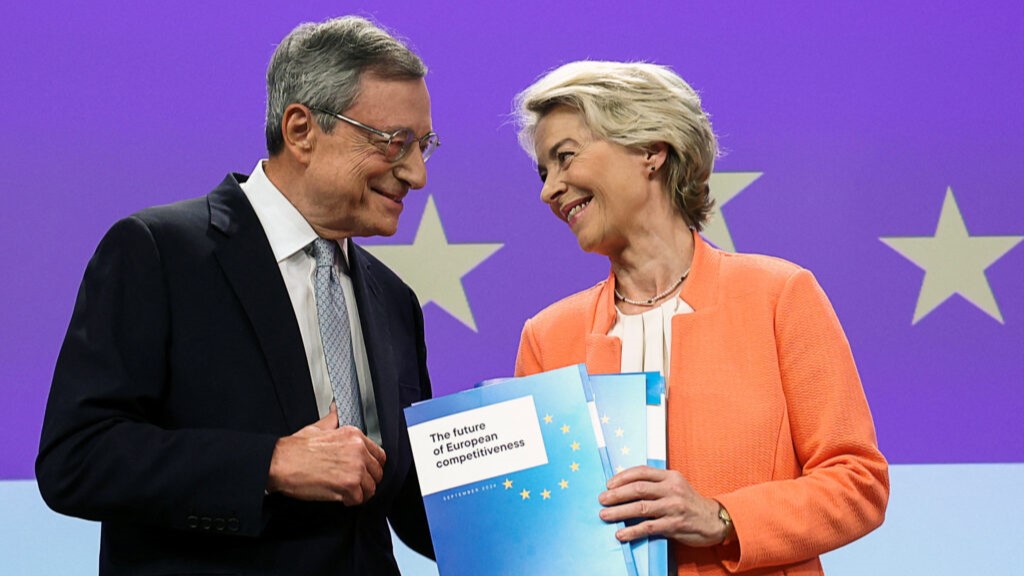
European Union leaders head to the Belgian countryside next week to discuss how to make Europe more competitive. Mario Draghi, a former Italian prime minister, has already spelled out how this should be achieved. Will his advice be followed?
Back in 2024, the former head of the European Central Bank and Italy’s most recent technocratic prime minister, Mario Draghi, was tasked by the European Commission with authoring a comprehensive report on European competitiveness.
Draghi had already steered the eurozone through the doldrums of the early 2010s by launching ambitious monetary policies like negative interest rates and quantitative easing. ‘Super Mario’ saved the euro, so he was the right man to save European industry and businesses.
His report was meant as a wakeup call for the continent, pinpointing a big and widening competition gap between the EU, the United States and China. Sluggish innovation and expensive electricity were highlighted as the main culprits.
There is no simple solution but Draghi’s headline-grabbing recommendation was that the EU needs to find €800 billion each year in additional investments.
To put that figure in context, the five-year-long Covid recovery fund is worth about €750 billion, depending on which year’s prices you decide to use. That particular funding instrument is due to wrap up at the end of 2026.
Draghi, who is known more widely as Mr ‘Whatever it takes’, has suggested that the Covid fund should not be a one-off and that, indeed, the €800bn annual investment should be sourced from joint-borrowing and common debt.
For many EU governments, the Covid fund was a one-time deal. Attitudes have evolved since then but the idea of repeating it on a regular basis is still not universally supported.
The report also insists that the EU needs to finally start coming up with proper industrial planning and bring down energy prices wherever possible, as well as investing more in artificial intelligence applications and cloud computing.
Commission President Ursula von der Leyen has used the Draghi report’s guiding principles as the basis for much of the policymaking that has come out of her second mandate, including simplification measures and a bigger focus on affordable energy.
But it probably does not go far enough to move the needle quickly and firmly enough to put the EU on a level footing with its competitors.
At the EU leaders meeting next week, heads of state and government are going to be urged once again to take the report’s message to heart and embark on greater integration so that many of its recommendations can actually be achieved.
Recent geopolitical developments largely driven by the actions of Donald Trump’s administration, as well as the evolution of China’s trade policies, might well increase the chances of leaders deciding to put their money where their mouths are for once.
Draghi himself is scheduled to attend the retreat at a castle in Limburg, as is his fellow ex-Italian prime minister and EU report author Enrico Letta, whose study in April 2024 was an aperitivo for the more comprehensive report by Draghi that followed.
Letta’s work focused more on how the single market should evolve to include energy, telecommunications, financial services and research & innovation. He has since called on leaders to make a firm political commitment to get this done.
Every country wants to preserve and increase their competitiveness but the next month will show whether they are serious about actually putting in place the measures needed to achieve it.
