
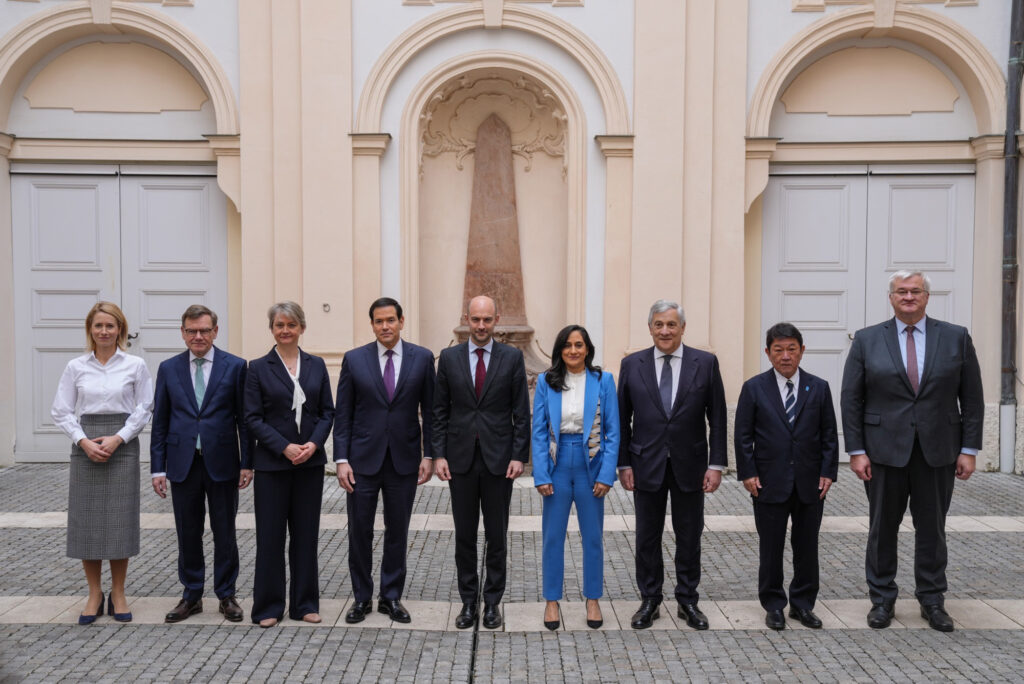
G7 foreign ministers met on the margins of the Munich Security Conference for the first time under Canada’s 2025 presidency, alongside the EU’s High Representative.
The ministers — from Canada, France, Germany, Italy, Japan, the United Kingdom and the United States — discussed Russia’s war in Ukraine and said they would work together to support “a durable peace” and a “strong and prosperous Ukraine”, their joint statement said.
They met Ukraine’s foreign minister, Andrii Sybiha, and referred to steps the G7 has backed to support Kyiv, including financial support linked to “extraordinary revenues” from Russian sovereign assets, and measures such as oil and gas price caps and sanctions.
Any new sanctions imposed after February should be linked to whether Russia enters “real, good-faith efforts” to end the war in a way that provides Ukraine with long-term security and stability as a sovereign, independent country, according to the statement.
The group also discussed support to Russia from other countries, including “dual-use” assistance — items that can have both civilian and military uses — from China, and military assistance from North Korea and Iran, condemning such support.
Middle East, Syria and the Indo-Pacific
The ministers discussed political, security and humanitarian issues across the Middle East, including Israel, Gaza, Lebanon, Syria and Iran, and reiterated support for the implementation of the ceasefire reached between Israel and Hamas, including the release of all hostages and expanded humanitarian aid in Gaza, according to the statement.
They said they backed efforts by Egypt, Qatar and the United States to work towards a permanent ceasefire, and repeated their condemnation of Hamas and the need to ensure it does not reconstitute militarily or take part in governance.
The G7 welcomed the outcomes of an International Conference on Syria hosted by France on 13 February 2025 and reaffirmed support for an inclusive political transition process in line with UN Security Council Resolution 2254 — a UN framework for a political settlement in Syria.
They also welcomed developments in Lebanon, including the election of President Joseph Aoun, the designation of Nawaf Salam as prime minister, and the formation of a new government.
Iran was criticised for actions the G7 described as destabilising, including advancing uranium enrichment “without credible civil justification”, facilitating armed groups and organisations across the Middle East and Red Sea, and proliferating ballistic missiles and drones.
On the Indo-Pacific, the ministers reaffirmed support for a “free, open and secure” region and opposed attempts to change the status quo by force, while also opposing China’s efforts to restrict freedom of navigation through militarisation and coercive activities in the South China Sea, .
They also expressed concern over North Korea’s nuclear and ballistic missile programmes and called for the complete denuclearisation of the Korean Peninsula, urging Pyongyang to stop supporting Russia’s war against Ukraine and to withdraw its troops.
The ministers said they discussed conflicts and instability in the Democratic Republic of the Congo and Sudan, as well as Haiti and Venezuela, and confirmed they would meet next in Charlevoix, Quebec, on 12–14 March.
