
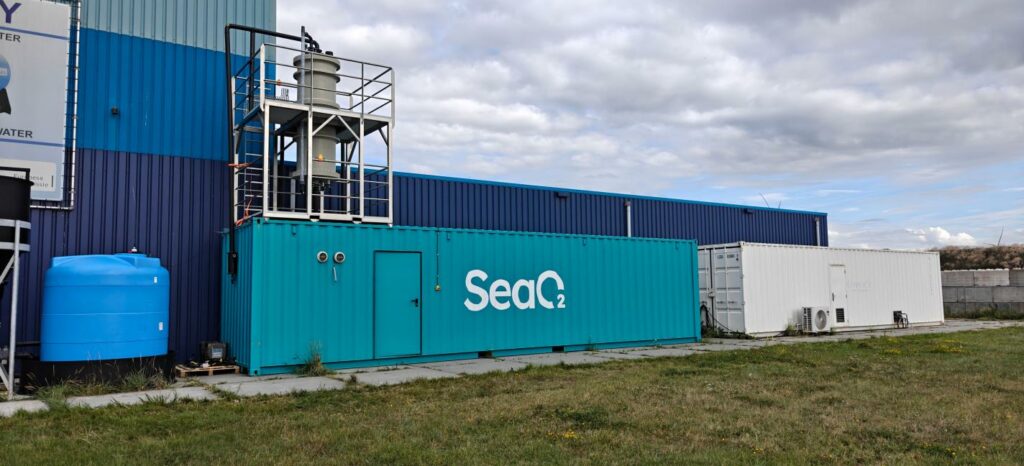
SeaO₂, a Dutch start-up that removes carbon dioxide by treating seawater and returning “decarbonised” water to the ocean, has received EU-backed support to help refine its investor engagement and strategic planning.
The company says its approach is designed to enable the ocean to absorb CO₂ from the air again and to counter ocean acidification locally by reducing the CO₂ content of seawater before it is released back into surface waters, the European Commission informed in a statement on Wednesday.
“The oceans absorbs over 25% of human CO₂ emissions and hold vastly more carbon than air, so it is a very strong ally in carbon removal,” said Zamin Syed, Founder’s Associate at SeaO₂, in the programme’s statement.
SeaO₂ was founded in 2021 as a spin-off from TU Delft and now has a team of 12 working across chemistry, oceanography, engineering and business.
The firm’s model includes developing direct ocean capture (DOC) technology — a method that extracts CO₂ from seawater — selling carbon-dioxide removal (CDR) credits to businesses, and supplying captured CO₂ to industrial clients.
Testing sites and plans for commercial scale-up
SeaO₂’s process uses an electrochemical method to remove CO₂ from seawater, with the treated water then returned to the ocean so it can take up more CO₂ from the atmosphere, the Commission said.
The company prefers to work with existing coastal infrastructure such as desalination plants to reduce energy needs and operating costs, and it has identified potential future locations including Norway and Canada where ocean conditions and renewable energy access are favourable.
SeaO₂ said it first demonstrated the technology in 2023 through “Project Ripple”, capturing CO₂ and storing it permanently through mineralisation, a process that turns CO₂ into stable minerals.
A follow-on pilot, “Project Swell”, is operating in the Netherlands under real marine conditions, with a larger project — “Project Breaker” — planned for 2028 that is intended to include a commercial element by generating carbon credits.
To fund that phase, SeaO₂ is preparing a Series A fundraising round of around €12 million for early 2027, and it has pre-sold carbon-removal credits to early buyers including Klarna, with delivery due once operations begin.
The organisation said SeaO₂ joined the BlueInvest Readiness Assistance programme in 2024 and received tailored coaching on investor engagement and strategic planning, alongside networking through BlueInvest Day.
BlueInvest is the EU’s innovation and investment platform for the “blue economy” — business activity linked to oceans and coastal areas — offering coaching, fundraising support and networking for ocean technology companies.
