
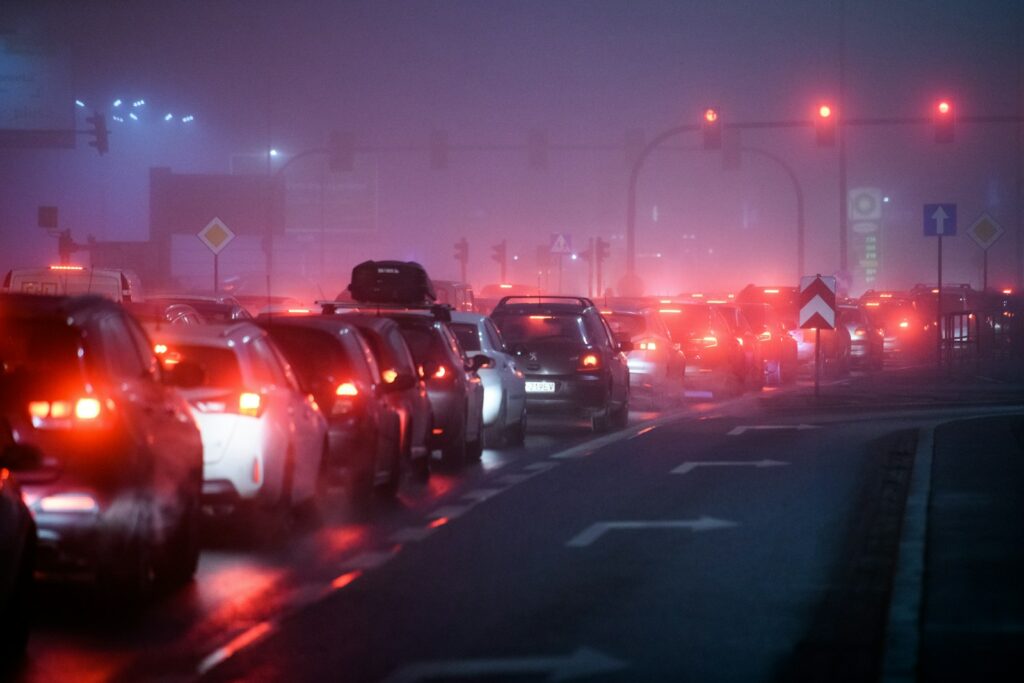
Traffic was responsible for about two-fifths of fine and coarse particle pollution measured at a busy roadside site in Warsaw, according to researchers using a modelling system designed to separate emissions from vehicles, heating and re-suspended road dust.
Ambient air pollution remains the leading environmental cause of premature death in the EU, contributing to around 400,000 deaths each year, the European Commission's Science for Environment Policy news service informed on Thursday.
Most of the EU’s urban population is exposed to particulate matter and nitrogen oxides above recommended thresholds, according to the European Environment Agency.
A research team in Warsaw examined how much the city’s transport sector contributes to local air pollution by combining data on traffic emissions, road dust resuspension — where particles on roads are lifted back into the air by traffic or wind — and residential heating, which the researchers described as Poland’s primary source of air pollutants because fossil fuels including coal are still used.
They also accounted for the “street canyon effect”, where buildings lining both sides of a street can alter local air movement and affect how pollutants disperse.
Models checked against nine monitoring stations
The researchers combined two established air pollution models — ATMO-Street, developed in Belgium to assess street-level pollution, and GEM-AQ, derived from Canada’s weather system service to calculate airborne chemical processes.
They compared their results with measurements from nine monitoring stations in Warsaw, including eight background stations intended to capture city-wide conditions away from major roads and one traffic station designed to measure street-level pollution from transport.
Including street canyon effects and road dust resuspension improved modelling accuracy for PM2.5 and PM10 particulate matter by 34% and 55%, respectively, according to the study. Traffic accounted for 41% of PM2.5 and 42% of PM10 at the traffic station, and vehicles contributed 84% of nitrogen dioxide (NO2) there.
The researchers noted their findings depend on model assumptions and that only one traffic monitoring station was available for comparison, according to the Science for Environment Policy summary.
The work was published as: Sattari, A. et al (2025), “Evaluating traffic-related air pollution in urban areas: A case study of Warsaw using the ATMO-Street model chain”, "Atmospheric Environment."
