
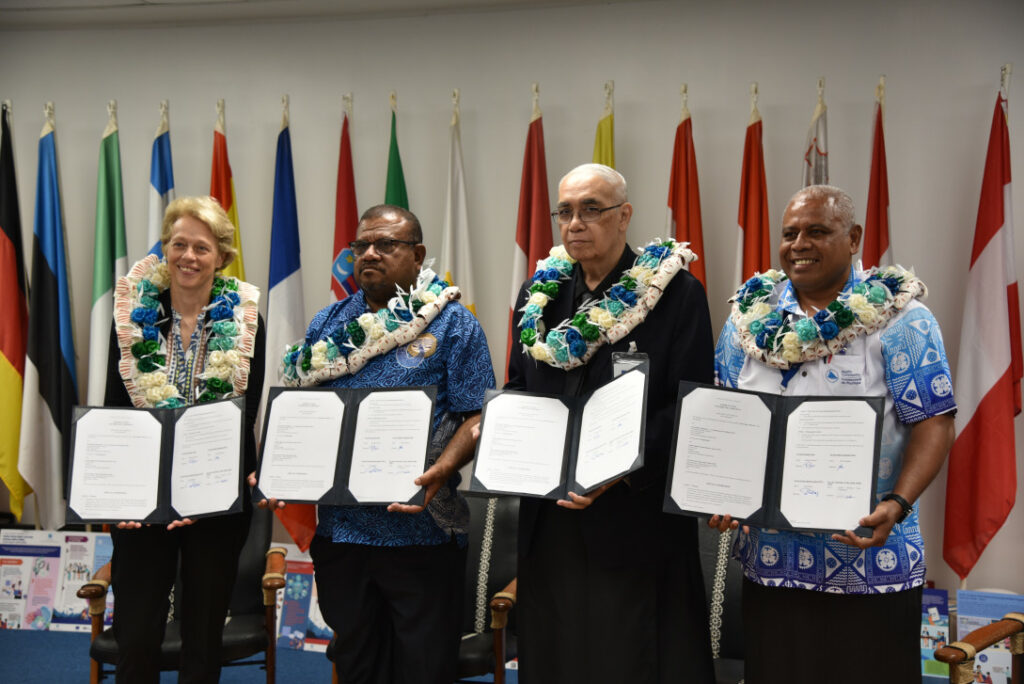
The European Union has signed a new phase of its Pacific – EU Marine Partnership (PEUMP), committing €20 million to ocean and fisheries work across Pacific Island countries and Timor-Leste through to 2030.
Implementation of the programme’s second phase will begin in 2026 and run until 2030, with work coordinated by the Pacific Community (SPC), the Pacific Islands Forum Fisheries Agency (FFA) and the University of the South Pacific (USP), the European External Action Service (EEAS) announced on Friday.
The EU said the funding will support education, research and training, evidence-based policy making, and technical assistance linked to ocean-related challenges in the region.
Work under the programme will include strengthening ocean governance, managing oceanic and coastal fisheries, improving value chains and market access, and tackling Illegal, Unregulated and Unreported (IUU) fishing — fishing that breaks rules, is not reported, or is not properly regulated.
The agreement was signed in Suva, Fiji, and was described as covering “almost 40 countries” across the two regions, EU Ambassador to the Pacific Barbara Plinkert said.
Focus on tuna fisheries and regional training
The FFA Director General, Noan David Pakop, said the second phase would focus on “strengthening value chains”, investing in national industries and developing “innovative monitoring and compliance” for member countries.
SPC Deputy Director for the Educational Quality and Assessment Programme Seci Waqabaca said the programme would address “capacity gaps” and “evolving science” affecting ocean governance.
USP, which the EU said has 12 campuses across the region, will be involved in ocean learning and capacity building through education, research and training.
USP Pro-Chancellor Siosiua Tuitalukua Tupou Utoikamanu said the university would work to strengthen capacity in ocean science, climate adaptation and biodiversity, and improve laboratory and market readiness for fisheries.
The programme will be delivered with the Office of the Pacific Ocean Commissioner (OPOC), national governments, civil society and local communities.
