
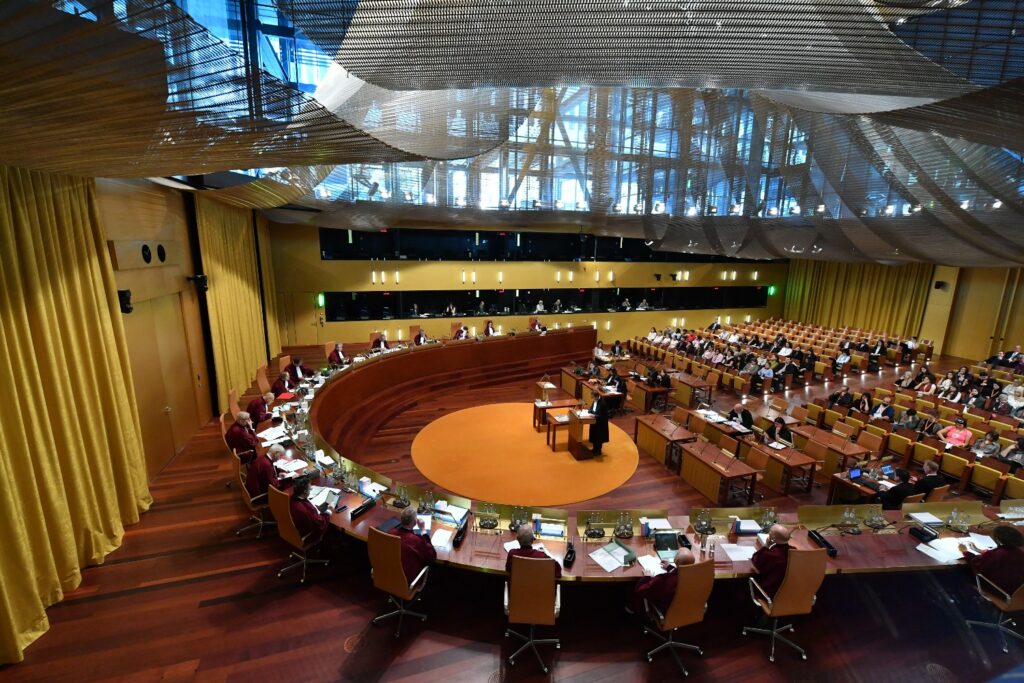
Russia’s central bank has decided to sue the European Union at the EU’s court of justice over frozen assets, but how does the bloc’s top legal apparatus actually work?
The European Court of Justice (ECJ) was established in 1952 to ensure the application of rules under the organisation that would eventually become the EU, the European Coal and Steel Community. It is headquartered in Luxembourg.
Originally just one body, the court was eventually split in two: the Court of Justice interprets EU law, while the General Court handles complaints lodged by citizens and companies. The ECJ was given its current name in 2009 when the Lisbon Treaty was signed.
The most common legal case handled by the court are preliminary rulings, where national courts ask the ECJ to interpret EU law, so that they can ensure it is applied consistently.
Direct actions are also handled by the court, when individuals, companies or organisations – like Russia’s central bank – sue the European institutions. The European Commission can also sue member states when EU law has potentially been breached.
The actual legality of EU law can also be challenged at the court.
Normally, court cases proceed with written arguments, followed by a non-binding opinion prepared by one of the 11 advocates-general and then a ruling by the judges. Decisions are made on a majority basis and unlike, for example, the US supreme court, no dissenting opinions are published.
Cases can be heard by chambers of three or five judges and sometimes a grand chamber of 15 judges can be assembled for particularly complex cases. A full sitting of all the judges is a rare event and would only be necessary for the removal of high-ranking officials like commissioners.
Each of the EU’s 27 members appoints one judge to sit on the Court of Justice and two judges each to sit on the General Court. Judges serve a six-year-long renewable term.
The 11 advocates-general that provide independent non-binding legal advice on cases guide the work of the full court. The five largest EU members, Germany, France, Italy, Spain and Poland, each appoint an AG, while the six other positions are shared on a rotating basis among the 22 other member states.
Before Brexit, the United Kingdom had a permanent AG position as well. In fact its final AG, Eleanor Sharpston sued the European Council and the ECJ itself, claiming that her position could not be terminated ahead of its originally scheduled expiry date just because the UK had ceased to be an EU member.
Sharpston’s case was ultimately dismissed.
The ECJ has ruled on every aspect of EU law over the years. Notable cases include the Schrems rulings, which invalidated the EU’s data transfer agreements with the US, as well as 1964’s Costa ruling, which confirmed that EU law has supremacy over national law.
Recently, the ECJ ruled that same-sex marriages recognised in one member state must be granted the same recognition in another when it comes to residency rights.
In the world of sport, the Bosman ruling, named after Belgian footballer Jean-Marc Bosman, held that professional football transfer rules breached freedom of movement principles.
Currently, the ECJ is working on a number of potentially significant cases, including the Russian central bank’s complaint against the EU’s freezing of assets, the legality of the Mercosur trade agreement and whether Hungary’s national sovereignty law breaches EU rules.
