
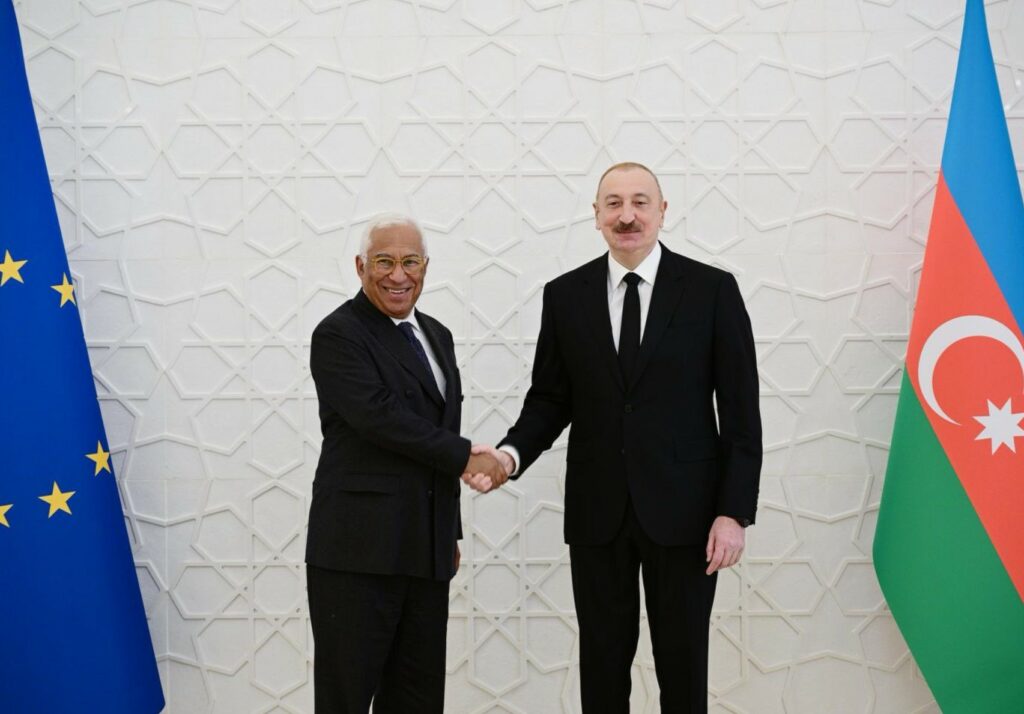
The EU seeks to deepen deepen cooperation with Azerbaijan on energy, transport and security after European Council President António Costa met President Ilham Aliyev in Baku on 11 March 2026.
The two leaders said EU-Azerbaijan relations were based on mutual respect and international law, including the sovereignty and territorial integrity of states, according to a joint statement released by the European External Action Service (EEAS) on Thursday.
They declared said negotiations should be swiftly concluded on a new comprehensive bilateral agreement between the EU and Azerbaijan, alongside renewed “Partnership Priorities” and continued use of existing dialogue formats such as the EU-Azerbaijan Cooperation Council.
Costa and Aliyev welcomed what they called momentum in the Azerbaijan-Armenia peace process, including the outcomes of an 8 August 2025 Washington summit and subsequent steps towards normalising relations between the two countries.
Costa reiterated the EU’s support for efforts by Azerbaijan and Armenia to reach sustainable peace through bilateral dialogue.
Energy and connectivity
Azerbaijan’s role in diversifying Europe’s energy supplies was discussed, with both leaders committing to further implementation of a 2022 EU-Azerbaijan energy partnership memorandum.
They referred to the Southern Gas Corridor — a network of pipelines that carries natural gas from the Caspian region to Europe — and discussed expanding cooperation on renewable energy such as wind and solar, as well as electricity interconnection projects including the planned Black Sea Submarine Cable.
The leaders also described Azerbaijan as a key route for regional links via the “Middle Corridor”, a trade and transport route connecting Europe and Asia, and said they would work together on connectivity under the EU’s Global Gateway investment initiative.
The statement referred to support for railway modernisation in Azerbaijan’s Nakhchivan Autonomous Republic and noted the creation of a High-Level Working Group on Economic Cooperation to strengthen EU-Azerbaijan economic cooperation and investment under Global Gateway.
The two leaders also discussed post-conflict reconstruction in Azerbaijan’s Garabagh and Eastern Zangezur regions and cited landmine contamination as a major challenge, calling for increased international support.
The European Union was described as the leading international donor in humanitarian de-mining.
The joint statement said the leaders also covered security cooperation to address threats including organised crime, terrorism, illicit trafficking, money laundering, human trafficking and irregular migration, and discussed current developments in Iran and Ukraine.
