
At the foreign affairs council meeting on Monday, EU foreign ministers discussed among others the situation in the Middle East, following the outbreak of the war between the US, Israel and Iran. The war has diverted attention from the implementation of the peace plan for Gaza and Russia’s war of aggression against Ukraine.
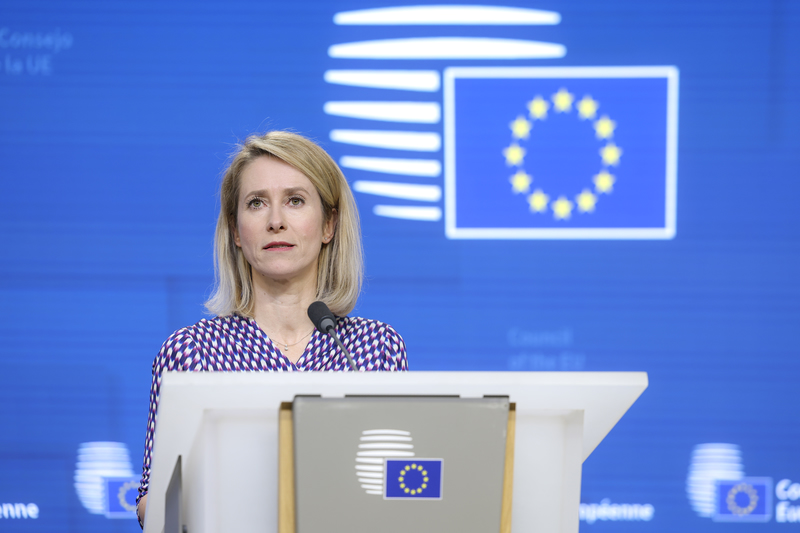
The council meetings end without any formal minutes and the discussions are summarized by Kaja Kallas, EU High Representative for Foreign Affairs and Security Policy, who is chairing the meetings.
Ukraine remains Europe’s top security priority, she said in her remarks. “The same drones that are hitting Kyiv are hitting the states of the Gulf, so as Ukraine has the best drone defences, we also discussed briefly how we can put these things together.” She did not elaborate on how this would be done.
“Iran is now waging war on the global economy,” she said, referring to Iran’s blockade of the strategic Strait of Hormuz, allowing only oil transports to India and China. “What we see right now, in terms of the economic consequences, 20% of the world's energy (oil and gas) goes through the strait.” But also, fertilizers, made of natural gas.
“It is affecting Asia, mostly. It is affecting Asia, but also Africa. If we do not have fertilizers now this year, we will have a famine next year.”
She admitted that restarting the shipments of fertilizers, food and energy through the Strait of Hormuz is an urgent priority. Before the meeting, there were expectations that EU would use its existing maritime mission ‘Aspides’ in the Red Sea to protect the freedom of navigation also in the Persian Gulf and the Strait of Hormuz.
“But for the time being, there was no appetite in changing the mandate of operation Aspides - for now,” she explained. “Nobody wants to go actively in this war.” While the Strait of Hormuz is at the centre stage, the Red Sea also remains critical. The risk that Houthis (an Iran-backed proxy in Yemen) get involved is real. Currently Aspides has not enough naval assets.
“This is not Europe's war, but Europe's interests are directly at stake. As this war expands, the EU’s priority remains the protection of our citizens. We have evacuated more than 30,000 from the region, many on the flights also funded and organised by the EU.”
In the beginning of the war, EU leaders rallied behind by the goals announced by the US and Israel. Kallas issued a statement on behalf of all 27 EU Member States condemning Iran, indirectly justifying the US – Israeli strikes on Iran, repeating the US conditions for a diplomatic solution but stopping short of calling for regime change.
“The EU has consistently urged Iran to end Iran’s nuclear programme, curb its ballistic missile programme, refrain from destabilising activities in the region and in Europe, and to cease the appalling violence and repression against its own people.”
“You will hear different views about whether the conflict in Iran is a war of choice or a war of necessity,” said Commission President Ursula von der Leyen at the EU Ambassadors Conference (9 March). “But I believe this debate partly misses the point. Because Europe must focus on the reality of the situation, to see the world as it actually is today.”
“I want to be clear: There should be no tears shed for the Iranian regime that has inflicted death and imposed repression on its own people.”
But as the war has escalated and expanded to Lebanon and the Gulf States, threating energy supply and rising oil- and gas prices, EU appears to backtrack from its position. “On the military action, the goals of this military action need to be given by those who have started this war,” Kallas said. “Europe is not part of this war. We have not started this war and the political objectives are unclear.”
That said, the EU continues to call for constraint, de-escalation and for diplomatic solutions. Iran’s military infrastructure and internal security forces have been heavily hit. There are cracks in the regime but it has not collapsed and it continues to launch missiles and drones. Regime change must come from within and will not happen any time soon.
There is a feeling of frustration that the diplomatic process before the war was not solid enough, a senior EU official commented before the foreign affairs council meeting. “EU continues to believe in a peaceful solution of all issues with Iran. We are busy in protecting our interests and working for de-escalation. If it will lead to a regime which respects freedom and human rights, so better.”
By now, US President Trump was expected to have declared victory and end the war but he is in no hurry. Israel announces that it is preparing for at least three more weeks of military operations. Iran continues to fire ballistic missiles carrying cluster bombs, in coordination with Hezbollah in Lebanon, against civilian targets.
Iran’s foreign minister Abbas Araghchi, who is considered to be moderate, said recently: “No, we never asked for a ceasefire, and we have never asked even for negotiation. We are ready to defend ourselves as long as it takes.” The survival of the Iranian regime, despite the heavy losses, would probably be seen as the victory that it is fighting by all available means.
In the meantime, Iran’s stockpile of highly enriched uranium has not been found or destroyed. It is buried “under the rubble,” Araghchi said. In a situation where none of the parties seem interested in ending the war and find a solution through negotiations, EU’s calls for a diplomatic solution fall on deaf ears. Kallas did no elaborate on how the EU could contribute to a solution.
As regards Lebanon, she was clear that Hezbollah, an Iranian proxy, had dragged the country into a war that is not its own. “The Lebanese people are paying the price for Hezbollah's attacks. But Israel's heavy-handed response has caused mass displacement, and ground invasion will further deteriorate the situation,” she warned.
Israel has already started a large-scale military operation in southern Lebanon to "remove threats and protect the residents of the Galilee and the north". It can easily spiral out of control, as has happened in the past, without achieving its aim of destroying Hezbollah’s rockets and drones. They are mostly launched north of the Litani river where Hezbollah has not been disarmed.
Even if the war with Iran would suddenly end with the resumption of diplomatic talks, the war with Hezbollah in Lebanon risks to continue. Kallas said that the EU will provide €100 million in humanitarian aid to Lebanon and support the Lebanese Armed Forces to disarm Hezbollah but that is not enough without an urgent ceasefire.
She did not mention the recent French proposal to end the fighting in Lebanon between Israel and Hezbollah. The proposal has reportedly been accepted by the Lebanese government and is still reviewed by Israel. It calls for direct talks between the two countries to solve all outstanding issues, such as political recognition, demarcation of the border, Israeli withdrawal and full disarmament of Hezbollah.
