
Except for a few drones directed at a British air base in Cyprus, Europe remains physically unscathed by the war with Iran. But as a big energy importer, Europe is economically vulnerable to a prolonged conflict in the Gulf.
Amid unprecedented disruption to global oil and gas supplies, it now faces a triple blow of higher energy costs, inflated borrowing costs and increased uncertainty that looks set to push up inflation and depress economic growth. Stagflation beckons.
Dire straits
In the 1970s, two huge oil shocks caused inflation to surge and Europe’s economy to contract.
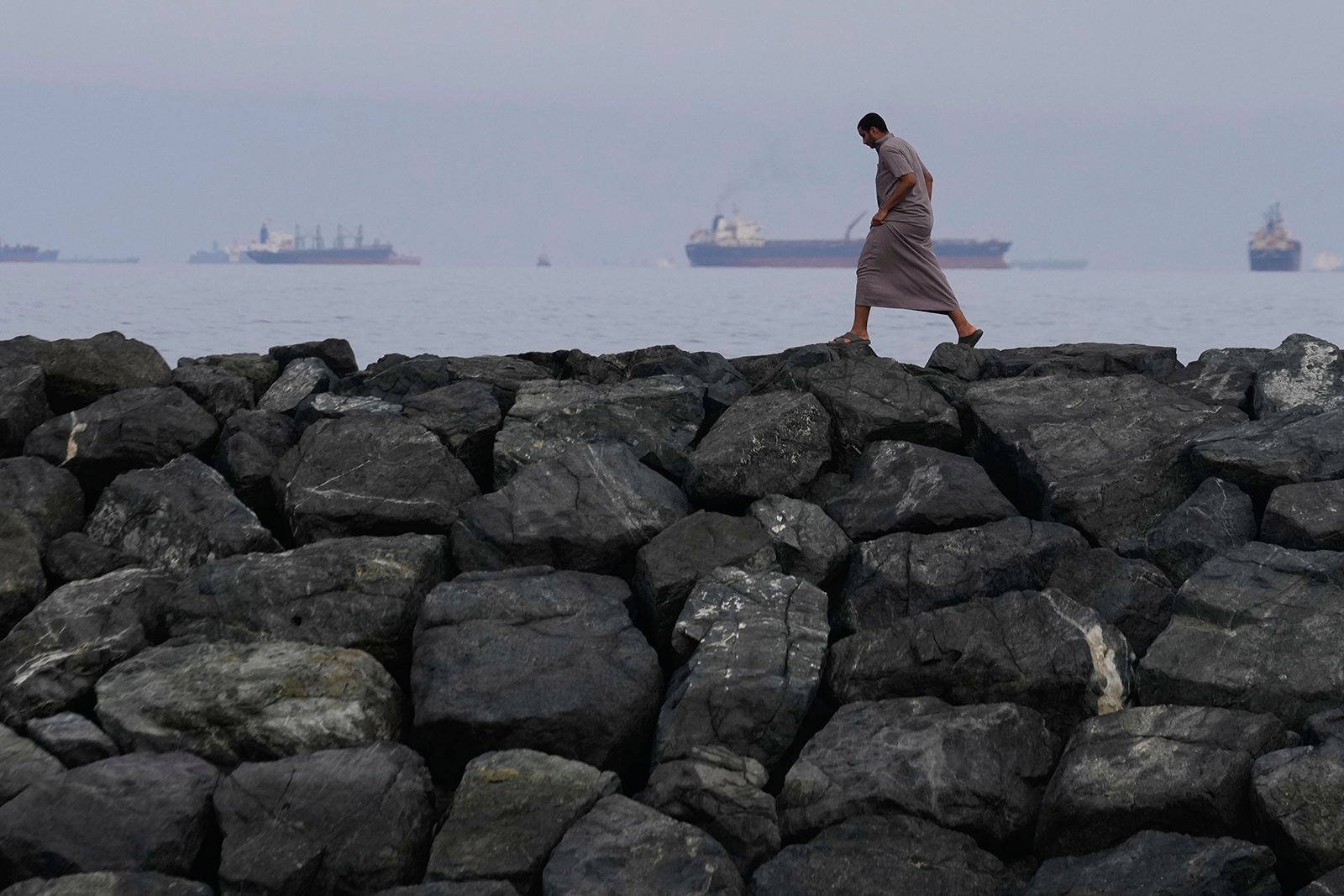
Now, Iran’s chokehold over the passage of oil tankers and other maritime traffic through the narrow Strait of Hormuz that connects the Persian (or Arabian) Gulf to the rest of the world has blocked around 15% of global oil supplies. Alarmingly, this constitutes the “largest supply disruption in the history of the global oil market”, according to the International Energy Agency (IEA).
But so far, oil prices have risen much less than they did in the 1970s. In 1973-74, the Arab oil embargo caused oil prices to nearly quadruple. In 1979, in the aftermath of the Iranian revolution that brought the current Islamic regime to power, they nearly doubled. For now, the price of the Brent benchmark has risen by around 55% since the outbreak of hostilities on 28 February, from around $70 a barrel to $110 (€95) on 20 March.
The main reason for the relatively restrained price response is that markets still expect the war to end soon and its disruption to be contained. Futures markets are pricing a return to $85 oil by the end of the year. But a prolonged and more intensive conflict could see oil prices rise much further.
Both spot and futures prices leapt on 18 March after Israel bombed Iran’s biggest gas field and Iran responded by bombing Qatar’s energy infrastructure and that of its Gulf neighbours.
More extensive attacks on energy infrastructure would not just deepen the short-term supply disruption, they would also prolong it, since repairs may take months – and in some cases years – to be completed. Imagine, for instance, if Iran attacked Saudi Arabia’s massive oilfields with swarms of drones. Some analysts foresee oil prices rising to $150 – or even $200 – a barrel for several months.
Fortunately, Europe is much less reliant on oil than it was 50 years ago. Back then, cars guzzled gasoline, oil was often used to heat homes and generate electricity, and net zero carbon emissions targets didn’t exist. So even if the oil price does rise further and stay high, the negative economic impact would be proportionately smaller than in the 1970s.
But petroleum remains essential for making petrochemicals (including plastics) and fuelling planes, shipping tankers and cars with combustion engines, so it would still be painful. The average price of a litre of diesel in Belgium has already soared from €1.75 to €2.11. The price of jet fuel in Europe has doubled over the past month. Moreover, fuel shortages are more likely the longer the conflict endures.
Gas hike
To make matters worse, Iranian attacks and the closure of the Strait of Hormuz have also disrupted supplies of liquefied natural gas (LNG).
Qatar, the world’s biggest producer, has shut down production, taking out around 20% of global supply. Moreover, the damage to its LNG production facilities is extensive and could take years to fix fully. That affects Europe, which imports around a quarter of global LNG production.
Italy is particularly at risk: it sources 30% of its LNG from the Gulf state; Belgium gets some 8%. But even countries that don’t buy much from Qatar face higher prices because the LNG market is global and Asian buyers are scrambling for scarce supplies. The price of European natural gas futures has already doubled since the start of the war.
Even so, the disruption remains much smaller than in 2022, when Vladimir Putin cut off much of Europe’s natural gas supplies after his invasion of Ukraine, and the EU responded by diversifying away from Russian gas. In 2022 gas prices quadrupled to more than €300 per MWh; now, they are around €60 per MWh. EU gas consumption last year was also 16% lower than the five-year average before the Ukraine war.
Spring is bringing higher temperatures, so there is less immediate need for gas for heating. But gas reserves are low and will need to be restocked before the onset of winter. Gas is also used to make fertiliser, whose supplies have also been disrupted, and which in turn is essential for food production.
More broadly, higher energy and transport prices are set to push up business costs, and thus prices in general, exacerbating the cost-of-living crisis. And that will cut corporate profits and give households less to spend on other things, depressing economic growth.
Higher borrowing costs
Expectations of higher inflation have already pushed up government borrowing costs. The yield on two-year German government bonds has shot up from 2% before the war to 2.63% on 20 March. Ten-year bond yields have also risen sharply, to just under 3%.
Other European governments have experienced slightly larger increases. That entails higher borrowing costs not just for governments, but also for businesses and ultimately households too.
There has also been a huge increase in uncertainty, since nobody knows how long the war will last, how bad it will get and what its wider effects could be. That is causing businesses to pause investments and consumers to hold off on big spending decisions, both of which will also crimp growth. And as a big exporter, Europe is also vulnerable to a global downturn.
Many still assume that the war will be relatively short, because Donald Trump doesn’t want to see a sustained rise in politically sensitive US petrol prices and wider inflation ahead of the midterm Congressional elections in November.
But if the Iranian regime remains resilient and the disruption to energy supplies becomes more extensive, he may yet choose to double down rather than suffer the humiliation of being perceived as a loser. Witness how he threatened to “blow up” all of Iran’s biggest gas field if it bombed Qatar’s again.
Moreover, now that Iran has realised the power that it derives from its stranglehold over the Strait of Hormuz and its ability to damage Gulf energy infrastructure, it may continue to disrupt global energy supplies even if President Trump tries to declare victory and walk away. And in any case, damage to energy infrastructure will take time to repair once hostilities cease.
With such uncertainty, nobody knows how the economic situation will pan out. But for what it’s worth, the European Central Bank (ECB) has sketched out three scenarios for how the eurozone economy may fare.
Its baseline scenario – which already looks outdated – envisages inflation rising to 2.6% and GDP growth slowing to 0.9% this year. In its adverse scenario, inflation peaks at more than 4% in the second half of the year and the economy flatlines in the second and third quarters.
In its severe scenario, inflation exceeds 6% early next year and the economy shrinks in the second and third quarters of this year. In short, the outlook seems grim, and potentially bleak, but not yet catastrophic.
If rising inflation drives the ECB to raise interest rates, the economic gloom could deepen further.
The big question is whether central bankers in Frankfurt will choose to “look through” what they hope is a temporary, one-off rise in inflation, or whether they feel compelled to respond – at least with tougher language but perhaps also by raising rates – to avoid a repeat of the inflation spike in 2022 and an enduring rise in inflation expectations.
The ECB’s key policy rate, the deposit facility rate, is currently 2%. Financial markets are now betting that it will implement three quarter-point rate hikes this year, with the first rise seen next month. But that seems unduly pessimistic. It seems more plausible that the ECB will sit on its hands for now and wait and see, as it did at its policy meeting on 19 March.
Easing the pain
EU leaders also met in Brussels on 19 March to discuss potential measures to ease the economic impact of the energy shock. But unfortunately, their policy options are limited.
One option is further releases of oil from official reserves. On 11 March, the IEA announced that its member countries would release 400 million barrels of oil from their emergency reserves – the largest such move ever. But since the war has knocked out around 20 million barrels a day of global supply, this covers only 20 days’ disruption.
In total, the IEA’s 32 members — which include most EU countries, as well as other Western countries such as the US, Japan, the UK and Norway – hold emergency stockpiles of over 1.2 billion barrels, with a further 600 million barrels of industry stocks held under government obligation. Overall, then, these could offset 90 days of disruption at current levels.
Another option to boost global oil supplies would be to lift sanctions on Russia, as Trump has done temporarily. But given the war in Ukraine and the threat to the rest of Europe that Putin’s regime poses, this would be short-sighted for the EU, and has been roundly rejected.
In addition to boosting supply, another option is to curb demand. While higher prices change behaviour, industry and households can also actively seek to economise on oil and gas, as they did in the aftermath of the invasion of Ukraine in 2022.
Buying an electric vehicle, swapping a gas boiler for a heat pump, installing solar panels, or simply turning down the heating and driving less – for instance, by working from home – would all make a difference.
EU governments could also intervene to hold down energy prices, through subsidies and tax cuts, as they did in 2022. While such measures can ease the pain, they can be counterproductive if they deter energy users from cutting consumption.
The European Commission has been tasked with developing a toolbox for governments keen to pursue such measures. But most cost money, and many EU governments have limited fiscal firepower.
Debt is very high in France, Italy and Belgium, while Germany is already splurging on defence and infrastructure. Against a backdrop of rising borrowing costs, generous subsidies and tax cuts could prove prohibitively costly, so support is more likely to be small and targeted.
Italy has been boldest so far, cutting fuel duties by 25 cents per litre for an initial 20 days. France has enacted more limited measures to help the likes of truck drivers and nurses
Some governments are also calling for the EU to cut energy costs by suspending its emissions trading scheme (ETS), which seeks to curb industry’s carbon emissions by putting a tradable price on them. But the Commission is resisting, arguing that this would be short-sighted. EU leaders have ruled out suspending the ETS for now, but they have agreed to review it by the summer instead.
Energy insecurity
With luck, the Iran war will soon be over and the economic harm will be limited. But unfortunately, it may turn out much worse, and there is little EU policymakers can do to ease the short-term pain.
Looking forward, the war in the Gulf is yet another reminder of Europe’s vulnerabilities. Trump attacked Iran without consulting Europeans, yet they are now paying a price for his unilateral decision. And just as Trump’s tariff war confirmed that China’s chokehold over rare-earth minerals critical to industrial production enabled it to harm not just Trump but also Europe, so his Iran war has revealed that Tehran’s stranglehold over the Strait of Hormuz gives it global leverage too.
So, while the talk in Brussels recently has been of slowing the climate transition to boost European competitiveness, the war in the Gulf is actually a reason to accelerate it in order to enhance longer-term energy security. Once wind, solar, hydro and nuclear power infrastructure is built, their electricity production – and the electric cars, heat pumps and other machines they power – is not reliant on events in the Middle East or the rest of the world.
Two EU countries are leading the way. France generates most of its electricity from nuclear power, while Spain has a nuclear baseload with a huge renewables sector. As a result, both face a much smaller uptick in electricity prices this year than most. In Italy, where gas still plays a larger role in marginal electricity generation, prices are forecast to be double those in Spain this year.
The conclusion is clear: Europe’s future energy security and business competitiveness both depend on shifting to locally produced clean energy.
