
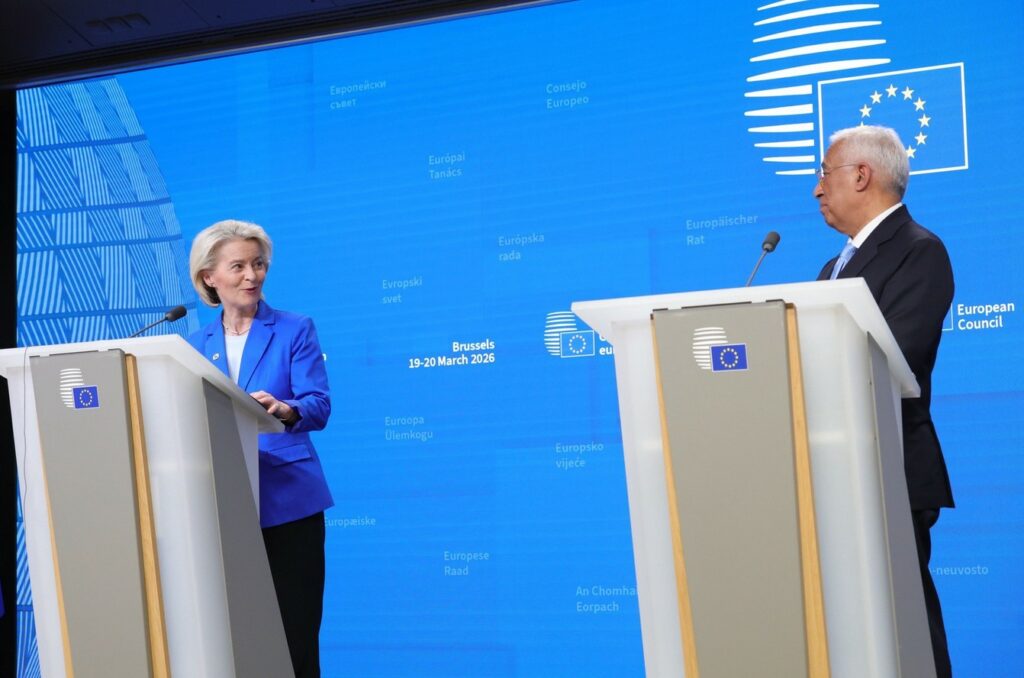
European Commission President Ursula von der Leyen said EU leaders had discussed the escalating conflict in the Middle East, warning of risks spreading beyond the region, after a European Council meeting in March 2026.
She called for de-escalation, “maximum restraint” and the protection of civilians and civilian infrastructure, according to her statement after the meeting, cited by the Commission press service.
The European Commission announced more than €450 million in humanitarian assistance for the region this week, she added.
Von der Leyen noted the EU had so far not seen migration flows towards Europe linked to the crisis, but that member states should be prepared.
The EU would not allow “a repeat of 2015”, she said, citing stronger external borders, stronger EU agencies and the bloc’s Migration and Asylum Pact — the EU’s updated framework for handling asylum and migration.
She also referred to Cyprus, saying it had been “directly impacted” by the war and that the security of Cyprus “as of any Member State” was the security of the European Union.
She said she planned to attend an informal European Council meeting in Cyprus in April.
Energy price swings and electricity bills
The war’s most immediate impact on Europe was on energy, with the EU’s physical security of supply currently “secure” but still exposed to global price spikes, von der Leyen said.
Gas prices rose by 30% “today” after attacks on Qatari gas infrastructure, she said, describing attacks on infrastructure and unarmed commercial vessels as raising costs and creating supply concerns.
The Commission head outlined a plan discussed by leaders that she said would be “temporary and targeted”, focusing on four elements that determine electricity prices: energy costs, grid charges, taxes and levies, and carbon pricing.
Energy costs make up 56% of electricity prices on average across the EU, she said, adding that member states can use state aid to compensate for increases and that the Commission would further relax state-aid rules for this purpose.
Grid charges account for an average 18%, and the Commission will prepare a legal proposal to improve the productivity of grid infrastructure and allow countries to reduce grid charges for energy-intensive industries.
Taxes and levies account for about 15% on average, with wide variation between countries, von der Leyen added, saying electricity is taxed much more than gas in some member states — “partially up to 15 times more”.
The Commission will propose mandating lower tax rates on electricity and ensuring it is taxed less than fossil fuels, she said.
On carbon pricing, she stated the EU’s Emissions Trading System (ETS) — the bloc’s cap-and-trade market for CO2 allowances — was “working” and would be modernised to be more flexible.
Planned steps include updating benchmarks for free allocations, increasing the capacity of the Market Stability Reserve to reduce price volatility, and working on a wider ETS review.
Von der Leyen also proposed what she called an “ETS Investment Booster” with a €30 billion budget financed by 400 million ETS allowances to support decarbonisation projects, with a “first come, first serve” approach and guaranteed access for lower-income member states.
On competitiveness, she said the Commission would introduce a “simplicity by design” approach for future rules and described efforts to reduce fragmentation in the Single Market.
Von der Leyen noted a draft of revised EU merger guidelines would be presented in April, and that the Commission would bring forward a banking report to the summer.
She added the Commission would soon present a “One Europe, One Market” roadmap with legislative measures and a timeline running to the end of 2027, with the intention of agreeing it with the Council and European Parliament and presenting it at the informal summit in Cyprus in April.
She also addressed a planned €90 billion EU support loan for Ukraine, saying the European Council agreed the decision in December subject to a condition that three countries would not take part, and that the condition had been met.
The loan remains blocked because “one leader is not honouring his word”, she said, adding: “We will deliver — one way or the other.”
