
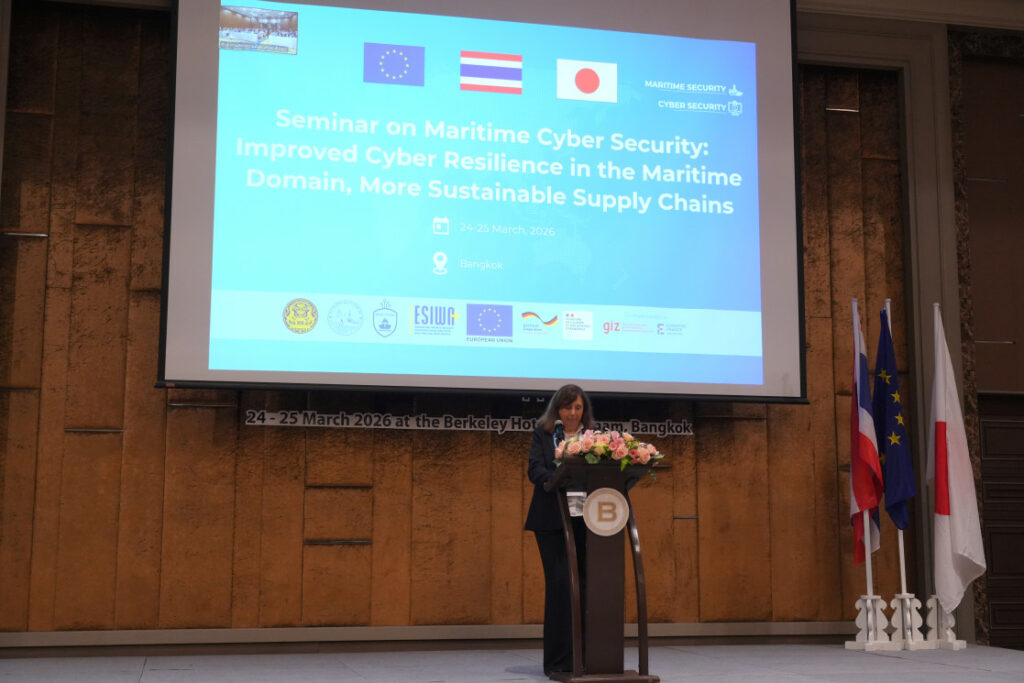
EU, Thai and Japanese maritime and cyber security experts met in Bangkok on 25 March to discuss strengthening cyber resilience in maritime supply chains.
The two-day seminar focused on cyber security risks across the maritime ecosystem, including harbours, ships, ports and navigation systems, the European External Action Service announced on Wednesday.
About 140 participants attended, with speakers from Asian and European ministries, agencies and academic institutions.
Delegations from Indonesia, Malaysia, the Philippines, Singapore and Vietnam joined Thailand at the event.
The seminar was co-organised by the EU, Thailand’s Office of the National Security Council and Japan, with support from the Port Authority of Thailand, the EU-backed ESIWA+ project and Romania-based Maritime Cybersecurity Centre of Excellence (MARCYSCOE).
Participants discussed the impact of cyber threats on maritime infrastructure and commercial vessels, reviewed responses to cyber incidents and called for greater collaboration among stakeholders.
Comments from EU, Thailand and Japan
“Maritime cyber security has gained strategic importance for both the EU and its partners in the region,” said Paola Pampaloni, Deputy Managing Director for Asia and the Pacific at the European External Action Service.
The seminar followed a first joint EU–Thailand–Japan event on the Law of the Sea held in March 2025, said Ruchakorn Napapornpipat, Deputy Secretary-General of Thailand’s National Security Council.
Japan is determined to enhance cooperation with the EU in areas including maritime security, space, cyber security and hybrid threats, including foreign information manipulation and interference, said Otaka Masato, Japan’s ambassador to Thailand.
The EU is currently running two naval operations — Atalanta and Aspides — in the North-West Indian Ocean and the Red Sea.
