
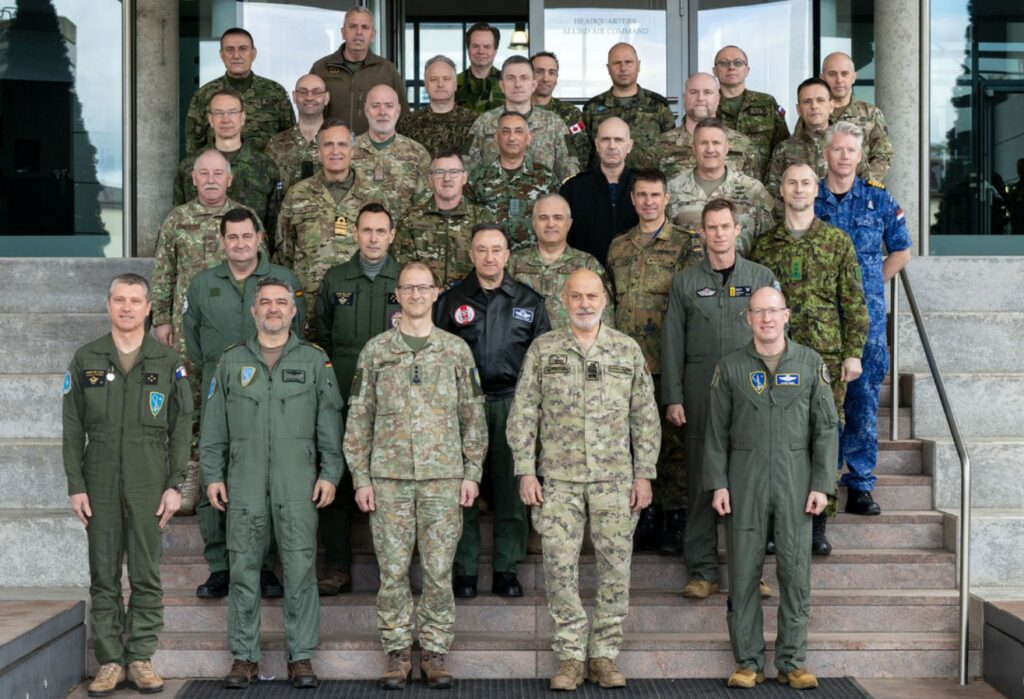
NATO officials have highlighted eastern flank readiness as the alliance is seeking to boost its "no nation alone" commitment.
NATO’s Military Committee visited the alliance’s Allied Air Command headquarters in Ramstein and its Airborne Early Warning and Control Force base in Geilenkirchen, Germany, from 25 to 27 March, the alliance press service informed.
The committee received briefings on Allied Air Command’s role in securing NATO airspace across the alliance, with a focus on the eastern flank.
Officials discussed NATO’s Integrated Air and Missile Defence framework — which NATO said includes Air Policing, Ballistic Missile Defence and vigilance activities such as “Eastern Sentry” — as well as Agile Combat Employment, a concept for dispersing and sustaining air operations to improve survivability and resilience.
Admiral Giuseppe Cavo Dragone, chairman of the NATO Military Committee, said initiatives including Eastern Sentry were strengthening operational bonds among allies and that “no nation will be left to stand alone.”
Lieutenant General Jason T. Hinds, commander of Allied Air Command, said the command would continue to “leverage national capabilities” through daily missions, operations and training to address current and future threats.
Focus on airborne surveillance operations
The visit ended at Geilenkirchen, where the committee was updated on current air operations including enhanced vigilance activities along the eastern flank and a deployment to Konya, Turkey, NATO said.
Discussions also covered future airborne early warning capabilities and plans to replace the current E-3A fleet — large radar aircraft used to detect and track activity in the air.
Major General Andreas Korb, commander of the Airborne Early Warning and Control Force, said the unit’s role was “strategic” amid an increased operational tempo.
On the return to Brussels, Cavo Dragone said “mutual trust, cohesion and reliability among Allies” underpinned collective resilience and that combat aircraft effectiveness depended on integration across multiple domains.
