
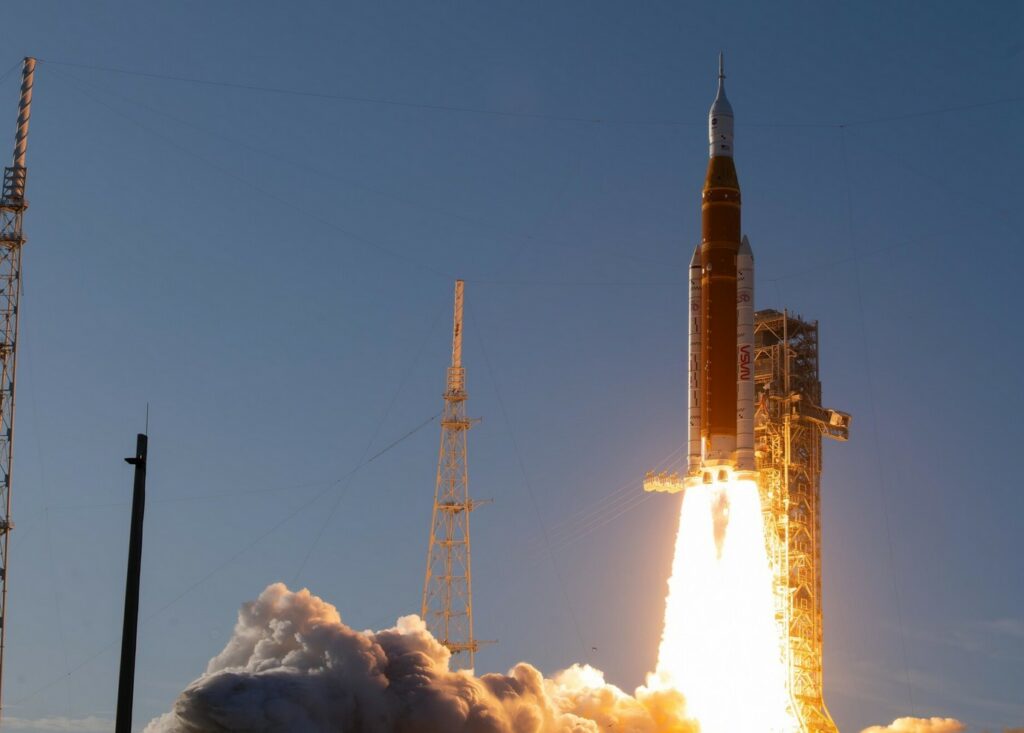
NASA’s Space Launch System rocket lifted off from the Kennedy Space Center in Florida at 00:35 CEST on 2 April, sending four astronauts into space aboard the Orion spacecraft for the Artemis II mission, with Europe playing a vital role.
The launch is the first crewed flight of NASA’s Artemis programme and the first time humans have travelled towards the Moon in more than 50 years, the European Space Agency (ESA) noted in a release on Thursday.
Europe is contributing a key part of the spacecraft — the European Service Module, built for ESA — which provides power, propulsion and life-support supplies for Orion during the mission, according to the statement.
The module supplies air and water for the astronauts, generates electricity using four solar arrays, helps regulate temperature, and provides propulsion for manoeuvres in deep space.
The European Service Module was assembled by Airbus in Bremen, Germany, with contributions from 13 ESA member states, involving 20 main contractors and more than 100 European suppliers.
A 10-day flight around the Moon
Artemis II is a 10-day lunar flyby mission by NASA astronauts Reid Wiseman, Victor Glover and Christina Koch, alongside Canadian Space Agency (CSA) astronaut Jeremy Hansen, the ESA statement said.
The mission is due to end with a splashdown in the Pacific Ocean off the coast of California, after which the European Service Module will separate from Orion and burn up in the atmosphere shortly before the crew capsule re-enters.
ESA said the European Service Module has three sets of engines: one main engine for major changes in speed, eight auxiliary engines for course corrections and backup, and 24 smaller thrusters used to rotate and orient the spacecraft.
European engineers will support the mission around the clock from ESA’s technical centre ESTEC in the Netherlands, as well as from NASA’s Johnson Space Center in Houston and the European Astronaut Centre in Germany.
