
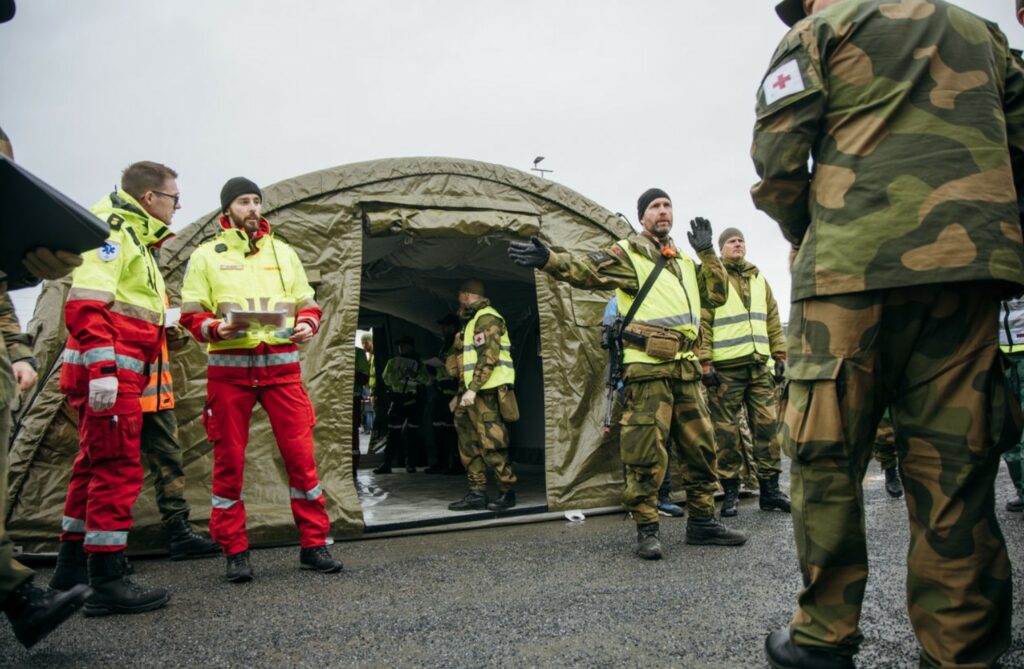
NATO allies carried out a series of winter military medical exercises in Norway and Germany to test how armed forces and civilian services would deliver care and move large numbers of casualties during a crisis or conflict.
The drills were designed to strengthen “medical resilience” — the ability of health systems and military medical services to keep operating under pressure — and to improve coordination between civilian and military responders, NATO announced on Tuesday.
Brigadier General Petter Iversen, chair of NATO’s Committee of Chiefs of Military Medical Services (COMEDS), said medical support “is not an add-on to operations, but a core element of Allied deterrence and defence.”
COMEDS is NATO’s senior military medical body on military medical matters.
Iversen said militaries and civilian services were training together “to save lives in the most demanding conditions.”
He also cited lessons from Russia’s war against Ukraine, saying “full-scale war takes an immense toll on the health of both military forces and civilian populations.”
Exercises tested evacuation and cross-border casualty movement
In Cold Response, an Arctic-based exercise in Norway, civilian and military participants practised large-scale wartime health preparedness by moving wounded personnel over long distances and across borders, from the High North to hospitals at home and abroad, NATO said.
The activities included live training and virtual elements.
Medic Quadriga 26 in Germany focused on the full medical evacuation chain — from the front line to strategic aeromedical evacuation, meaning transport of patients by aircraft — and was closely coordinated with civilian health providers.
A third exercise, Casualty Move (CAMO) 26, was led by the Multinational Medical Coordination Centre – Europe (MMCC-E) and trained teams to manage “massive patient flow”, medical command and control, and civil–military coordination in a major crisis or conflict.
The main training location was in Germany, with additional “reach back” cells in different countries.
