
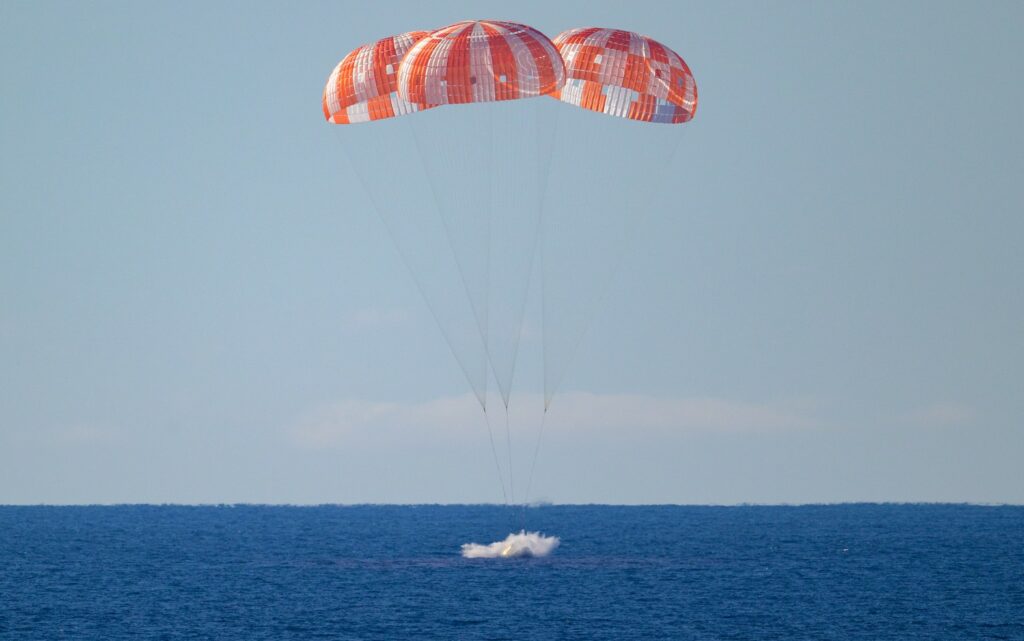
NASA’s Orion spacecraft splashed down safely in the Pacific Ocean at 17:07 local time on 10 April, ending the Artemis II mission after a crewed flight around the Moon and back.
The mission took four astronauts around the Moon for the first time since Apollo 17 in 1972, the European Space Agency (ESA) stressed in a release on Saturday.
Orion was powered in space by ESA’s European Service Module, which supplied air and drinking water, generated electricity using four solar arrays, controlled the spacecraft’s temperature and provided propulsion over more than 1 million kilometres of travel.
The European Service Module was mostly built by European industry under ESA leadership and assembled by Airbus Defence and Space in Bremen, Germany, with contributions from companies across 13 European countries, involving 20 main contractors and more than 100 suppliers.
Engineers supported the mission around the clock from ESA’s technical centre ESTEC in the Netherlands, NASA’s Johnson Space Center in Houston and ESA’s European Astronaut Centre in Germany.
Key burns and a lunar flyby
NASA’s Space Launch System rocket lifted off from the Kennedy Space Center in Florida at 00:35 CEST on 2 April, carrying the crew aboard Orion, according to ESA.
The European Service Module’s solar arrays unfurled about 20 minutes after launch, and around three hours into the mission Orion separated from the rocket’s upper stage, with the astronauts taking manual control to practise manoeuvres using the module’s engines.
On flight day 2, mission control authorised a trans-lunar injection — a main-engine burn that sends a spacecraft from Earth orbit towards the Moon — which lasted 350 seconds and placed Orion on a free-return trajectory that loops around the Moon and heads back to Earth.
Two of three planned trajectory correction burns on the way to the Moon were cancelled because the initial burn was so precise.
The crew flew past the Moon on 6 April, breaking the Apollo 13 record for the farthest distance from Earth.
On the final day of the mission, the crew module separated from the European Service Module at 00:33 BST on 11 April, before re-entering Earth’s atmosphere about 20 minutes later and splashing down minutes after that.
The European Service Module burned up harmlessly in Earth’s atmosphere.
