
Local and regional leaders from across the EU’s eastern flank met in Elbląg, Poland, on 10 April to discuss security, public services and economic pressures in communities along the EU’s land border with Russia.
The European Committee of the Regions (CoR) held an external seminar of its CIVEX commission, which covers citizenship, governance and external relations, to review conditions along the EU-Russia border and to discuss how authorities can strengthen preparedness, resilience and cohesion in border areas, CoR informed on Friday night.
Participants included CoR members, elected representatives from regions and cities, and experts.
Discussions focused on concerns shared by border regions in Finland, Estonia, Latvia, Lithuania and Poland, including cyber-attacks, disinformation and the instrumentalisation of migration.
The seminar also looked at civil protection, crisis communication and maintaining essential public services under heightened security constraints.
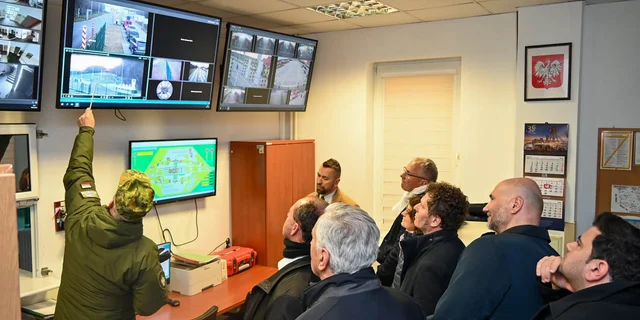
Attendees visited the municipality of Braniewo near the Poland-Kaliningrad border and the Grzechotki-Mamonowo border crossing, where local leaders described day-to-day challenges including economic decline and depopulation.
A 2,500 km border and disrupted cross-border links
The EU shares an approximately 2,500 km land border with Russia, running along Finland, Estonia, Latvia, Lithuania and Poland, including the Russian enclave of Kaliningrad, according to the CoR.
It said that since 2022 border areas have faced reduced cross-border mobility and increased exposure to hybrid threats — a term used for a mix of tactics such as cyber-attacks, disinformation and other disruptive actions.
Marcin Kuchciński, President of Poland’s Warmińsko-Mazurskie Region, said the seminar in Elbląg — about 50 km from the Polish-Russian border — was intended to convey the “specific challenges” facing communities “from Lapland to the Black Sea”, including a need for new support mechanisms.
Dovydas Kaminskas, Mayor of Tauragė District Municipality in Lithuania, said cyber-attacks, disinformation, propaganda, “weaponised migration” and air incursions were creating fear and reducing trust in democracy, and called for incentives for businesses, investment in public services and new opportunities for citizens so people could “stay and live in their region”.
Jacek Protas, a Polish Member of the European Parliament, said decisions had already been made on new instruments and special support for eastern regions to address what he called an “extremely challenging situation”.
The CoR said it is preparing further work on eastern border regions, including an upcoming opinion on a European Commission communication covering the EU’s eastern border regions.
