
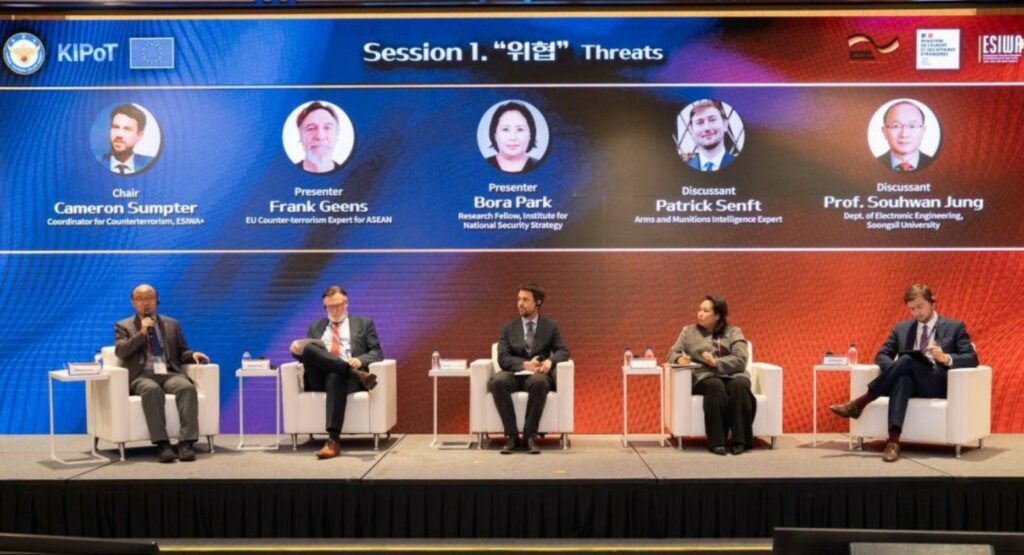
South Korea’s Korean National Police Agency hosted its 5th International Counter-Terrorism Symposium in Incheon on 8 April, drawing about 150 security practitioners, policymakers and experts from more than 20 countries.
The event was organised in partnership with the EU and focused on “The Dual Nature of Technology in the AI Era: Future Terrorist Threats and Prevention Strategies”, the European External Action Service (EEAS) informed in a statement.
Former UN Secretary-General Ban Ki-moon told attendees he was “confident” the discussions would “sharpen the global strategic response” to terrorist threats and said international solidarity “must be faster — and stronger” than technological change.
Roland Honekamp, Deputy Head of Mission of the EU Delegation to the Republic of Korea, said security challenges “cannot be addressed in isolation” and require cooperation “across borders, institutions, and disciplines.”
Focus on AI, 3D-printed weapons and online extremism
Sessions examined how artificial intelligence and other emerging technologies could be exploited by terrorists, alongside policy and technical approaches to prevention and response, the EEAS said.
Topics included AI-assisted terrorism, the use of AI and quantum technologies in detecting chemical threats, and the growing accessibility of 3D-printed weapons, according to the statement. Discussions also covered how AI is affecting extremist content online.
The EU said it contributed through ESIWA+ — a project supporting EU security cooperation in Asia and the Indo-Pacific — including a presentation on 3D-printed weapons by the EU’s Counterterrorism Expert to ASEAN, Frank Geens, and input on online extremist content from a senior Europol specialist.
The symposium formed part of wider EU–Republic of Korea cooperation on counterterrorism under the EU-ROK Security and Defence Partnership signed in November 2024.
