
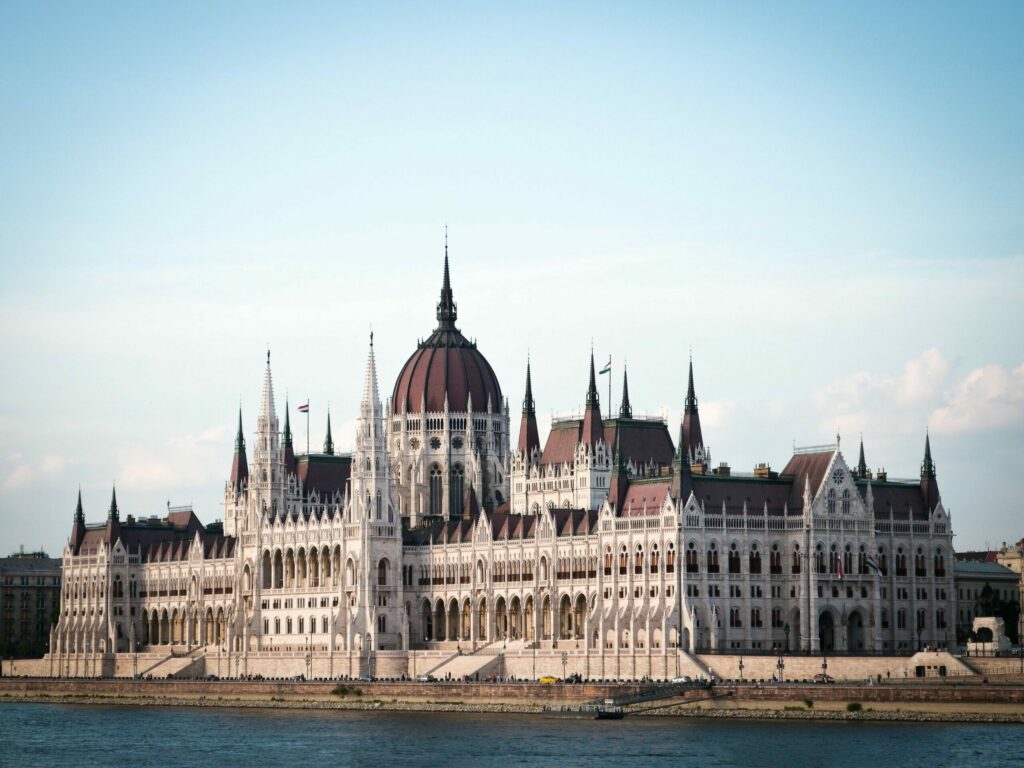
The parliamentary elections last Sunday saw active citizen engagement but there was no level playing field, with the ruling party benefitting from systemic advantages that blurred the line between state and party, according to the preliminary findings of elections observers.
The OSCE Office for Democratic Institutions and Human Rights (ODIHR) sent an election observation mission to Hungary ahead of the election day, following an invitation from the national authorities, to promote confidence in the electoral process. A similar mission was deployed during Hungary's previous parliamentary elections in 2022.
The record voter turnout, close to 80%, brought the newly formed opposition party, Respect and Freedom Party (Tisza), led by Peter Magyar, to power. As the opinion polls had predicted, Magyar won a landslide victory with 54.4% of the votes over the governing party Fidesz, led by Prime Minister Viktor Orbán with 37,8 %. Orbán conceded defeat and congratulated Magyar within hours of the closing of the polls.
In fact, the election resulted in peaceful "regime change" from within in Hungary. Orbán, who has been in power since 2010, had most of the time been ruling with a ‘supermajority’ of two thirds of the 199 seats in the parliament. This enabled him to transform Hungary to an “illiberal democracy”. Now Magyar gained the supermajority and will be able to amend the constitution and undo Orbán’s legislation.
“There was an active and highly visible campaign, and candidates were able to campaign freely, but the framework for the elections does not ensure a fair basis for contestants,” said Eoghan Murphy, Head of the Election Observers Mission.
“For example, our monitoring showed that the ruling party greatly benefitted from the misuse of government messaging to amplify campaign messages, the removal of spending limits, significant increases in public funding for parliamentary groups prior to the election – funding which can be used in the campaign – all further distorting the playing field.”
"I was impressed by the spirited citizen engagement we have witnessed in these elections. It is a testament to the voters that the ruling party’s divisive and inflammatory rhetoric and misuse of office did not stop them voting in record high numbers,” said Sargis Khandanyan, the OSCE Special Co-ordinator and leader of the short-term observers.
Polarised election campaign
While the campaign was active and highly visible, both online and across the country, the ruling party’s divisive messaging on Ukraine and the EU institutions dominated the highly polarised campaign discourse with domestic issue-based policies receiving less prominence.
According to a preliminary statement released by the international observers on Monday, the authorities’ failed to adequately address public and stakeholders’ concerns regarding foreign interference. Referring among others to US Vice-President JD Vance, who visited Budapest last week, several foreign leaders came out in support of Orbán but that did not help him.
As in the previous elections, there was no level playing field, with the ruling party benefitting from systemic advantages that blurred the line between state and party. The legal framework underwent a series of mainly technical and procedural changes since the last elections but continues to fall short of OSCE commitments and other international standards for democratic elections.
The previous report included a list of 30 recommendations on what Hungary needed do to to bring the conduct of elections in line with commitments made by all countries belonging to the Organisation for Security and Co-operation in Europe (OSCE) and standards for democratic elections.
Recommendations not implemented
However, recent amendments did not address a number of previous recommendations, including on suffrage rights, electoral boundary delimitation, preventing the misuse of administrative resources and the blurring of state and party functions, the independence of public service media, transparency of campaign finance, the right to seek effective legal remedy, and citizen observation.
The members of parliament are elected under a mixed system of single-member constituencies by first-past-the-post voting and closed candidate lists in a nationwide proportional contest with varying thresholds. The boundaries of the single-member constituencies have been redrawn (‘gerrymandering’), benefitting the government party.
In addition, there are national minority lists that need one fourth of the electoral quotient for one member to be elected. Those who register for voting for these lists cannot vote in the nationwide party lists. According to a 2022 European Court of Human Rights ruling, it violates the right to free elections and is discriminatory, especially against the Roma minority which accounts for 8 % of the population.
On-line election manipulation
Despite a roundtable organised by the European Commission ahead of the elections on how to prevent disinformation and election manipulation on social media, the election observers noted with concern the use of generative AI and manipulative content for purposes of domestic disinformation and to discredit political opponents.
Multiple AI-generated videos by political actors circulated on social media before and during the official campaign period, including related to alleged plans by Tisza to raise taxes or to reintroduce military conscription once in power. This reinforced the highly polarized nature of the campaign discourse, including fear-mongering narrative around possible opposition victory.
Online campaigning is insufficiently regulated by domestic legislation, although the EU’s Digital Services Act (DSA) does apply to online activity more broadly.
The observers wrote that authorities and parties have made virtually no efforts to enhance women’s political participation, resulting in their significant underrepresentation, with only 15.6 % of seats in the outgoing parliament and no minister in the current government. Less than one quarter of candidates were women. With few exceptions, women did not feature prominently in the campaign.
Systemic gaps in the campaign finance legislative framework, coupled with limited oversight resulting from regulatory shortcomings, significantly weakened transparency and accountability and did not ensure the equality of opportunity for contestants. Recent amendments removed spending limits, in favour of the ruling party.
The election observers focused on the overall election process and are not expected to judge if the elections were "free and fair". A spokesperson of the European Commission declined to comment on the preliminary report. The conduct and organisation of national elections is a competency of the Member States.
Unlocking of EU funds
The new government led by Peter Magyar is expected to be installed by mid-May. His election programme was “anti-Orbán” and vague on concrete measures but he has already announced that the intends to limit the mandate period of Prime Ministers to two periods. The Commission expects him to withdraw Hungary’s opposition to supporting Ukraine.
Peter Magyar wrote on Facebook that he had a call with European Commission President von der Leyen on Tuesday. “We agreed that unlocking the EU funds earmarked for the Hungarian people but frozen due to the previous government’s corruption is the top priority. The Hungarian government will take the key political decisions on how to unlock and invest these funds.”
Hungary is waiting for receiving billions in EU financial assistance which until now has been suspended because of rule of law concerns (conditionality mechanism, cohesion fund) and missing milestones (Covid recovery fund). The Commission is prepared to start paying part of the assistance by the end of June provided that the new government will cancel previous legislation and file revised paying requests in time (by August).
“From political complacency to a disconnect from a new generation of voters, it’s essential to learn the lessons of this moment and for all patriots to fight for the ideas that bind us together,” commented Frank Furedi, Executive Director of MCC Brussels, a conservative think tank linked to the Orbán government. “We will continue to fight for free speech, against EU overreach and for patriotic values.”
