
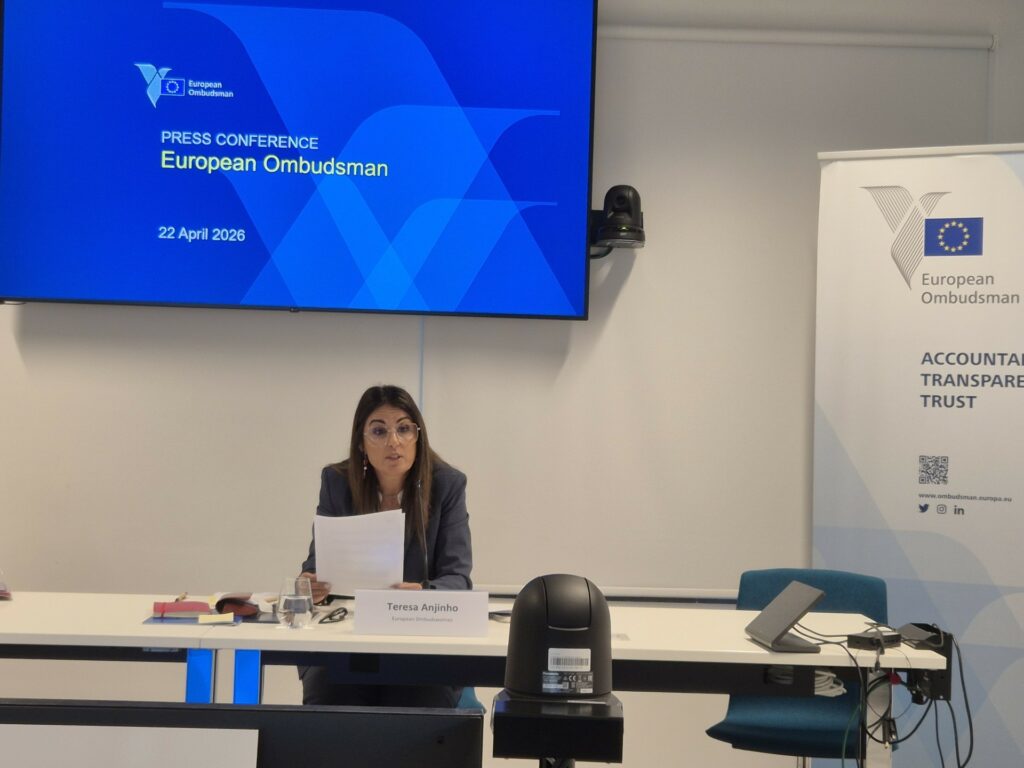
During her first year as European Ombudsman, Teresa Anjinho was confronted with a record number of complaints, according to the 2025 annual report published last week.
The European Ombudsman oversees good administration across all European Union institutions, bodies, offices, and agencies. “I took up this role just over a year ago with high expectations - both for the office and for the EU administration,” Anjinho, a Portuguese national, told journalists in Brussels. “Public administration must be open, transparent, and accountable.”
She brought a wealth of experience to the Ombudsman Office. With a background as a lawyer and human rights expert, she has held the positions of Deputy Ombudsperson, Secretary of State for Justice, and Member of Parliament in Portugal. She has also served as a Member of the Supervisory Committee of the European Anti-Fraud Office (OLAF)
The core of the European Ombudsman Office is to investigate complaints by EU citizens and residents against the European Commission and the other EU institutions. Complainants are individual citizens, civil society organisations, businesses, academics and, regularly, journalists.
The annual report shows that the office registered around 3,500 complaints in 2025, an increase by 54% compared to the previous year. According to the Ombudsman, this was partially due to complainants learning about the Ombudsman’s existence through the use of AI tools. They also used AI to help formulate complaints.
While greater public awareness about citizens’ rights is positive, the surge in complaints puts a significant strain on the Office’s scarce resources. With an annual budget of €15,5 million, the Ombudsman Office has a workforce of 75 staff and a small number of trainees.
The Ombudsman Office has taken some steps toward technical AI use in 2025. A dedicated AI officer was recruited to provide specialist oversight. It also launched a pilot project to test the use of AI for routine tasks. The Ombudsman is adamant that AI should not play any role in decision-making or the assessment of the admissibility of complaints.
Has the office asked for more resources, considering the workload and pressure? “My office needs an adequate budget to protect our independence and empower us to fulfil our mission effectively,” she replied. “I am hopeful that the budget negotiators will recognise that investing in this office is akin to investing in a strong EU administration and therefore a strong European democracy.”
Admissibility test
The increase in new inquiries in 2025 was much less (19%) because the majority of complaints did not fall within the Ombudsman’s mandate and were deemed not admissible. Cases that concern the implementation of EU law in EU Member States are referred to the Ombudsman institutions in those countries. As regards specific EU legislation, complainants are advised to turn to the European Parliament’s Committee on Petitions.
The annual report shows the national origin of registered complaints and inquiries opened. Spain (455 complaints), Germany (351), Belgium (245) and Poland (233) accounted for most complaints with varying admissibility percentages (outside the Ombudsman’s mandate).
As in previous years, inquiries related to accountability and transparency – including access to document requests – accounted for the largest proportion (38%) of the inquiries opened in 2025 across the EU administration.
The European Commission’s ‘Code of good administrative behaviour' says that it should reply to letters and requests from the public within 15 working days. “We regularly conduct inquiries concerning requests for access to documents in the European Commission, and of those inquiries, 70% are related to delays in its handling of access requests,” the Ombudsman told The Brussels Times.
“I’m convinced that the EU administration, overall, strives to adhere to these standards. However, we do receive complaints about EU institutions that have failed to reply to citizens on time, and we remind them of their obligations where necessary.”
Complaints are preferably made via an online complaint form. A complaint must be made within two years of the date when the person affected became aware of the facts. The complainant must first have contacted and tried to resolve the matter with the institution in question. The Ombudsman cannot investigate matters that are subject to legal proceedings.
High acceptance rate
If someone complains about mismanagement or wants to change a decision, do you recommend the person to first contact the Ombudsman before going to court to save time and costs? “The European Ombudsman is intentionally very accessible to EU citizens,” Anjinho replied.
“It is cost-free, and anyone can submit a complaint about an issue they have encountered with the EU administration, so long as the institution concerned has been given a chance to reply first. The additional advantage of turning to the Ombudsman is that we can go beyond the immediate issue at hand and make forward-looking suggestions to help improve standards in the EU administration.”
Judging by statistics, the acceptance rate regarding the Ombudsman’s non-binding proposals for solutions and recommendations is high. She says that she sees some good results in her work on access to documents, but admitted that the Commission can do better. “I’ll put the issue in the public eye. If there is no change to the better by the end of this year, I’ll consider an own-initiative inquiry.”
Besides dealing with complaints, the European Ombudsman has the power to act proactively and initiate its own inquiries. In 2025, it opened 11 so-called strategic inquiries and one request for clarification (strategic initiative). There are three inquiries relating to AI – a sign of the growing use of AI and the questions it raises about oversight and accountability, she says.
Among the closed strategic inquiries was one on the handling of ‘revolving doors’ by 15 EU agencies. She assures that there is no overlap with the audits of the European Court of Auditors (ECA).
“When assessing whether to open such inquiries, I ensure there is no duplication of the work other institutions are doing. This means my office’s resources are being used efficiently and in a way that brings the greatest value to citizens.” Usually, own-initiated inquiries are desk studies, limited in scope and data collection, but a new inquiry, which was recently launched, digs deeper.
Following concerns raised by stakeholders, the inquiry looks into how the European Commission ensures the protection of consumers from food-related hazards through the Rapid Alert System for Food and Feed (RASFF). The Commission will be asked questions on the functioning of the system. In parallel, national Ombudsmen will investigate their functioning with their national authorities.
Asked about its monitoring of a uniform treatment of access to documents requests, a Commission spokesperson replied that the Commission is applying the highest standards of transparency and access to documents of any public institution in the world.
“We are receiving a colossal number of requests,” he told The Brussels Times. “With the resources we have, we endeavour to reply as quickly and comprehensively as possible. Statistical analyses show that we succeed in doing so.”
Fast-track procedure
Journalists are used to getting their requests for access to documents rejected, sometimes without any motivation. Is there a fast-track procedure for them?
"The average duration of all public access inquiries in 2025 was 104 working days," the Ombudsman replied. “We have a fast-track procedure for access to document complaints under which we aim to open an inquiry within 5 working days of registering the complaint and have an outcome as fast as possible."
“We use this procedure where it makes sense in terms of the documents asked for and where the institution concerned has confirmed its initial decision to either refuse access or only grant partial access to the requested documents. It can be used for an access complaint by anyone, but it often turns out that journalists and researchers have filed the access requests to which it is applied.”
The right to public access to European Parliament, Council and Commission documents is regulated in a regulation dating back to 2001 (Regulation (EC) No 1049/2001). According to the Ombudsman, it needs to be revised or updated, but there is a risk of “regression” – an even stricter regulation leading to less openness, although its assumption is all about openness.
“The EU regulation should be revised to explicitly take into account the current digital reality, which is very different to when the regulation came into force 25 years ago,” she explained.
“Overall, I would like the law to be recalibrated towards more proactive transparency for a wider set of documents. As the EU grows in terms of the areas it has powers in, citizens will increasingly want to scrutinise its decision-making. A strong, modern access law can help achieve this.”
“What we need now are solutions to clearly identified problems: more clarity and a structural approach, from the legal framework itself to the day-to-day practices of the institutions, and even to the governance models that guide how decisions are recorded and shared. Getting this right would benefit everyone: citizens and institutions.”
The Ombudsman idea originated in Sweden in 1809 and has spread around the world in waves, especially after the Second World War. The word “ombudsman” comes from the Swedish word “ombud”, meaning representative. The European Ombudsman is sometimes seen as representing the Parliament, which elected him or her, but the real principle is the law and the EU treaties.
