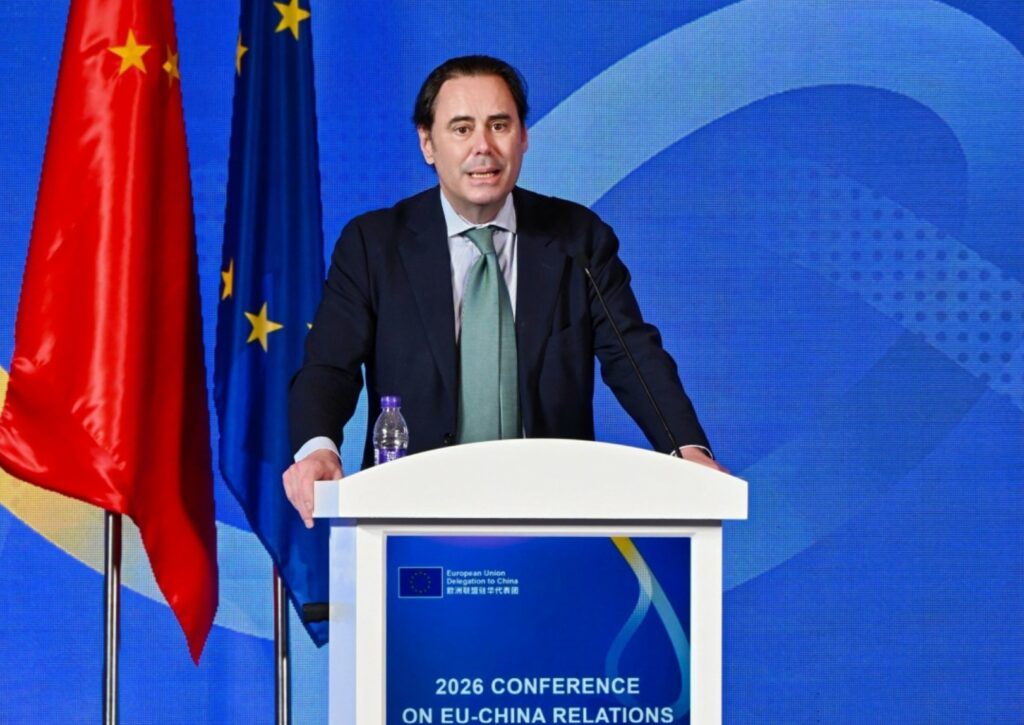
The EU’s ambassador to China, Jorge Toledo, opened the second EU–China Conference in Beijing by describing relations as a mix of “partnership”, “competition” and “systemic rivalry.”
Toledo referred to the 25th EU–China Summit held in Beijing in July 2025, which took place 50 years after the EU and China established diplomatic relations, the European External Action Service (EEAS) reported on Friday.
EU–China trade has expanded sharply over that period, growing from about €2 billion a year to more than €2 billion a day last year, according to the speech published by the EEAS.
Toledo said leaders’ talks at the 2025 summit covered trade imbalances, industrial overcapacity, market access, critical supply chains, Russia’s war against Ukraine and global security.
He also pointed to a joint EU–China statement on climate change agreed at the summit.
Climate cooperation and points of tension
In the address, Toledo quoted Chinese Premier Li Qiang as telling European Commission President Ursula von der Leyen in 2023 that “green is the colour of our cooperation”, referring to work on climate change, biodiversity and the environment.
Toledo said the EU intended to keep engaging China through dialogue while “protecting our interests”, reducing “strategic vulnerabilities” and defending EU principles.
He listed areas where he said European concerns needed to be taken seriously, including market access, subsidies, industrial capacity, critical raw materials, security, human rights and China’s position on Russia’s war against Ukraine.
The ambassador also highlighted the EU–China Think Tank Exchange Dialogue — a programme he said is fully funded by the EU’s Service for Foreign Policy Instruments — as part of the conference’s expert engagement.
Toledo told participants that “dialogue remains necessary, but dialogue alone is not enough”, calling for words to be matched by action.
