
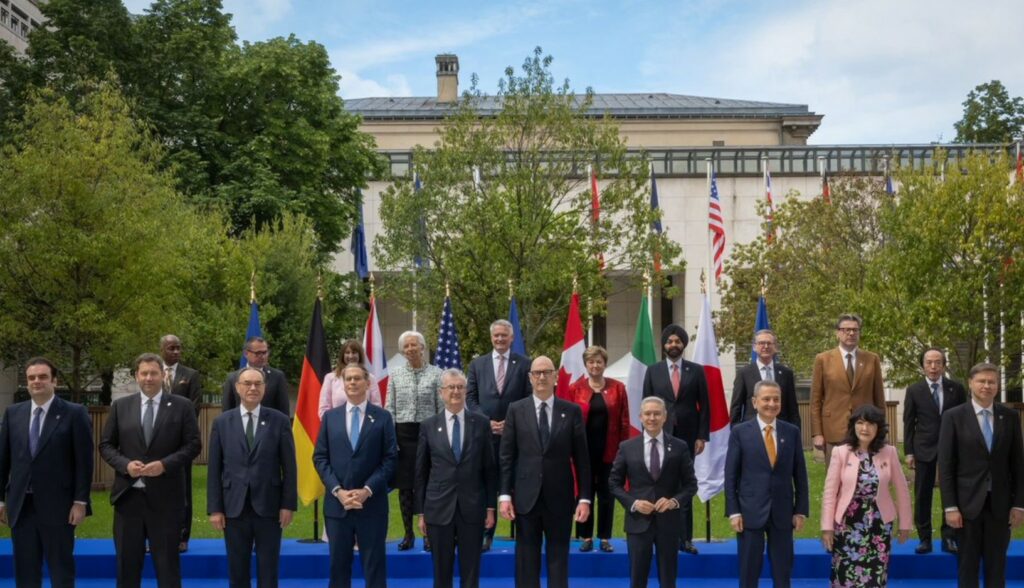
G7 finance ministers and central bank governors warned that heightened global economic uncertainty is increasing risks to growth and inflation, in a communiqué issued after talks in Paris.
Ministers and governors met on 18 and 19 May and held consultations with counterparts from Brazil, India, Kenya and South Korea, according to the statement released by the Eurogroup on Tuesday.
They said disruption linked to the conflict in the Middle East was putting pressure on supply chains for energy, food and fertilisers, with the greatest impact on vulnerable countries.
A “swift return to free and safe transit” through the Strait of Hormuz and a lasting resolution to the conflict were described as “imperative”, the group declared.
Central banks said they remained “strongly committed” to maintaining price stability and ensuring the resilience of the financial system, adding that monetary policy would remain data dependent as they monitor the impact of energy and other commodity prices on inflation and economic activity.
Concerns over widening global imbalances
The G7 stated that global current account imbalances — gaps between what countries earn from exports and other income and what they spend on imports and payments abroad — had been persistent and had widened in recent years, raising potential risks to balanced global growth and financial stability.
It said the imbalances largely reflect savings and investment patterns, and can also be driven by “non-market policies and practices” as well as sectoral and fiscal policies.
Countries with large and persistent external deficits should pursue policies that support domestic savings and fiscal consolidation, while countries with large and persistent external surpluses should strengthen domestic sources of growth.
The group also called for stronger surveillance of external imbalances through the International Monetary Fund’s bilateral and multilateral monitoring, with more emphasis on forward-looking scenarios and impacts on emerging and developing economies.
