
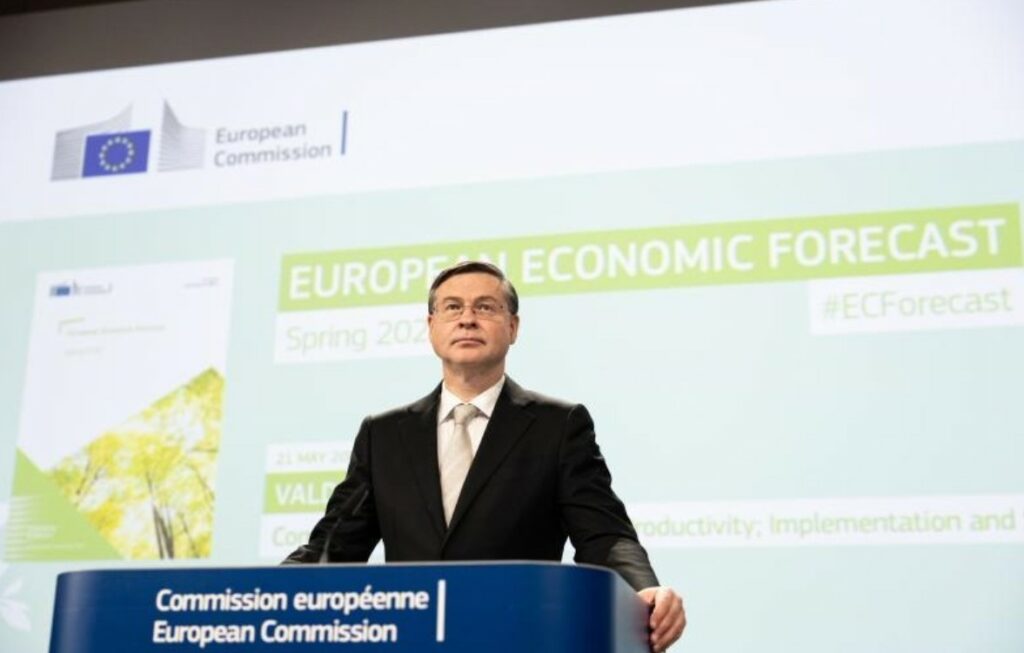
Economic growth in the EU is expected to slow in 2026 after a new energy price shock linked to the conflict in the Middle East pushed inflation higher.
EU GDP growth is projected to ease to 1.1% in 2026, down from 1.5% in 2025, before edging up to 1.4% in 2027, the European Commission said in its Spring 2026 Economic Forecast released on Thursday.
The 2026 forecast is 0.3 percentage points lower than the Commission’s Autumn 2025 projection of 1.4%.
"The conflict in the Middle East has triggered a major energy shock, further testing Europe as it navigates an already volatile geopolitical and trade environment," said EU Economy Commissioner Valdis Dombrovskis.
"The EU must learn from past crises by keeping fiscal support temporary and targeted, and further reducing its reliance on imported fossil fuels – a shift that has already strengthened our resilience," he added.
The euro area is forecast to grow by 0.9% in 2026 and 1.2% in 2027, revised down from 1.2% and 1.4% previously.
Inflation across the EU is expected to rise to 3.1% in 2026 — one percentage point higher than previously forecast — before easing to 2.4% in 2027.
Inflation in the euro area is projected at 3.0% in 2026 and 2.3% in 2027, compared with autumn projections of 1.9% and 2.0%.
Energy prices hit confidence and investment
The EU is particularly exposed to energy price swings because it is a net importer of energy, and the latest disruption is the second major shock in less than five years, the Commission said.
Consumer confidence fell to a 40-month low after the conflict began, amid fears of rising inflation and job losses.
Consumption is still expected to be the main driver of growth, while business investment is forecast to be constrained by tighter financing conditions, lower profits and heightened uncertainty.
Employment in the EU grew by 0.5% in 2025 — an increase of more than one million jobs — but that is forecast to slow to 0.3% in 2026, before picking up to 0.4% in 2027.
The long-running fall in unemployment is expected to end, with the rate stabilising at around 6% in 2027.
Public finances are also forecast to weaken, with the general government deficit in the EU projected to rise from 3.1% of GDP in 2025 to 3.6% by 2027, reflecting slower growth, higher interest spending, measures to cushion households and firms from higher energy prices, and increased defence spending.
EU debt is projected to rise from 82.8% of GDP in 2025 to 85.3% by 2027, while the euro area debt ratio is forecast to reach 91.2% in 2027.
