
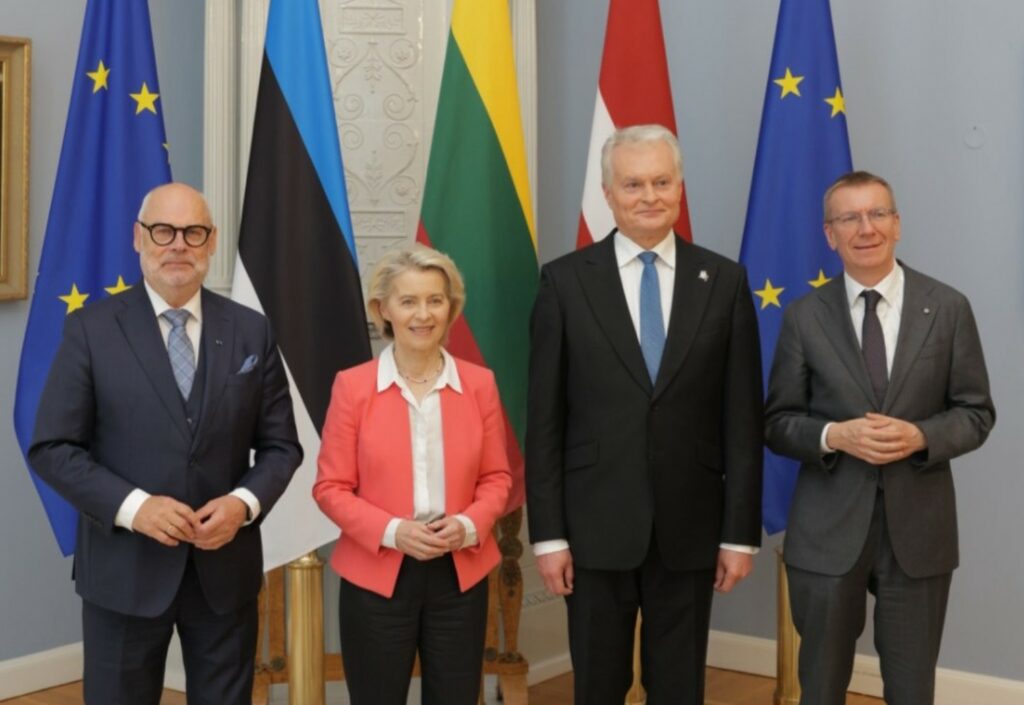
European Commission President Ursula von der Leyen said Lithuania, Latvia and Estonia would receive an additional €12 billion in EU funding for security and defence measures during a visit to Vilnius.
People in the Baltic states are facing air raid alerts, families sheltering, school closures and disrupted transport, she said in a statement, cited by the Commission on Tuesday.
She described the incidents as a “deliberate strategy” by Russia to destabilise democratic societies.
Von der Leyen said Lithuania’s plan under SAFE — an EU funding programme — had already been signed, and that the Commission was ready to sign plans with Estonia and Latvia “any time.”
The money would support investment in areas including anti-drone capabilities, advanced air defence and protection of critical infrastructure.
She also stated the Commission had selected 16 new projects under what it called “European Readiness Flagships”, including initiatives named the Eastern Flank Watch and the European Air Shield, adding that Baltic companies were contributing to them.
Cohesion funding and preparedness measures
The Commission has opened EU Cohesion funds for defence-related expenditure for the first time as part of a mid-term review, von der Leyen said.
She added that €1.5 billion had been redirected across the three Baltic states for defence preparedness, border surveillance and economic security.
Von der Leyen said recent incidents had exposed vulnerabilities and called for more unified alert systems and improved cross-border coordination.
She also declared that national systems should be better connected with Copernicus and Galileo — EU satellite programmes used for Earth observation and positioning — to improve information-sharing and early warning capacity.
She said the EU could carry out, in coordination with NATO, an assessment of counter-drone and early-warning systems across the region to identify gaps and speed up support where needed.
Von der Leyen also stressed that the EU should integrate Ukraine into Europe’s defence-industrial strategy and develop a protocol for “hybrid situations” such as cyberattacks, foreign interference and disinformation.
