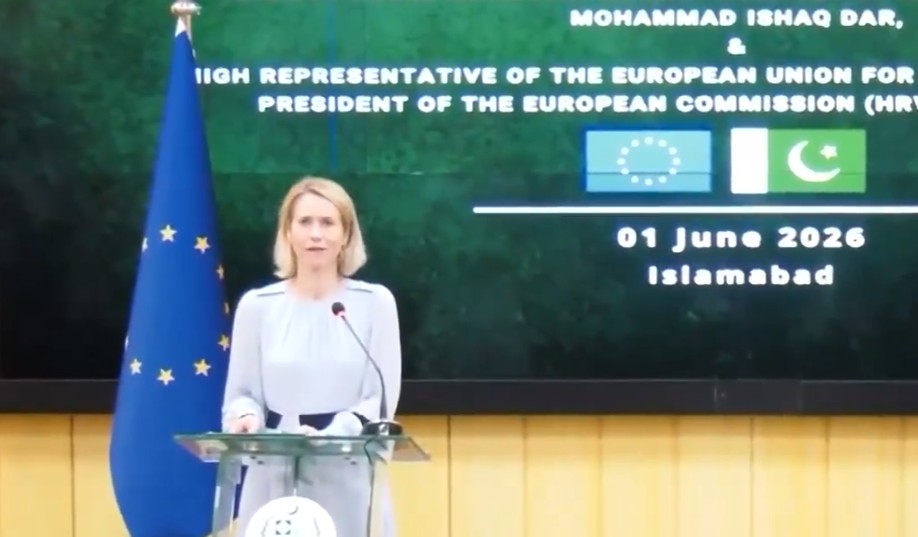
EU foreign policy chief Kaja Kallas said the EU and Pakistan had agreed to deepen ties at a strategic dialogue in Islamabad, with trade, regional security and cooperation on issues from climate resilience to migration on the agenda.
The EU remains Pakistan’s largest export destination — larger than China and the United States combined — and Pakistan is the biggest global beneficiary of the EU’s GSP+ trade preferences, Kallas said in Islamabad, as cited by the European External Action Service (EEAS) on Monday.
GSP+ is an EU scheme that gives lower tariffs to eligible countries, but it comes with conditions linked to implementing international conventions, including on governance, environmental protection, labour rights and human rights.
Kallas stated that the two sides discussed expanding cooperation beyond trade, including work on digital infrastructure, clean energy, migration and mobility, and “people-to-people” links.
Pakistan has topped the EU’s global Erasmus Mundus scholarship rankings for a fifth consecutive year, she said, referring to an EU-funded programme that supports students studying on joint master’s courses.
Middle East diplomacy and Afghanistan conflict
Pakistan has been the main mediator between the United States and Iran and its diplomatic efforts have helped prevent a return to “full blown war” on several occasions, Kallas said.
She added there was a “tenuous diplomatic opening” to extend a ceasefire and reopen the Strait of Hormuz, a key shipping route for global oil and gas supplies.
Any temporary understanding between Washington and Tehran should be followed by deeper talks about Iran’s nuclear stockpile and other issues, Kallas said, adding that the EU was ready to contribute to a sustainable solution through areas such as maritime operations and economic incentives.
Kallas also pointed out that Pakistan had been locked in a conflict with Afghanistan, with fighting in recent weeks causing “grave humanitarian consequences.”
She said the EU had called on both sides to exercise restraint and de-escalate, adding that Pakistan had the right to defend itself in line with international law but that dialogue — not air strikes — was the best way out of the situation.
