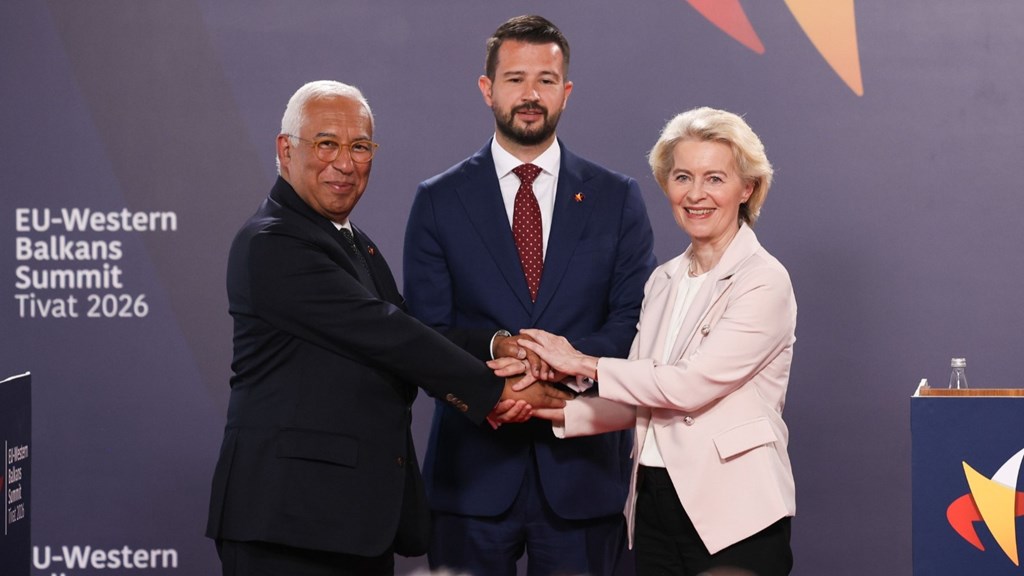
EU and Western Balkans leaders met on Friday in Tivat, Montenegro, where they highlighted enlargement as a strategic investment in Europe's peace, stability and security and ensured that Montenegro will become the 28th Member State by 2028.
The summit, held six months after the last summit in Brussels, was chaired by European Council President António Costa and hosted by the President of Montenegro, Jakov Milatović. The EU was also represented by European Commission President Ursula von der Leyen.
The summit coincided with the 20th anniversary of Montenegro’s restored independence and was the first summit of its kind to be held in Montenegro during its accession negotiations. Montenegro became a candidate country in 2010. Accession negotiations started in 2012. Interim benchmarks for the crucial rule of law chapters (23 and 24 in the acquis) were issued the following year.
However, the benchmarks were not met until June 2024 after Milatović was elected to president on a pro-EU and anti-corruption programme against the previous president Đukanović who had ruled the country for 30 years. During that period, Montenegro had opened all 33 acquis chapters but only closed one of them until 2024.
With public support reportedly at around 80%, Milatović revived the accession process. "Montenegro is an example of a successful European future for the Western Balkans,” he said at the summit. “From Tivat, we send a message that EU enlargement is a strategically important and achievable European policy.”
"Our goal is for Montenegro to enter the European Union as an orderly, solidary and economically strong state. Citizens must experience Europe through better standards, strong institutions, more investments, development of the north, better education and healthcare, as well as through a state where honest work pays off.”
He is convinced that the goal of Montenegro entering the EU in 2028 “is realistic and achievable and strongly supported by all our European partners”. The EU leaders shared his optimism.
In his press remarks, Costa reminded that the EU last month began drafting Montenegro’s accession treaty. “For the first time since 2013 (when Croatia joined the EU), we are really counting down to the next enlargement. For Montenegro to become the 28th Member State by 2028.”
He added that the discussions at the summit “showed a shared ambition to deliver as soon as possible on enlargement. That’s why we are considering new ideas to streamline and accelerate the process.”
Von der Leyen summarized the summit in two words: determination and confidence. “Determination to make the European future of the Western Balkans concrete as quickly as possible. And confidence that our Union will grow in the years ahead. And yes, Montenegro becoming the 28th Member State by 2028 is within reach. That is very clear.”
Both von der Leyen and Costa were optimistic that next front runner country, Albania, will follow quickly after the EU recently agreed with Albania that it, overall, has met the interim benchmarks for the fundamentals cluster. The fundamentals cluster, which includes the rule of law chapters, is the first to be opened and the last to be closed in the process towards EU membership.
But meeting interim benchmarks is one thing. What matters are the closing benchmarks and ensuring full implementation of key reforms and legislation across the fundamentals cluster, including solid track records.
At the summit, leaders took also stock of the implementation of the Growth Plan for the Western Balkans, adopted in 2023. The Plan aims to bring partner countries from the region benefits of membership ahead of their accession to the EU. Until now €673.6 million have been disbursed to support investments to promote regional economic cooperation and deepen EU-related reforms.
As an example, the EU decided before the summit to start negotiations with the Western Balkans partners to integrate them into the 'Roam Like at Home' area. This would enable their citizens to make calls, send text messages and use mobile data while travelling abroad without paying additional roaming charges, under the same conditions as at home.
