
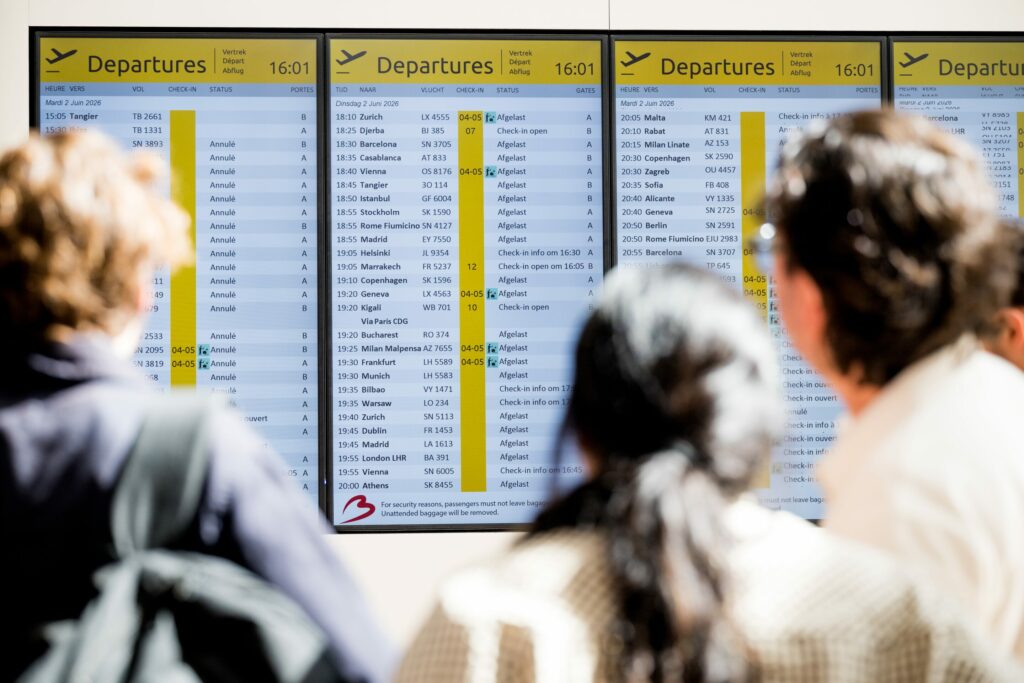
After over a decade of negotiations, the European Union reached an agreement on improving air passengers' rights on Monday afternoon, just hours before a final legal deadline.
With the deal, MEPs have largely prevented a watering down of consumer rights during negotiations with EU Member States. Passengers will continue to benefit from strong compensation rights clearly set in the legislation.
"The deal consolidates in the law key air passenger rights while thankfully putting an end to unfair practices like preventing passengers from taking their return flight when they have missed the first part of a multi-leg itinerary," said Agustín Reyna, Director General of BEUC.
Under the deal, air travellers maintain the right to be reimbursed or re-routed in case of cancellation, and to claim compensation if a flight is delayed by more than three hours, if it is cancelled less than 14 days before a flight, or if they are denied boarding.
Compensation for delayed or cancelled flights will depend on flight distance:
- €250 for journeys up to 1,500 km
- €400 for journeys between 1,500 km and 3,500 km
- €600 for all other longer journeys.
Air carriers will have the possibility to reduce compensation by 50% for their longest journeys if passengers are offered re-routing to their final destination following travel disruption, or if the delay at arrival does not last more than four hours.
However, airlines will be able to avoid paying compensation if the delay or cancellation was caused by events beyond their control.
Duty of care
The new rules will have an open list of extraordinary circumstances, which include natural disasters, war, weather conditions, unruly passengers, or airport, air navigation or ground handling service provider strikes.
Policymakers clarified that the list of extraordinary circumstances remains in line with rulings from the EU's top court. This will provide more certainty to passengers and airlines alike, and prevent air carriers from denying compensation "on unjustified grounds".
In all cases, air operators will have a duty to take care of stranded passengers by providing refreshments every two hours of waiting time, a meal after three hours (and every five hours thereafter, up to three meals per day), internet access and two phone calls.
Should an overnight stay of one or more nights become necessary, passengers should be accommodated in a hotel free of charge and get free transport from the airport to the accommodation and back.
If airlines fail to provide the required assistance, passengers may make their own arrangements and request reimbursement.
A KLM plane is seen through the window. Credit: AFP/Belga
Additionally, air carriers will need to electronically provide passengers facing travel disruptions (delay or cancellation) with clear instructions on how to submit a request for compensation, within four days of the termination of their journey.
Importantly, MEPs ensured that passengers are not obliged to have a user account or need to use a specific application to receive this information.
While air passengers will have nine months to file a compensation request, airlines will have 30 days to pay the compensation or invoke extraordinary circumstances, explain why compensation will not be provided and refer passengers to complaint handling steps.
The agreement also prohibits airlines from denying a passenger boarding because they did not take an inbound flight or missed the first part of a multi-leg itinerary (known as a "no-show").
Protecting vulnerable passengers
The deal also stipulates that families with kids are not separated during seating, by obliging air carriers to ensure that any person accompanying a child below the age of 14 should be seated on an adjacent seat without paying extra.
The same right will apply to passengers with disabilities and reduced mobility, and to pregnant women.
MEPs also ensured that passengers with disabilities and reduced mobility will have the right to compensation, re-routing and assistance by airlines if they miss a flight due to the airport's failure to help them reach the gate on time.
No-show will also be completely forbidden for passengers with reduced mobility, pregnant travellers, and unaccompanied minors.
Departure area at Alicante Airport. Credit: Wikimedia Commons
Additionally, policymakers also recognised hand luggage – a key consumer concern – as an essential part of air travel and boosted price transparency.
In practice, this means that the new rules now include the right to carry one personal item (such as a small bag or backpack) on board, without an additional fee.
On the insistence of MEPs, price transparency and the comparability of air tickets were increased: airlines, intermediaries and search portals are now obliged to always display the airfare inclusive of carry-on luggage at the outset of the booking process.
Negotiators also agreed that airlines may offer cheaper tickets for passengers who choose voluntarily to travel without hand luggage.
"Although not free as we had hoped, carry-on luggage prices will be displayed upfront, helping consumers compare deals more easily and avoid surprise fees during their booking process," Reyna said. "Airlines can offer fares without hand luggage, ensuring price flexibility remains unchanged for consumers."
Greater transparancy
On top of that, passengers will no longer be charged additional fees for correcting spelling errors in their name, or for getting a printed version of a boarding pass if they have already checked in.
MEPs also secured the right for passengers to obtain boarding passes digitally upon check-in, without any further request or obligation to have a user account or a specific application.
Additionally, passengers shall not be denied boarding because they used their own printed version of a digitally issued boarding pass.
"This agreement will strengthen the rights of air passengers across Europe. It will bring greater transparency and predictability for both consumers and airlines, without creating unnecessary bureaucracy for our industry," said Roberta Metsola, President of the European Parliament.
Aeroplanes pictured at the presentation of the summer plan of the aviation police at Brussels Airport, in Zaventem, on Monday, 16 June 2025. Credit: Belga / Benoit Doppagne
The rules apply to:
- passengers flying within the EU,
- on flights operated by either EU or non-EU airlines,
- those arriving in a member state from a non-EU country on an EU airline,
- those departing from the EU to a non-EU country on either an EU or non-EU airline.
Under the agreement, the Commission will assess within three years whether the scope of the regulation could be revised and possibly extended fully to third-country operators.
To inform passengers better about which airlines are covered by EU passenger rights rules, a voluntary EU air passenger rights label will be introduced and displayed during the booking process. The Commission will further develop this label.
The provisional agreement must still be formally adopted by both the European Parliament and Council following legal-linguistic revision.
The European Parliament is planning to vote on the agreement during its July plenary session.
