
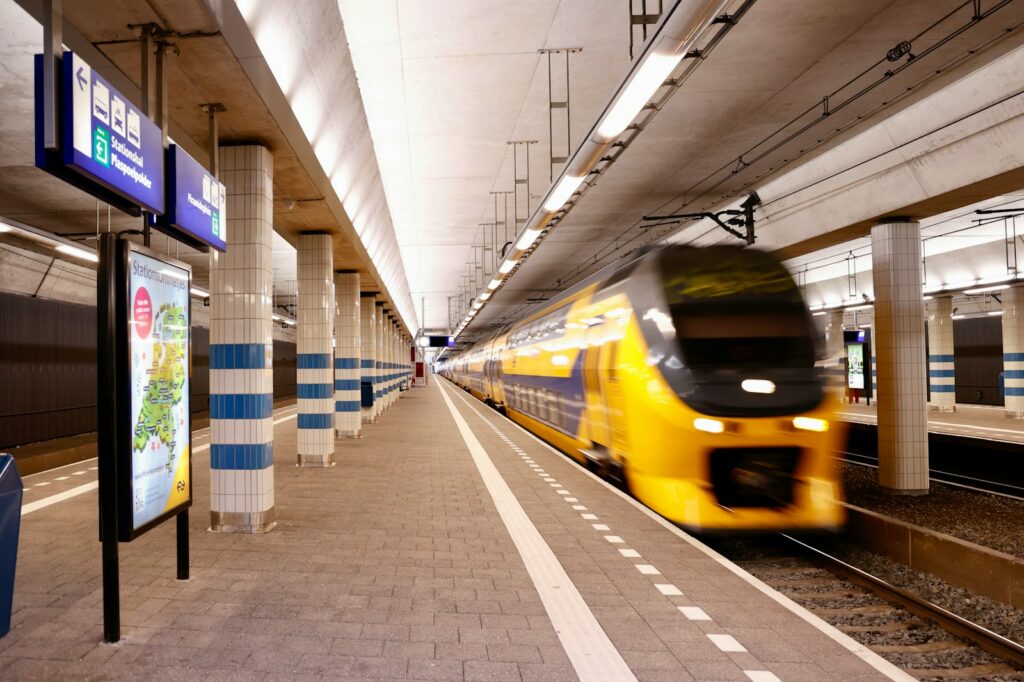
The European Commission has told the Netherlands it may be breaching EU competition rules through the way train capacity is allocated on the country’s main railway network.
The Commission has informed the Dutch authorities that national rules governing the allocation of “train paths” — the time slots trains use to run on particular sections of track — may breach EU antitrust rules, it said in a statement on Tuesday.
The Netherlands was required to open its domestic rail passenger market to competition in 2025, allowing railway companies to run services on the main lines alongside the state-owned incumbent operator Nederlandse Spoorwegen (NS).
NS Reizigers, an NS subsidiary, provides public transport on the main lines of the Dutch railway network under a concession running from 2025 to 2033.
Another NS subsidiary, NS International, works with other incumbent rail companies — including Belgium’s SNCB, Germany’s DB, Austria’s ÖBB and Switzerland’s SBB — and Eurostar to provide international services from the Netherlands to destinations including Belgium, Germany, France, Austria, the UK and Switzerland.
The Commission said the Netherlands adopted rules before opening the domestic market that give NS, as the holder of the main concession contract, priority over competitors when rail capacity is insufficient to meet all requests for train paths, adding that these capacity allocation rules have applied since 2024.
Concerns focus on international passenger services
The Commission said it has reached a preliminary conclusion that the Dutch rules are capable of distorting competition in the market for international rail passenger services by creating an “inequality of opportunity” between NS and competing operators when it comes to access to capacity on the Dutch network. That could allow NS to maintain or strengthen a dominant position.
The Commission has set out its preliminary concerns in a Letter of Formal Notice sent to the Netherlands.
If the preliminary view is confirmed, the Commission said the conduct would breach Article 106 of the Treaty on the Functioning of the European Union, alongside Article 102, which prohibits abuse of a dominant market position.
A Letter of Formal Notice is an early formal step in an EU investigation and gives the member state two months to provide observations, the Commission said, adding that the letter does not prejudge the outcome. The case is listed under reference AT.40886 in the Commission’s public case register
