
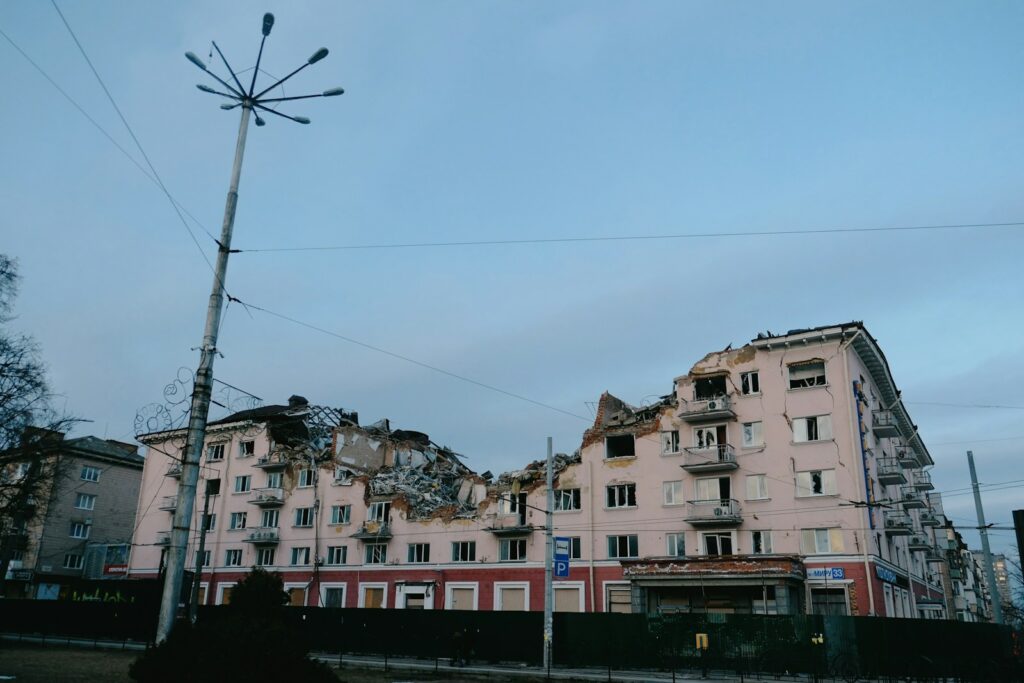
Waves of Russian missile and drone attacks in early July killed at least 58 people in and around Kyiv and left more than 90 wounded, the European Union told the OSCE in Vienna.
Russia launched more than 70 missiles and almost 500 drones on the night of 1 — 2 July, targeting Kyiv and other Ukrainian cities, according to the EU statement, the European External Action Service (EEAS) announced on Thursday.
At least 30 people were killed and more than 90 were wounded in what it called the deadliest strike on the capital this year, with most of the injured requiring hospital treatment.
The EU’s Ambassador to Ukraine described fires across “large parts of the city” and said residents spent the night in bomb shelters, with some people still trapped under rubble as the attacks continued.
She added: “We are here to do our job, and we will continue to do it,” it stated.
Another large-scale attack followed on the night of 5 — 6 July, killing 28 people in the Kyiv region, the EU told the OSCE Forum for Security Co-operation.
UN report cites rising civilian deaths and strikes on energy systems
Civilian deaths rose over the six months to the end of May, according to a recent report by the UN Human Rights Monitoring Mission in Ukraine cited by the EU.
The UN report also described what it called systematic strikes on energy facilities and heating infrastructure during the 2025 — 2026 winter months.
Russian forces repeatedly targeted centralised heating systems — networks that supply heat and hot water to most urban households — disrupting services to hundreds of thousands of civilians for weeks as temperatures fell below minus 20°C during the coldest winter in Ukraine since 2010, according to the UN report quoted by the EU.
The EU said it would continue providing political, financial, economic, humanitarian, military and diplomatic support to Ukraine.
It added that it began disbursing €6 billion last week under a €90 billion support loan, describing it as intended to strengthen Kyiv’s defences.
The EU called on Russia to “immediately, completely and unconditionally withdraw” all forces and military equipment from Ukraine’s internationally recognised borders, and urged countries to stop providing direct or indirect assistance to Russia, including “dual-use” goods — items that can be used for both civilian and military purposes.
It also condemned the deployment of North Korean forces in the war and cited military support to Russia from Belarus, Iran and the Democratic People’s Republic of Korea.
Albania, Andorra, Bosnia and Herzegovina, Georgia, Iceland, Liechtenstein, Moldova, Montenegro, North Macedonia, Norway and Ukraine aligned themselves with the statement.
