
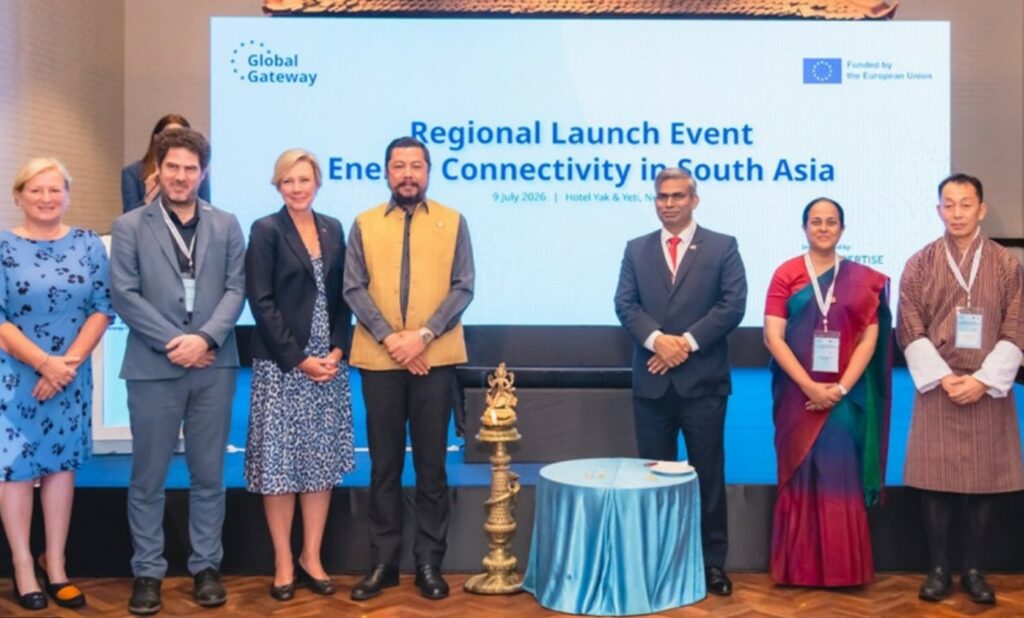
The European Union has launched a €5 million programme to support cross-border electricity trade and regional power links across five South Asian countries, according to a statement by the EU Delegation to Bangladesh.
The four-year “Energy Connectivity in South Asia” (ECSA) project was launched at a regional event in Kathmandu on 9 July, bringing together government representatives and energy-sector stakeholders from Bangladesh, Bhutan, India, Nepal and Sri Lanka, the organisation said.
The initiative is funded by the EU and implemented by Expertise France, a French public agency that works on international technical cooperation, it added.
European Commissioner for International Partnerships Jozef Síkela said the EU was investing in “cheaper, cleaner, and more reliable electricity” for communities and businesses in South Asia.
The EU’s ambassador to Nepal, Véronique Lorenzo, said Europe’s experience with an integrated electricity market showed that stronger energy connectivity can create “more resilient, affordable, and sustainable energy systems”.
Focus on cross-border power trade
Nepal’s Minister of Energy, Water Resources and Irrigation, Biraj Bhakta Shrestha, said South Asia has “vast renewable energy resources and growing electricity demand”, and that enhanced cross-border electricity trade could improve electricity reliability and affordability.
Nicolas Chenet, director of Expertise France’s Sustainable Development Department, said ECSA would provide a platform for knowledge exchange, capacity building and collaboration between European and South Asian stakeholders.
The Kathmandu programme included discussions on policy and regulation, and on how cross-border electricity trade could support investment in renewable energy generation and power transmission, according to the EU Delegation to Bangladesh.
The ECSA project covers Bangladesh, Bhutan, India, Nepal and Sri Lanka, and is intended to support increased regional electricity trade, improved energy security and greater integration of renewable energy, the organisation said.
