
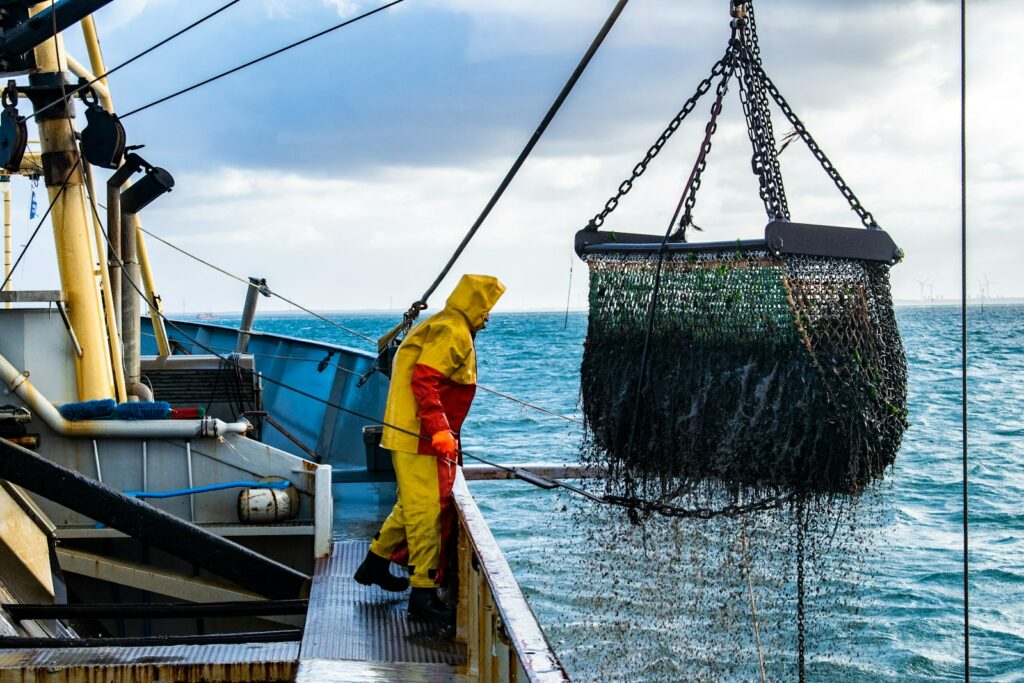
An EU-funded partnership on Sweden’s west coast is testing whether lights can be used to guide shrimp into a trawl while keeping the fishing gear off the seabed.
The trial is taking place as debate intensifies over a Swedish government proposal to ban bottom trawling in marine protected areas, the European Commission said in a release on Wednesday.
Fishers are also reporting “clear signs” that the marine environment is under pressure, with fish stocks out of balance.
The project, called “Light Trawling”, is EU-funded and is based on an approach first tried in Iceland.
Bottom trawling is a fishing method that typically involves dragging nets along the seabed.
The work is being led by Sotenäs Municipality, with the fishing association FF Norden representing fishers involved in testing the gear, and Chalmers Industriteknik providing expertise linked to the “blue and circular economy” — a term commonly used for making marine industries and resources more efficient and less wasteful.
Testing light-guided nets at sea
Instead of dragging equipment along the bottom to catch shrimp, the method being tested uses lights to draw shrimp upwards and into the trawl, with the aim that the gear does not touch the seabed, the Commission noted.
It said the system is designed to be smaller and lighter than conventional trawls, creating less resistance in the water.
The partnership is examining practical issues including how heavy each light unit needs to be in different currents, how water density and visibility affect the lights and catch response, and how high above the seabed the gear can operate while still catching shrimp.
The prototype is being adapted for Swedish seabed conditions and vessel types, and the work involves repeated adjustments during trials at sea, according to the same source.
EU funding made it possible to build and test the new gear because the cost and risk would otherwise have been too high.
The project includes 85-year-old fisher Sixten Söderberg, who has spent more than 50 years at sea and is active in FF Norden.
“We have to start thinking differently when it comes to how we fish,” Söderberg said, adding that “the marine environment is in poor condition and finding more sustainable methods is absolutely necessary.”
