
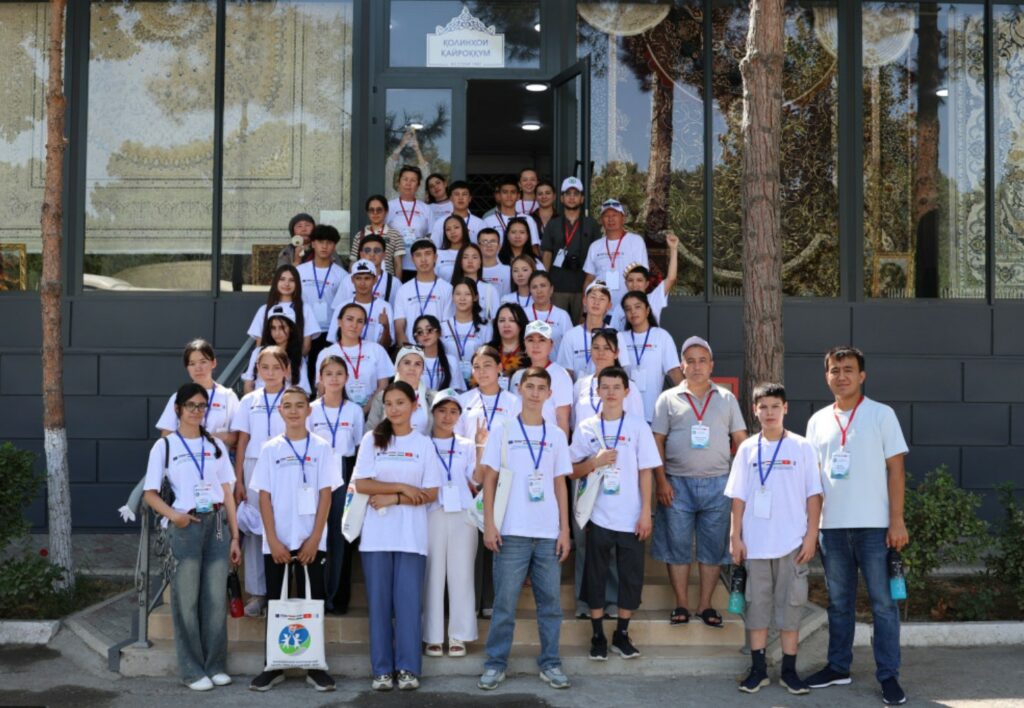
More than 40 young environmental volunteers and teachers from Kyrgyzstan, Tajikistan and Uzbekistan attended a six-day summer camp in northern Tajikistan earlier this month.
The camp, called "Our Green House," ran from 10 to 16 August in Guliston in Tajikistan’s Sughd Region and brought together 33 secondary school students and eight teachers, the EU Delegation to Uzbekistan reported on Thursday, cited by the European External Action Service.
The students were members of “Green Patrols” — youth groups that work in schools and communities to raise environmental awareness and encourage practical action.
Activities included sessions on water pollution, climate change, environmental protection and sustainable development, alongside team-building and practical exercises.
Participants also took part in a shoreline clean-up along the Kayrakkum Reservoir.
“What I enjoyed most was when the whole camp went together to the Bahri Tojik Reservoir and took part in a clean-up action along the shore,” said Ruslan Juraev, a student from Kyrgyzstan.
Regional co-operation and follow-up plans
The programme included discussions and workshops in which participants explored environmental challenges shared across Central Asia and how regional co-operation could help address them, according to the EU Delegation to Uzbekistan.
It also included a “climate quest.”
“I believe that camps like this help children become more responsible, active and mindful of the world around them, while gaining new knowledge, valuable experience and good memories,” said Barno Egamova, a teacher from Tajikistan.
Participants worked in teams to develop a regional action plan for the Green Patrols, setting out priority areas for co-operation and proposed initiatives to take back to their schools and communities.
“I’m going home with lots of new ideas and, honestly, even more motivation to do something useful in my own community,” said Ermatova Okila Abduzhalil-qizi, a student from Uzbekistan.
The camp was organised by the Organization for Security and Co-operation in Europe (OSCE) with the Youth Group on Protection of Environment (YGPE) — also known as the Aarhus Centre in Khujand — with financial support from the European Union.
It was held under an EU-funded project on “uranium legacy remediation” in Central Asia — work focused on reducing environmental and health risks linked to historic uranium sites that can still pose contamination hazards for nearby communities — implemented by the OSCE and the United Nations Development Programme in the three countries.
