
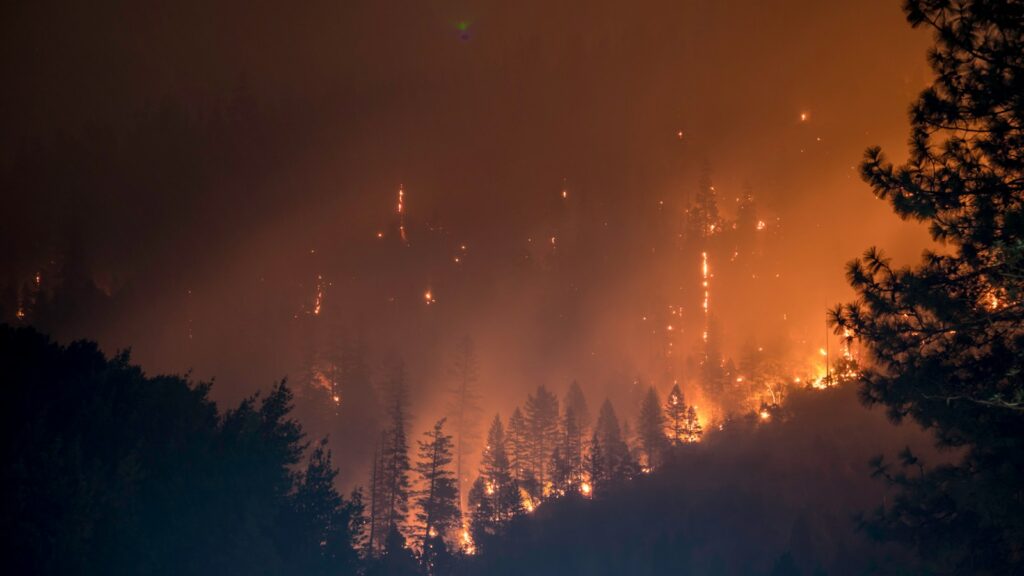
EU crisis management Commissioner Hadja Lahbib visited wildfire-hit areas of Belgium and Germany on Tuesday as European firefighting support continued during what the European Commission described as an intense wildfire season.
Lahbib travelled to the Hautes Fagnes in Belgium and the area around Monschau in Germany, where she met local and national authorities and first responders, and visited communities affected by fires, the Commission informed.
Belgium requested help through the EU Civil Protection Mechanism on 15 August, triggering support coordinated by the European Commission.
Two firefighting planes were deployed from Sweden, alongside six helicopters from the Netherlands, Germany and Norway, and specialised firefighting teams from the Netherlands and Spain. Emergency satellite mapping was also provided.
“The devastation in the Hautes Fagnes is a stark reminder that wildfire risk is changing across Europe,” Lahbib said.
Firefighters and emergency services were “on the front line, working tirelessly to protect communities”, she added.
European deployments and satellite mapping
The 2026 wildfire season has been “exceptionally severe”, the Commission said, with the area burned by 12 August already more than twice the average for that point in the year, according to figures published by the EU’s European Forest Fire Information System.
The EU Civil Protection Mechanism has been activated 10 times so far this season.
The Commission said it has coordinated and co-financed the deployments of more than 700 firefighters, more than 200 vehicles and 38 aircraft.
Copernicus satellites — part of the EU’s Earth observation programme — have produced 391 emergency maps to help authorities track and respond to wildfires, with mapping operations currently supporting Italy, Montenegro, Germany, Belgium, Albania, Serbia and Croatia.
Any country can request assistance via the EU Civil Protection Mechanism, with activations handled through the EU’s Emergency Response Coordination Centre, which operates 24 hours a day.
