
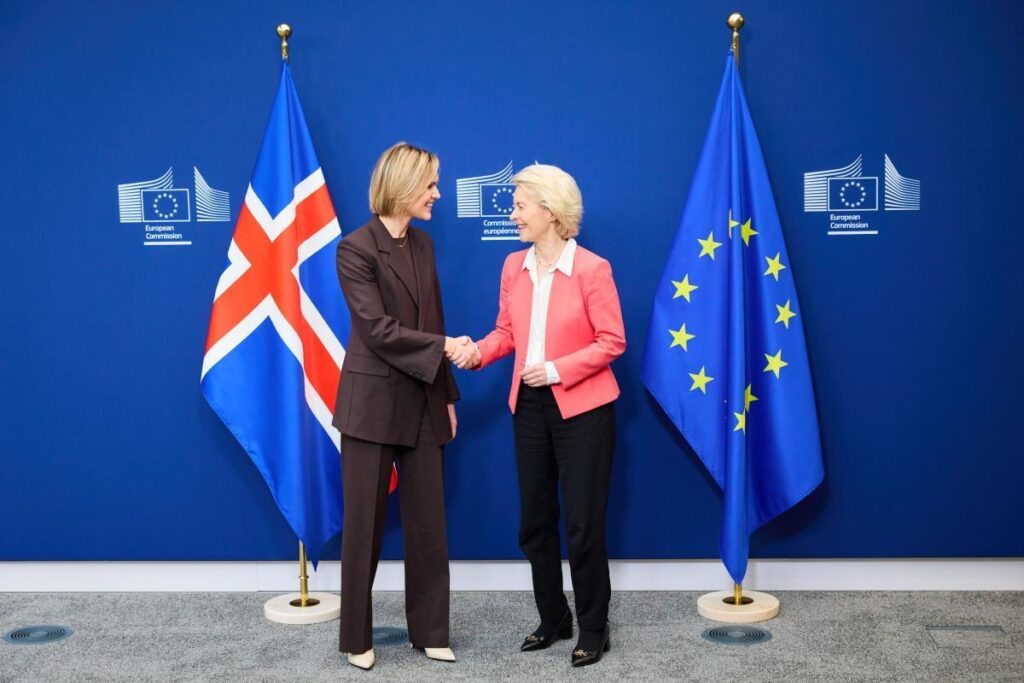
Icelanders go to the polls this weekend to vote on whether to resurrect EU membership talks. What are the chances then of the EU’s northern neighbour joining the bloc as the 28th member?
The year is 2009. Iceland is still reeling from the collapse of its banking sector and the subsequent financial crisis, plunging many businesses into technical bankruptcy. Thousands of people took to the streets to protest.
At the Althingi, Iceland’s parliament, the oldest in the world, lawmakers decided that action was needed in order to ride out the crisis and plot a path toward recovery.
Along with allowing three major banks to go under without bailouts and aggressive action against the bankers that were responsible, another decision was made: apply for EU membership.
A general election earlier in the year meant that a pro-EU party was in power, so the decision to apply for membership and start talks was made without asking Icelanders to vote in a referendum.
The EU welcomed Iceland’s request and even old rival the United Kingdom, which Iceland had routinely clashed with over the issue of fisheries, said they backed the application. The EU’s enlargement chief at the time predicted that Iceland would join the bloc in 2011 alongside Croatia.
Both of those predictions did not come to pass. Croatia ended up joining in 2013 and Iceland suspended its membership talks in that same year after another election. It was agreed that talks would be put on hold and that only a referendum could restart them.
Over the last couple of years, momentum has grown behind a fresh push for membership. The rewriting of the geopolitical playbook by the likes of Donald Trump, Vladimir Putin and Xi Jinping have forced Icelanders to reconsider their place in the world, in much the same way Sweden and Finland did with their NATO bids.
This weekend, Icelanders will be asked to vote whether to resurrect those negotiations. Opinion polls are reluctant to call it either way at the moment, with most projections putting ‘yes’ and ‘no’ at around the same level of support. What happens on the day of the vote though is anyone’s guess.
If Icelanders vote yes then talks with Brussels can essentially pick up where they left off, once a certain amount of due diligence is done and the EU appoints a special taskforce to handle the negotiations. Foreign policy chief Kaja Kallas has also stated that Iceland's bid would be a priority for Brussels.
Before the process was suspended more than a decade ago, 11 of the 33 so-called accession chapters had been closed, meaning Iceland is about a third ready to join the bloc.
For comparison, Montenegro, considered to be best-placed to join next, has provisionally closed 18 chapters and is eyeing a 2028 joining date. The accession treaty needed to formalise membership is in the process of being drafted so that process is moving forward.
The big sticking point will again be fishing rights. The original membership bid was allowed to move ahead because the government agreed that it would negotiate for exclusive rights to manage Iceland’s fishing grounds.
With the UK no longer in the picture and Norway not moving ahead yet with its own EU bid, there will be less pressure on Brussels to be tough on this issue in the negotiating room. Denmark may force the issue because of its ties with the Faroe Islands though.
In the event of a ‘no’ result though, it is hard to look past EU membership for Iceland being dead in the water for many years to come. If the current geopolitical upheaval is not enough to convince a majority then it is likely nothing will.
It could also have a negative impact on the EU’s overall enlargement process, which Brussels continues to insist is alive and well.
If Icelanders do not even want to see what a full membership offering might look like before even getting a chance to vote on it, then it will be a pretty damning indictment of membership’s attractiveness.
For both Brussels and Icelanders though, membership seems like a decent deal.
Iceland would be a net contributor to the EU budget, its population is small so it would have a limited impact on the EU Parliament and it is a good neighbour, so there is little for the EU’s current club of 27 members to oppose. All of them will have to ultimately vote in favour of allowing Iceland to join, if the process gets that far.
For Icelanders, they would get the added perks and security of membership not afforded by the current arrangement and euro adoption would also be finally on the table, a move that is widely supported as Iceland’s currency is particularly volatile.
As the world continues to change thanks to shifting geopolitics, the increasing impacts of climate change and the onslaught of digital technologies, it is hard to see why Icelanders would not at least want to see what they could get with membership.
Saturday’s vote is probably a one-shot-only moment for Iceland. Miss it and it will be a long while before another opportunity is granted, if ever again. The EU itself also has a fair amount riding on the result as well, even if the stakes are a lower.
The hunt for the 28th member continues.
