
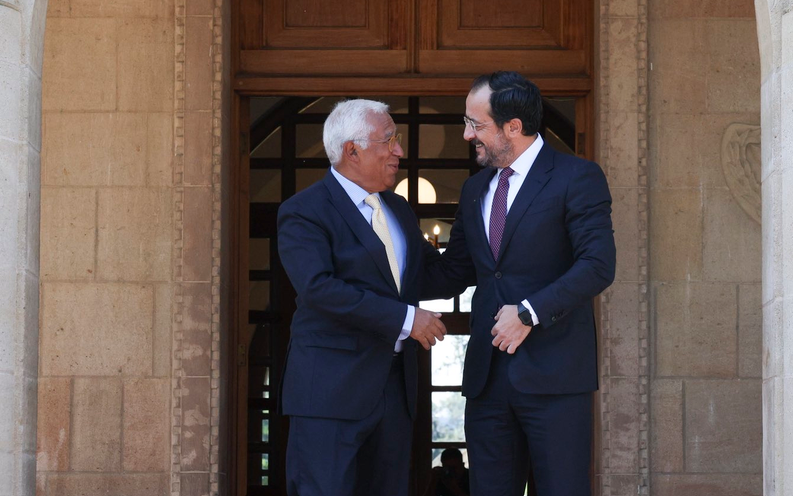
European Council President António Costa said the EU must agree its next long-term budget for 2028 – 2034 by the end of this year, after talks in Cyprus with President Nikos Christodoulides.
Costa thanked Christodoulides for hosting him in Cyprus and said he is meeting leaders in their home countries ahead of upcoming European Council discussions, according to a statement from Costa’s office issued on Friday.
He said the next budget would be decided in a “fundamentally different geopolitical context” from 2020, when the current EU budget was approved, and would need a new structure and a new way of allocating resources.
Priorities highlighted for EU spending included defence and security, competitiveness, innovation and “strategic resilience.”
Costa also referred to wildfires and droughts this summer, including in Cyprus, saying the EU needed tools in its budget to respond quickly to unforeseen challenges and urgent needs for citizens and businesses.
At the same time, he said the EU should preserve “key pillars” of support including cohesion policy — EU funding aimed at reducing regional disparities — and agricultural policy.
Cyprus security, regional diplomacy and reunification
Costa said Cyprus’s location gives it a “front-row perspective” on security challenges affecting Europe, including maritime security and stability in the Eastern Mediterranean and the Middle East.
Developments in the region affect Europe’s peace and stability and have a direct impact on energy security, he said, adding that the EU would hold a summit with the Gulf Cooperation Council countries on 24 October.
He also reiterated the EU’s support for reunification of Cyprus in line with UN Security Council resolutions and international law, and said the EU is supporting UN Secretary General António Guterres’s efforts towards a negotiated settlement.
Costa said the appointment of European Commissioner Raffaele Fitto as Special Representative for Cyprus was linked to that objective, and that he had received an update from Christodoulides on recent developments after Guterres visited at the end of July.
