
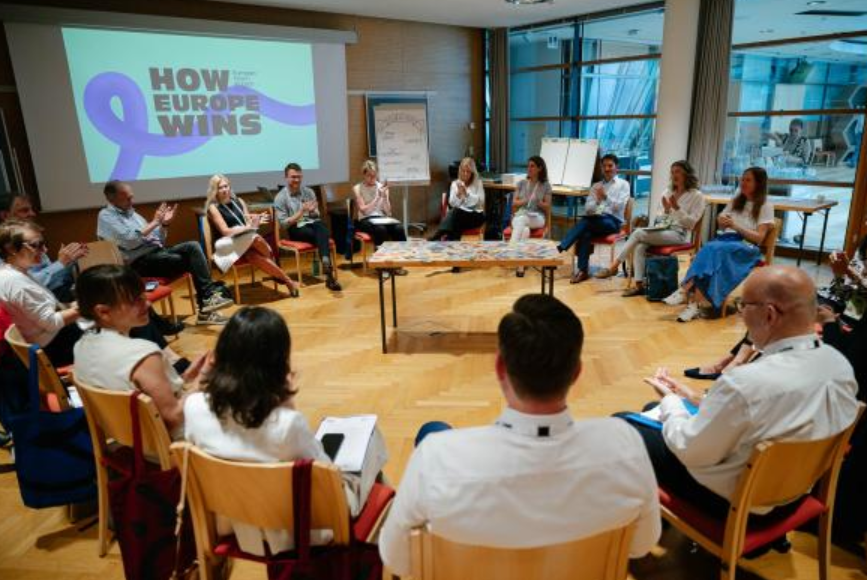
Financial education practitioners from nine EU countries have called for wider access to high-quality financial education across Europe, after adopting a statement at the European Forum Alpbach supported by the EIB Institute, part of the European Investment Bank Group.
The European Alliance of Financial Education Practitioners, known as FIN.e, said in a release on Friday that its advisory board agreed the Alpbach Statement on Financial Education to strengthen links between policymakers and those delivering lessons and training in communities.
Only 18% of EU citizens have a high level of financial literacy, according to the European Commission’s latest study, a figure cited by the European Investment Bank Group.
The statement sets out four priorities — bringing evidence from practitioners into policy discussions, sharing teaching approaches and tools across borders, strengthening cooperation and capacity among practitioners, and expanding access to financial education for underserved groups.
“Financial education is not only about understanding financial products. It is about equipping citizens with the confidence and skills to navigate an increasingly complex economic environment,” EIB Vice-President Marko Primorac said.
Ten organisations from nine countries join first lab
The first FIN.e Practitioner Lab brought together 10 organisations from Austria, Croatia, Cyprus, Germany, Hungary, Poland, Romania, Slovakia and Spain, according to the European Investment Bank Group.
FIN.e said the group works directly with learners, schools, families and communities, and met to exchange experiences, identify common challenges and examine approaches that could be adapted and shared across Europe.
The alliance will set up thematic working groups, strengthen peer learning and capacity-building, share effective approaches and create channels for practitioner experience to inform European and national policy discussions.
FIN.e is being implemented through a partnership between the EIB Institute, ActionAid Hellas and Aflatoun International, with funding provided by the EIB Institute.
By the end of 2028, the alliance aims to include at least 27 organisations and more than 4,000 practitioners.
