
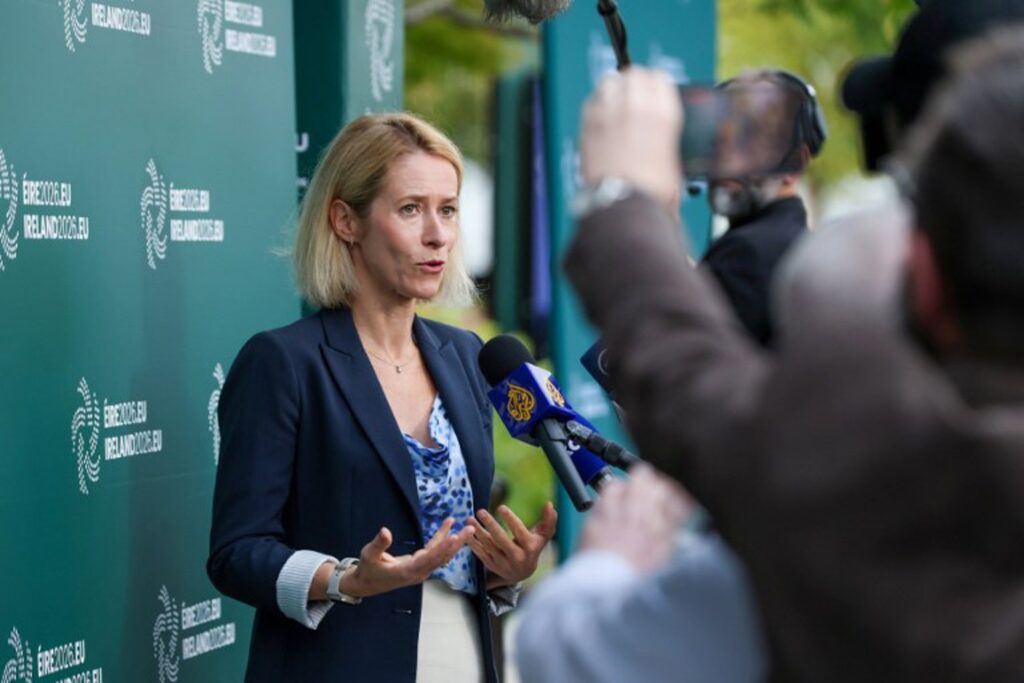
EU foreign policy chief Kaja Kallas will not launch a planned expert group on speeding up the strengthening of European defence after some member states concluded that now was not the right time, according to European sources.
Kallas announced last week, on the sidelines of an informal meeting of EU foreign ministers in Ireland, that she would set up a task force this week to develop new ideas for closing gaps in European defence more quickly.
The group was expected to include not only experts from EU member states, but also representatives from the United Kingdom and Ukraine.
According to the German news agency dpa, the German and Italian governments were among those opposed to the initiative. No official reasons were given.
Germany has, however, recently been publicly critical of Kallas, and Berlin is understood to prefer relying on NATO processes for defence policy.
Germany recently joined France in proposing that some powers and staff from the European External Action Service be transferred to the European Commission, while giving Kallas a stronger co-ordinating role within the Commission.
Opponents of that plan fear it would further increase the European Commission’s influence over foreign policy. Kallas and the Commission are also said to have clashed repeatedly over foreign policy issues, including sanctions on Israel.
Politico also reported that Italy faced an internal dispute over the task force, including disagreements over its possible members.
There was also resistance from within the European Commission, where officials were concerned that the task force’s work could overlap with that of Defence Commissioner Andrius Kubilius.
The decision to shelve the plan was ultimately taken after consultations with EU ministers.
The European External Action Service said defence remains high on the agenda and that new opportunities for co-operation between member states should still be explored.
According to Politico, the task force had been due to be led by former NATO Secretary-General Anders Fogh Rasmussen, who was also expected to produce a report with recommendations, and several former defence ministers were set to take part.
