
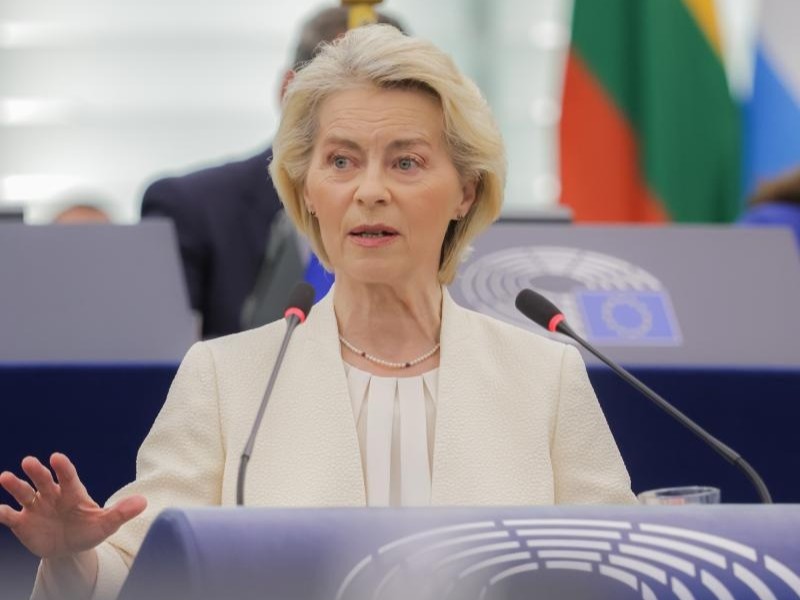
The President of the European Commission Ursula von der Leyen has delivered her annual State of the Union (SOTEU), addressing the European Parliament in Strasbourg.
‘It was the best of times, it was the worst of times.'
Channelling her inner Charles Dickens, Von der Leyen started her address by drawing parallels between the state of Europe during the French Revolution and the modern days.
Trying times, according to Von der Leyen, as challenges come fast and are exceptional. But according to her, there is still hope. "The state of our Union is the strongest it has ever been. The state of our Union can also feel as precarious as it has ever been. These two statements may seem incompatible. But they are both true."
Von der Leyen announced several new plans and initiatives for the upcoming political years to address these challenges. Among them are a European Heatwave Plan, a Security Council, an emergency framework for mass arrivals of irregular migrants, making Canada the first associate member of the EU, and banning social media for children under 13 years old.
'We want to bring the relationship with Canada to the highest level possible'
Von der Leyen invited the Canadian Prime Minister Mark Carney to attend her State of the Union for a very special proposal. "Dear Mark, I said we must urgently reimagine our partnerships," she addressed the Canadian leader.
"So, I would like to work with you on opening the door for Canada to be the first associate member of the EU."
The EU and Canada already have a free trade agreement through CETA, but Von der Leyen said she now wanted to take ties with Ottawa “to the highest possible level”.
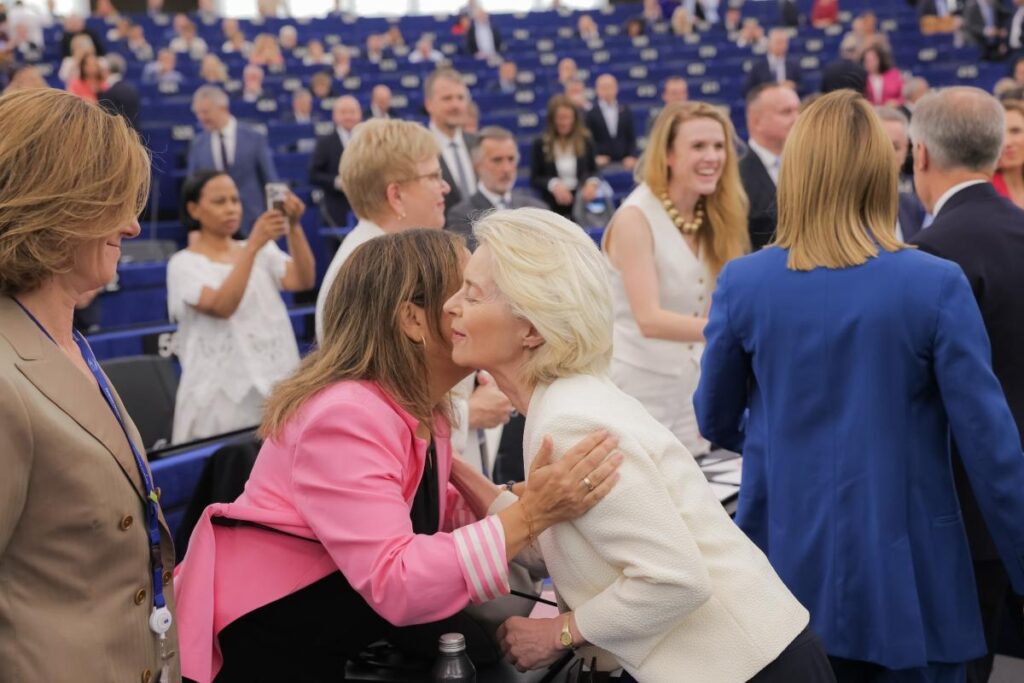
President of the European Commission Ursula von der Leyen during her speech. Credit: European Commission
She pointed to closer co-operation in energy, raw materials, artificial intelligence, quantum technology, cyber security and the defence industry.
"These partnerships are a strategic choice for Europe. But they also respond to the fracture in the international rules-based system. For some, the answer is to go it alone. But this is not an option for us," she said.
"Europe will always lead when it comes to defending the rules-based system. But we can no longer rely on it as the only way to secure our interests. Or assume that its rules will shelter us from the complex threats that we face."
'The principle is simple: Europe’s security is indivisible'
A major topic in Von der Leyen's address was security on the European continent. The ongoing war in Ukraine and Russia's hybrid attacks on countries in the Union call for what Von der Leyen described as a “counter-hybrid playbook.”
“We urgently need consensus on how to respond to certain incidents. Those which fall below armed aggression but clearly threaten our national security. In other words, a mechanism to flank NATO’s Article 4,” she said.
The mechanism would allow any of the EU countries to trigger a mandatory response from the other members against any form of aggression.
But Von der Leyen wants to go even further by establishing a European council, involving allies such as Ukraine, the United Kingdom, Norway, and Canada directly. “The urgency is clear. And the principle is simple: Europe’s security is indivisible,” she said.
Regarding Ukraine, Von der Leyen promised to support the country in what she described as the hardest winter of the war, promising air defence missiles and diversifying supply by developing systems in the Union.
To deter Russian aggression, the EU must increase the pressure on the country's economy. "Our sanctions are painful. They put the Russian economy under enormous pressure. We must close every loophole."
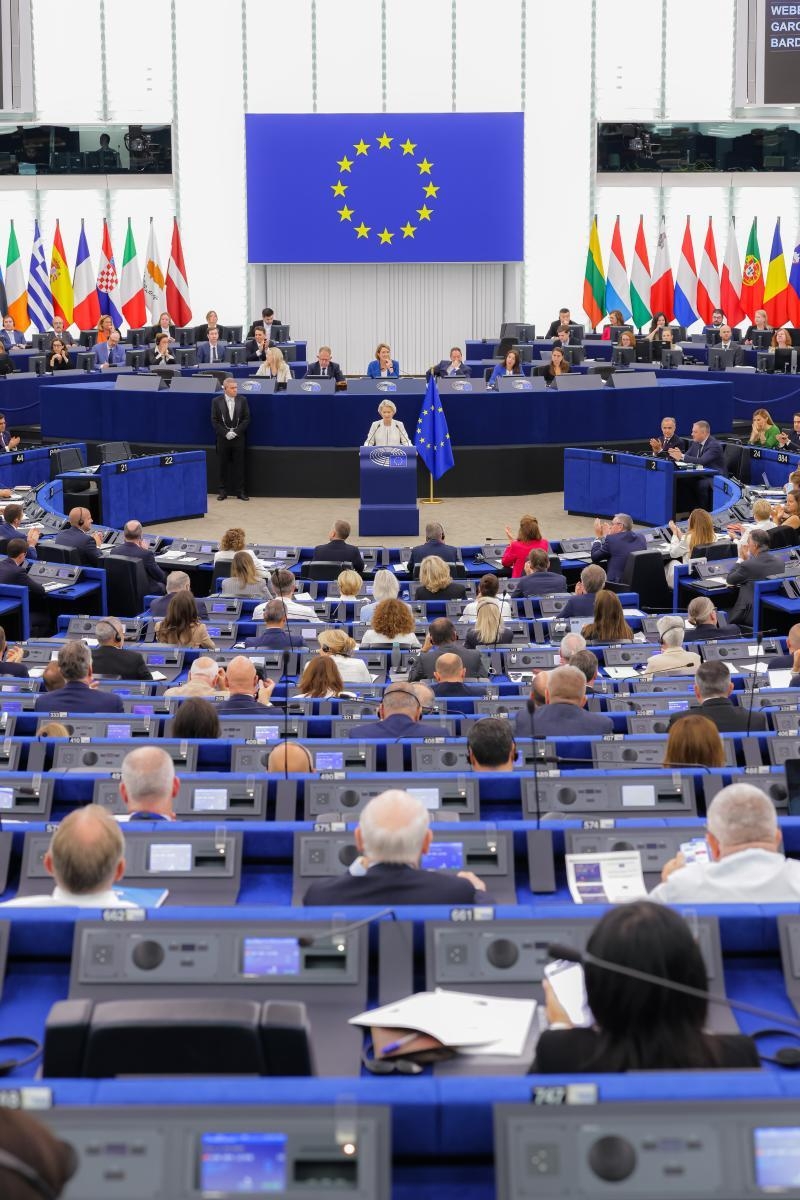
President of the European Commission Ursula von der Leyen during her speech. Credit: European Commission
'We do not have to accept addictive features'
The 'EU-KIDS' Act will officially be presented on Thursday, but Von der Leyen revealed the core of the new legislation in her State of the Union.
"I am aware that many perceive the power of big tech as overwhelming. And impossible to roll back. I disagree," she said about the restrictions the EU will implement on social media.
"We do not have to accept addictive features. We do not have to accept children being drawn into ever more extreme content. We do not have to accept that girls have their photos used for AI-generated sexualised images."
Von der Leyen proposed a complete ban on social media for children under 13 years old, and limited access under 15. The responsibility should be put entirely on the social media companies, and not on their users.
"Platforms will have to prove that they are safe. Because it is not about our minors accessing social media. It is about when and how we allow social media to access minors."
